

Rally ’Round the Cannon: Stamp Act, the Other One

The federal government spends millions to run the Postal Service. I could lose your mail for half of that. — Pat Paulsen
Although it says here in the fine print that my assignment is to illuminate the past — if I or any of my Impossible Princetoniana Force are caught or killed, the editor will disavow any knowledge of our actions — it should not be assumed we necessarily prefer the way things used to be, or that we regard each lost Princeton landmark or tradition as a debasement of the culture. That’s reserved for the Grad College DBar. We’re forward thinkers here in the History Corner, regarding both the University and its environs, that little slice of New Jersey (redundancy alert) that has for so long nurtured the all-world faculty, the seemingly infinite playing fields, the neighboring Institute for Advanced Study, Wawa, the Dinky, and the impenetrable playlist of WPRB. With all these and other acknowledged advancements the town has lavished on the school in 270 years, you just knew I was going to complain about one, right? We can’t delude you, the Savvy Historian, after all.
Sure enough, one of the unreasonable quirks of my Orange Bubble image of town/gown richness revolved around government services. It was this: the famed Stamp Act sycamores, planted by the trustees when the British Stamp Act of 1765 was being repealed, reigned over Nassau Street within sight of the United States Post Office on Palmer Square. A sort of cuddly “stamps for all occasions” humor to meet grim challenges like last month’s 16-inch snowstorm, or rushing a stuffed mini-tiger to mom in Tennessee for her almost-forgotten birthday.
Alas, the relentless upscaling of the town and plain old worn out infrastructure by 2022 drove the Postal Service from its classic home to a nondescript — but easy to access — plain vanilla storefront down Nassau Street even beyond Hoagie Haven, i.e. the netherworld, with its prior building being picked up by Triumph Brewery. This was clearly intended as a bribe for me to forget my dream in order to have a cold one and a mortadella slider and thus to fall into Triumph’s sphere of brewskiness, and indeed it’s with great difficulty and a discreet napkin I steel my resolve. I think back fondly instead to the glory days of the USPS and to the moment when the Princeton Post Office and the Revolutionary history of the University joined forces to provide both with one of their proudest moments, a unique position of honor on the national stage on Sept. 22, 1956.
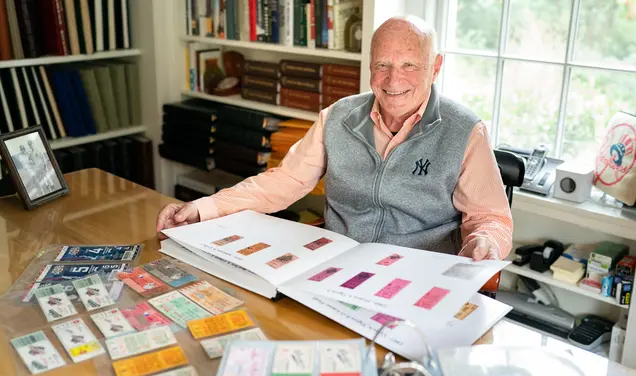
For that memory we owe a tip of the Class of 1970 pith helmet to Dan Lopresti *87, one of our premiere alumni volunteers and all-around talented folks. He’s been on alum tech committees, grad alum committees, and P-rade marshal committees; chaired the APGA; nominated alumni trustees; and masochistically served as Grand Marshal of the P-rade. He also is socially acceptable to the point of holding a paying job, as professor of computer science at Lehigh, where he again has his fingers in many pies, enough to gather 24 patents along the way. However, even the most productive, down-to-earth, brilliant Princetonian needs some release in life, a guilty pleasure if you will, to keep himself sane in these bizarre times. Dan is a philatelist.
We owe Dan multitudinous thanks for his introduction to the American First Day Cover Society, folks who have taken to that complex aspect of stamp collecting, the first day cover, and applied the historian’s brush to it. An FDC (as we knowledgeable Peers of Perforation refer to them) is an envelope with imprinted design — known as a cachet — with the corresponding commemorative stamp affixed, canceled by the home post office of first day issue. Last November, their bimonthly journal focused on the story of the FDC celebrating the bicentennial of Nassau Hall in 1956, an occasion which, 70 years later, contains enough juicy trivia to fill a couple long Princetoniana committee meetings, and then some.
You’ll recall the huge impact around the world of Princeton’s bicentennial celebration in 1946-47, replete with symposia, U.S. presidents, global intelligentsia, the Victory Reunion — a sort of coming-of-age party following World War II. The University power structure was highly impressed by the resulting worldwide publicity regarding Princeton as a “liberal university.” In fact, the phrase itself came from J. Douglas Brown 1919 *1928, the dean of the faculty who laid out much of the celebration, which was in turn meticulously documented by President Harold Dodds *1914’s assistant, retired Army Colonel Arthur Fox 1913 *1914.
So when the trustees and administration began to focus on the next big public-facing PR opportunity — the 1956 bicentennial of Nassau Hall — Dodds in 1953 turned again to Brown and Fox, who each had the huge advantage of experience navigating the federal bureaucracy. Brown had been instrumental in building the American social security system in the 1930s and was possibly the best-known labor economist in the country. Fox had served 28 years on active duty, then headed up the military activities at Princeton during World War II before being hired as Dodds’ assistant for the Princeton bicentennial. Their task was to get approval for a commemorative postage stamp celebrating the occasion and by extension, the University.
Now this is a lot harder than it sounds. True, commemorative postage stamps had been around for 60 years — the first set was issued for the Columbian Exhibition in Chicago, the World’s Fair of 1893 — but the practice had evolved into only five or six new stamps per year. They might honor anything from statehood to history (the Lewis and Clark commemorative of 1954 was a big favorite) to famous dead people (e.g. Will Rogers) to patriotic symbols (e.g. The USS Constitution) and trying to make the cut at the Post Office was an exercise shrouded in arbitrariness and mystery. The main precedent that quick Brown-Fox (really sorry about that…) had going for them was very recent and veryprecedential. In 1949 the equally well-connected administration at Washington and Lee designed a medium blue stampwith the college colonnade separating portraits of, well, Washington and Lee. Having a Confederate general on an American stamp seemingly wasn’t a deal-breaker, and 105 million three-cent stamps were printed. There were about 1,000 accredited four-year colleges in the country, and this very first college commemorative stirred up interest at perhaps 993 of them. The next one to successfully run the Post Office approval gauntlet was Columbia, for its bicentennial in 1954; this was simply an engraving of the front of Low Library — the tiny Alma Mater statue was unidentifiable — with two problems: its Columbia-blue color was quite pale printed on white stock, and it carried the ungainly message “man’s right to knowledge and the free use thereof,” a real snorer. But 119 million of these 3-cent stamps were sold. The next year was the 100th anniversary of the first Federal Land Grant colleges, so Michigan State and Penn State got their names on possibly the ugliest stamps ever issued by USPS, 120 million of them. And so Princeton was set up to be only the third, fourth, or fifth college ever so recognized, depending on how you count. Intriguingly, it remains to this day the last ever honored on its own — subsequent stamps have theoretically honored people like Daniel Webster (Dartmouth 1969) Stanford White (NYU 1981) or John Harvard (Harvard 1986), with the college in the background.
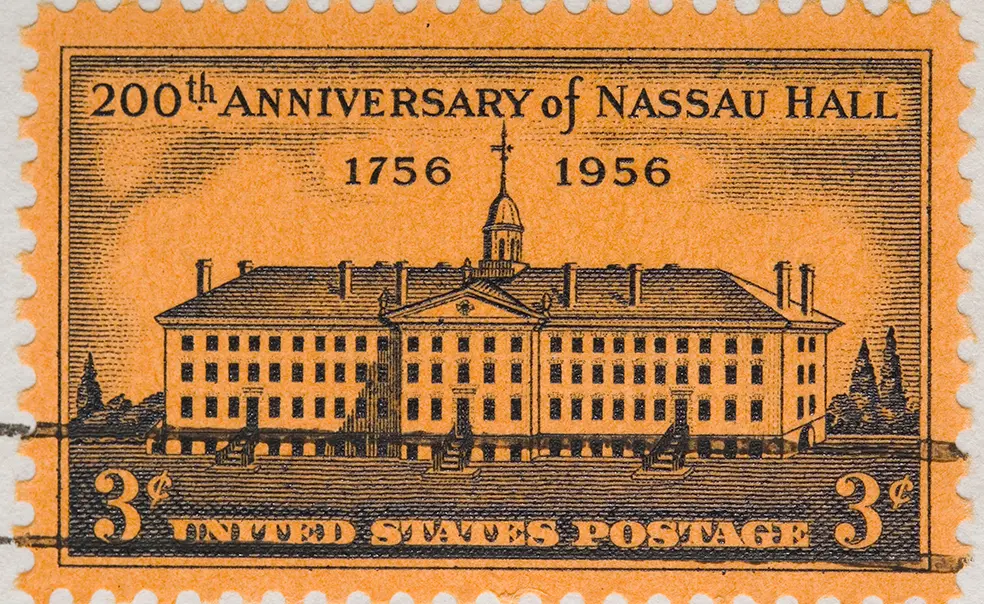
Quick Brown-Fox enlisted the engraving skills of P.J. Conkwright of the University Press to design a stamp based on the 1764 drawing of Nassau Hall by Henry Dawkins, with its original three front entrances, and the succinct message “Nassau Hall 1756-1956.” With U.S. Representative Alfred Sieminski ’34 and U.S. Sen. H. Alexander Smith 1921 running interference in Washington, the design sailed through. The remaining hurdle was the color artwork. The Princeton contingent insisted on the stamp being orange and black (GASP!), which posed severe printing challenges to the Post Office. This was conquered by the Bureau of Engraving and Printing using brains rather than technical expertise: Why not, they said, just print in simple black on orange paper stock, a first for the Post Office after 180 years. Voila.
The uniquely arresting result was released on Sept. 22, 1956, in a ceremony on the front campus, where the 200thanniversary of Nassau Hall was to be celebrated the following day. The Princeton postmaster hired 36 temps to cancel and process the first day covers — 350,000 of them — in the post office and the basement of Nassau Hall itself. The University sent out 45,000 FDCs to alumni and other community members; Princeton Bank & Trust and The Nassau Inn did the same for their customers. Over a million orange stamps were sold that first weekend in Princeton, and eventually 122 million would be printed.
And — perhaps in an unconscious tribute to the lyrics of Old Nassau? — not one of them included the word “Princeton,” an unnecessary embellishment for the true sons and daughters of Nassau Hall.
The Latest
See all


Related News
With Prominent Journalists and Hoagies, the ‘Prince’ Celebrates 150 Years
A gala at the New York Historical raised roughly $400,000 for the independent student newspaper


No responses yet