

Sophia Steele ’23 Rediscovered Her Jamaican Roots Through Art

Growing up, I often felt disconnected from my Caribbean heritage. My paternal grandfather, George Steele, was born and raised in Kingston, Jamaica, before he immigrated to the United States to serve in the military during the Korean War. He died when I was in elementary school, taking with him stories I wish I had asked more about.
As I got older, that loss began to linger more deeply. I realized how much of my understanding of Jamaica was pieced together from secondhand memories, and I wanted something more tangible — a way to experience the culture for myself and reconnect with a part of my identity that felt just out of reach. That desire is what led me to begin searching for exchange programs in Jamaica.
That’s when I came across the Adisa Ancestry Artists Residency, a new creative fellowship founded by Opal Palmer Adisa — an acclaimed novelist, poet, playwright, and professor at the University of the West Indies, Mona — along with her daughter, actress and singer Shola Adisa-Farrar.
Nestled in Linstead, Jamaica, the residency offers artists space to create, engage with the community, and explore their Caribbean heritage — a mission that felt like the answer to a question I’d carried for years.
A week before my departure in January, my grandmother, Sallie Mae, died at 90, and I postponed my flight by a week to help plan her funeral. While sorting through old photographs, my siblings and I found pictures of my grandparents and father in Jamaica, smiling in a lush garden beside a river. By the time I boarded the plane, the trip felt less like a creative excursion and more like a generational tribute.
I landed at Norman Manley International Airport in Kingston, near the sunken pirate city of Port Royal. Driving along Marcus Garvey Drive, with the Blue Mountains rising in the distance, I felt a quiet awe. The city gradually gave way to the countryside of Linstead, where Adisa and her daughter welcomed me with Jamaican treats.
Residency Life
Life at the residency quickly settled into a rhythm. Roosters crowed at dawn, and the days were filled with reading, writing, and conversation. In the evenings, neighbors brought fresh coconuts, and we shared stories on the veranda. Their quiet generosity made the countryside feel like an inherited home.
Adisa invited me to sit in on her graduate seminar, Women, Poetry, Gender, and Society, which offered an expansive intellectual framework for understanding Caribbean literature and feminist thought. Our class discussions were complemented by live artistic performances, including a staging of Look What Fell Out De Mango Tree, a new autobiographical play examining Jamaican girlhood and motherhood.
During a trip to Runaway Bay in St. Ann, one of the few beaches still open to the public in the area, I gained a deeper sense of Jamaica’s social landscape. As we chewed sugarcane on the sand, I learned that many beaches, including Bob Marley Beach, are controlled by private resorts and at risk of foreign privatization.
On the drive back, our conversation ranged widely — from Jamaica’s bauxite mining industry and Chinese-funded infrastructure projects to the island’s reputation for having more churches and rum bars per square mile than any other country. “For every church, there are two bars,” she joked.
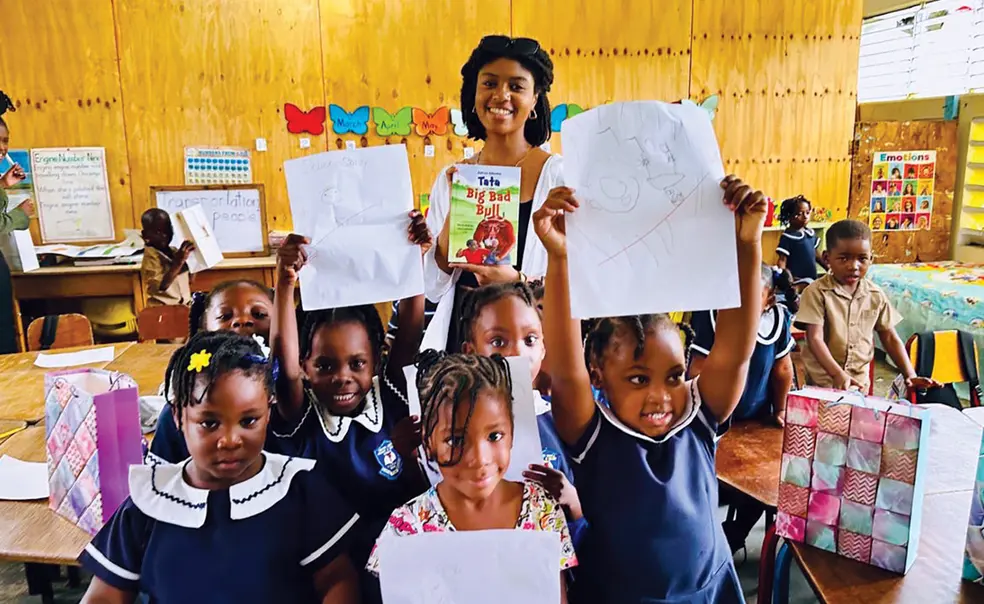
One of the most meaningful moments came during a visit to Chester Castle Primary School in Hanover, a school supported by the residency. The students were returning for the first time in four months since Hurricane Melissa hit the island in October, and despite the damage, their joy in the classroom shone through as we read them stories and gave them new school supplies.
What made it especially meaningful was witnessing the deep sense of care within the school — the teachers, principal, and students supported one another in ways that extended beyond academics. The school felt like a cornerstone of the broader community, reflecting a shared commitment to rebuilding and to the children’s future.
Cultural Connections
Jamaica’s national motto, “Out of Many, One People,” came alive at Linstead Market, where the island’s diverse peoples converged in daily life. I savored patties and coco bread while vendors and shoppers bargained in Patois.
In Kingston, that same spirit of cultural convergence unfolded on a larger scale. I attended the Jamaica Book Festival, where I met members of a local youth book club and joined conversations about the future of Caribbean art and intellectual life. Soon after, I immersed myself in reggae rhythms at the Lost in Time Festival at Hope Gardens, listening to performances by Lila Iké and Protoje.
Yet some of the most enduring moments came from quiet observation. I visited historic landmarks such as Devon House, the former home of Jamaica’s first Black millionaire, George Stiebel, and Milk River Spa in Clarendon, the parish where Harlem Renaissance novelist and poet Claude McKay was born.
These experiences now shape my Ph.D. research at Cornell, where I am studying Caribbean art, literature, and culture. This residency taught me that reconnecting with one’s heritage extends beyond geography — it is about relationships to history, to art, and to the people who welcome you home.
The Latest
See all


Related News
Janice Lee ’09 Worked to Renovate One of Hollywood’s Best-Kept Secrets
An engineer by training, Lee has been deputy project manager on the renovation of Hollywood Burbank Airport

No responses yet