

Who Gets to Be On a Student Reunions Crew?
Inside the hiring process for Reunions’ most coveted positions
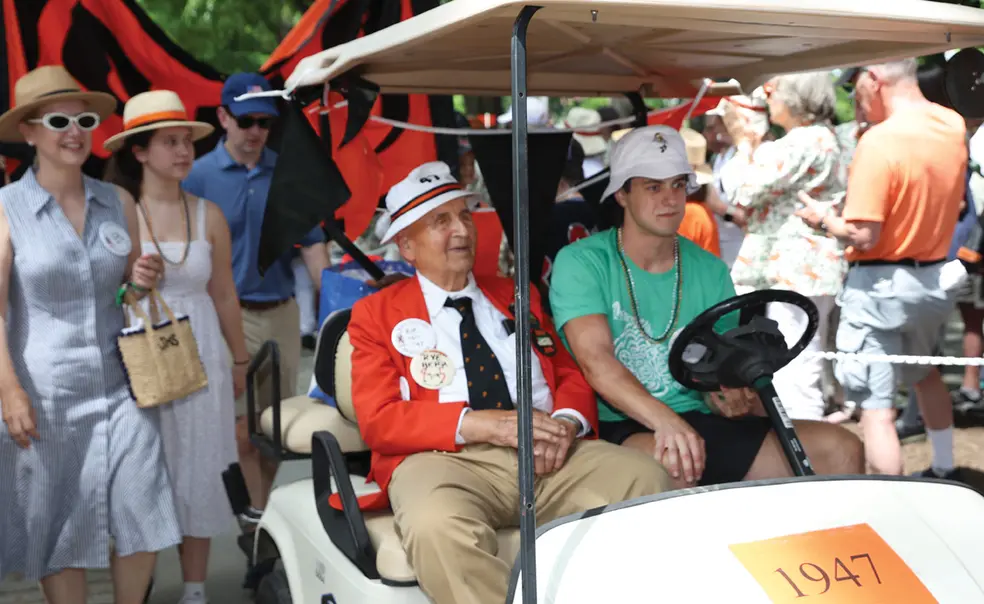

By the end of the fall semester, Princeton students’ inboxes begin to fill with near-weekly email reminders to apply for a Campus Dining job at Reunions the following May. The application process is straightforward: Answer a few questions and submit two references, and applicants will likely hear back by early spring. For many undergraduates, this is one of the most familiar ways to participate in Reunions.
Less visible, however, are the Reunions crews. While dining shifts are widely advertised, crew positions are not. These crews take on a variety of roles, from operating golf carts and overseeing transportation to managing logistics for each major reunion venue, setting up and taking down tents, bartending, and checking alumni in. Among students, crew positions are widely seen as some of the most coveted jobs during Reunions.
According to Erika Knudson, associate vice president for advancement communications, approximately 600 students are hired each year for Reunions, including about 200 by Campus Dining. The Reunions general student application — separate from the Campus Dining application — typically receives around 1,200 submissions. Final crew sizes depend on a variety of factors, with the reunion year size being the most important. For example, major Reunions crews like the 25th hire up to 30 students, whereas some crews like the 65th have a much smaller team of around six students. Similar variation applies across logistical crews such as golf carts and housing crews.
Returning students often rise through the ranks of Reunions hierarchy. Elena Winter ’27 began in Campus Dining her freshman year, joined the 25th reunion crew last year, and was hired as the co-head manager for the 25th this year. “I lose sight of what’s awesome about this school, but Reunions puts it into perspective,” she says.
Managers act as the liaison between crew members and alumni, running back and forth and making sure everything and everyone is in place. Winter describes the role as running the behind-the-scenes operations that allow the weekend’s events to function smoothly. Work typically begins the Monday or Tuesday before Reunions and continues through Sunday afternoon. Winter estimates that she worked at least 16 hours per day last year.
Students who work in Campus Dining earn the standard University hourly wage of $16.92. Compensation for other crew positions can vary, based on tips and bonuses. For example, golf cart crew members are permitted to receive tips, but students working specific class reunions are prohibited from accepting them. Instead, they receive performance-based bonuses at the conclusion of Reunions.
The hiring process for crews begins with the Reunions Student Employment Application, a Google form separate from the dining application, which can be found on the Reunions Student Employment website. Winter says the actual selection process is largely handled by undergraduate crew managers like herself.
More times than not, personal networks seem to play a significant role in being offered a crew position.
“Affiliation is big,” Winter says, noting that many crew members come from athletic teams, are children of alumni for that specific reunion year, or belong to some other established campus group. She explains that many football players work the 25th each year. Of the roughly 32 students hired for the 25th this year, she estimates that only 20% are non-athletes. Winter herself joined the 25th crew last year after being hired by a friend.
Among students, these hiring patterns have shaped a perception that crew positions circulate within specific campus networks. Most students don’t realize that reaching out to alumni organizers can also be helpful in securing a crew position, according to Winter.
“The crew application form takes about five minutes, and you just check the boxes for the jobs you want,” says Suthi Navaratnam-Tomayko ’26, who has worked Reunions first with Campus Dining and then later through her position as social chair at Terrace. Like Winter, she emphasizes that personal connections can strongly influence who ultimately receives an offer. In some cases, she says, students never hear back at all.
To make the approach fairer, Navaratnam-Tomayko suggests a more centralized hiring process that doesn’t put student managers in charge of member selection. For now, though, the most sought-after Reunions jobs are shaped by tradition — and, often, by the networks students bring with them.
The Latest
See all


Related News
With Prominent Journalists and Hoagies, the ‘Prince’ Celebrates 150 Years
A gala at the New York Historical raised roughly $400,000 for the independent student newspaper


No responses yet