

At Sotheby’s, Helen Culver Smith ’03 Practices the Art of the Auction
Smith handles all Russian works for the auction house as well as artwork from the former Soviet Union


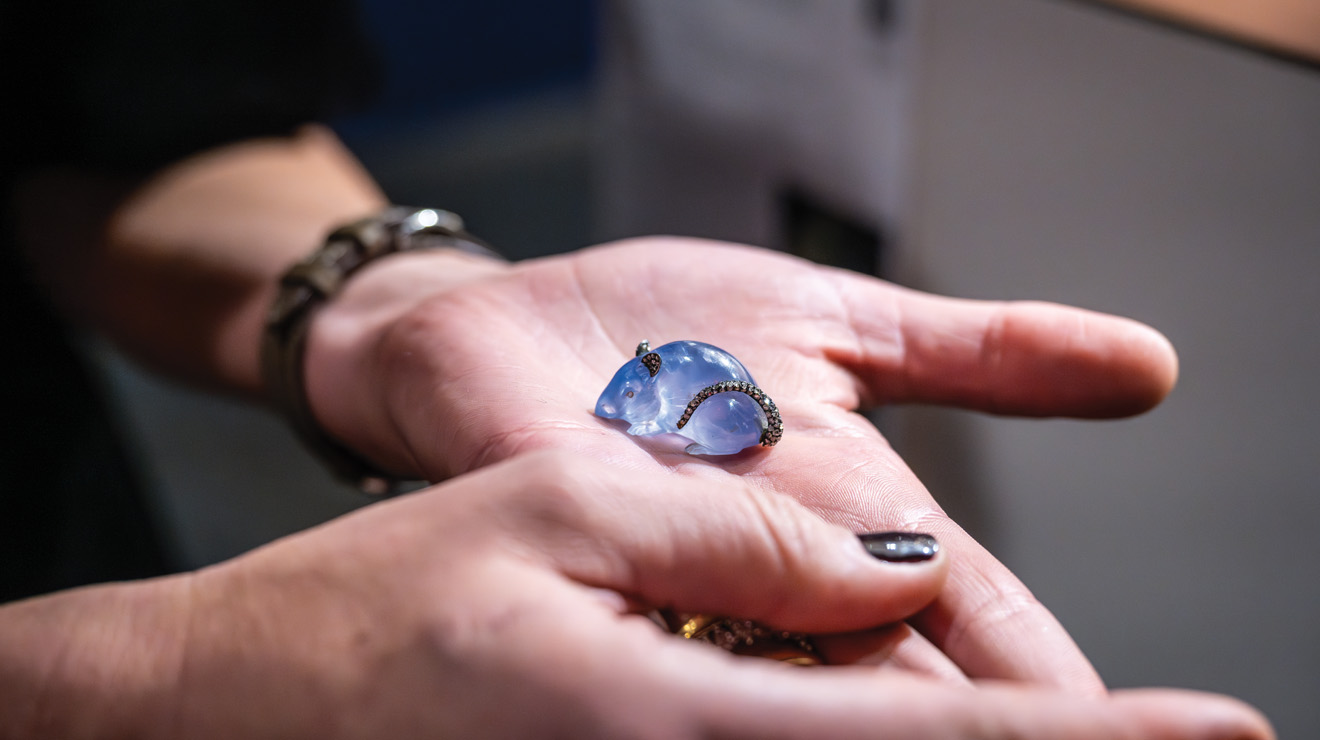
Bidding on the tiny mouse sculpture, just one-and-a-quarter inches long, started hot and got hotter. Exquisitely carved out of sapphire with diamond encrusted eyes, ears, and tail, the piece was made in the St. Petersburg, Russia, workshop of jeweler Gustav Fabergé around the turn of the 20th century. Experts, including Helen Culver Smith ’03 of Sotheby’s, believe it is the only piece of carved sapphire Fabergé ever made. Accordingly, the auction house had estimated that the mouse would command between $50,000 and $70,000, but prebids were already at $170,000 before bidding went live Dec. 18.
About 25 bidders or their representatives crammed into the auction room at Sotheby’s New York headquarters on the Upper East Side that morning. In a corner, Smith tried to keep up. Although her title is head of Sotheby’s decorative arts division as well as its Fabergé and Russian works of art division, Smith’s job during the auction was to track the bidding on each of the 187 items for sale, which ranged from jewelry to furniture to items of clothing. Smith juggled cell phones as she fielded offers from potential buyers around the world, competing with others in the room and online. After several frenzied minutes in which the bidding went up more than a dozen times, the tiny Fabergé mouse finally went for $355,600 to an unnamed online buyer.
By day’s end, the auction of items from the estate of singer Bing Crosby and his wife, Kathryn, brought in a total of $6.7 million. Two-thirds of those items sold for more than Sotheby’s presale estimates, evidence of a robust market in the decorative arts. Collectors certainly had a lot to choose from, as the Crosbys were themselves serious collectors. The grand piano Crosby played in the movie High Society fetched $95,250. Diamond and silver jewelry belonging to Russian empress Catherine the Great sold for more than $400,000. A collection of Crosby’s gold records brought in $6,985. In addition, the auction included paintings by Renoir, Corot, and western artist Charles Russell; oak paneling from the San Simeon, California, estate of William Randolph Hearst; and nearly 50 other Fabergé items, ranging from sculptures to picture frames.
Smith worked on the sale for more than a year. Following Kathryn Crosby’s death in 2024 (Bing, 30 years her senior, died in 1977), the family sought to have the estate appraised. Smith and members of her team visited the Crosby home in northern California to assess what was there, gauge its likely auction value, and convince the family that Sotheby’s, rather than a rival auction house, should handle everything. Smith was called in because of the large number of Fabergé pieces in the Crosby collection but ended up overseeing the entire auction.
Her responsibilities included appraising each item, researching its provenance, taking photographs, writing descriptions for the catalog, and helping to boost interest with Instagram posts and online videos. Everything was put on public display for two weeks before the auction date, during which period Sotheby’s also solicited prebids. Smith guessed correctly that the crooner of “White Christmas,” as well as dozens of other hits, still had a big enough name to command public interest, especially right before the holidays.
After majoring in art history at Princeton, where she also captained the women’s squash team, Smith taught high school art history briefly before earning a master’s degree from the Courtauld Institute of Art, which is affiliated with the University of London. Smith remained in the U.K. and spent a decade at Christie’s auction house, first specializing in portrait miniatures and gold boxes, which led her to Fabergé. She has been at Sotheby’s London office since 2018.
Best known for exquisitely decorated Easter eggs designed for the Russian czars, the house of Fabergé also made jewelry, sculptures, and even utilitarian items such as cigar cutters, letter openers, and glue pots. Although Smith herself has never handled any of the 61 Fabergé eggs still known to exist, they have a Princeton connection. Publisher Malcolm Forbes ’41 once possessed the world’s largest collection, owning more than even the Russian government. When Forbes purchased his 11th Fabergé egg in 1985, a New York Times headline crowed, “Forbes 11, Kremlin 10.” Forbes’ collection was sold to a Russian oligarch in 2004 following his death.
Fabergé works remain popular and, in the art world, all but recession-proof, owing to their materials, craftsmanship, and imagination. “Rather than just making functional things, there are also real toys, like miniature furniture or miniature animals,” Smith explains. “Something you would see in French [decorative art] done with gold with navy blue enamel, Fabergé does in bright orange. There’s a uniqueness to it.”
Smith now handles all Russian works for Sotheby’s, including ceramics, silver, bronzes, and objects of vertu (finely crafted miniatures such as Fabergé), as well as a subspecialty of artwork from the former Soviet Union. Sotheby’s usually stages two sales of Russian and Fabergé works annually, one in Geneva and one in London. But Smith also consults any time a private auction contains a piece in her area of expertise.
In the end, Smith says, the Crosby sale was “white glove,” which is auction-speak meaning that everything sold. Had items been left over, failing to achieve the minimum bid Sotheby’s had set, Smith would have offered them back to the family or repackaged them to be sold at a later date. Instead, her final job was to arrange for payment and shipping.
The range of work she is called to do, not only sourcing items but also valuing them and, as with the Crosby estate, getting them to market, is what keeps her job interesting.
“I have to do all of it,” Smith says. “That’s why I sometimes feel like a hamster on a wheel. Or, you know, a Fabergé mouse on a wheel.”
The Latest
See all


Related News


Janice Lee ’09 Worked to Renovate One of Hollywood’s Best-Kept Secrets
An engineer by training, Lee has been deputy project manager on the renovation of Hollywood Burbank Airport


No responses yet