

Alumni Have Read Dante at Reunions For Nearly Half a Century
To read Dante together is to produce knowledge together, said professor Simone Marchesi *02
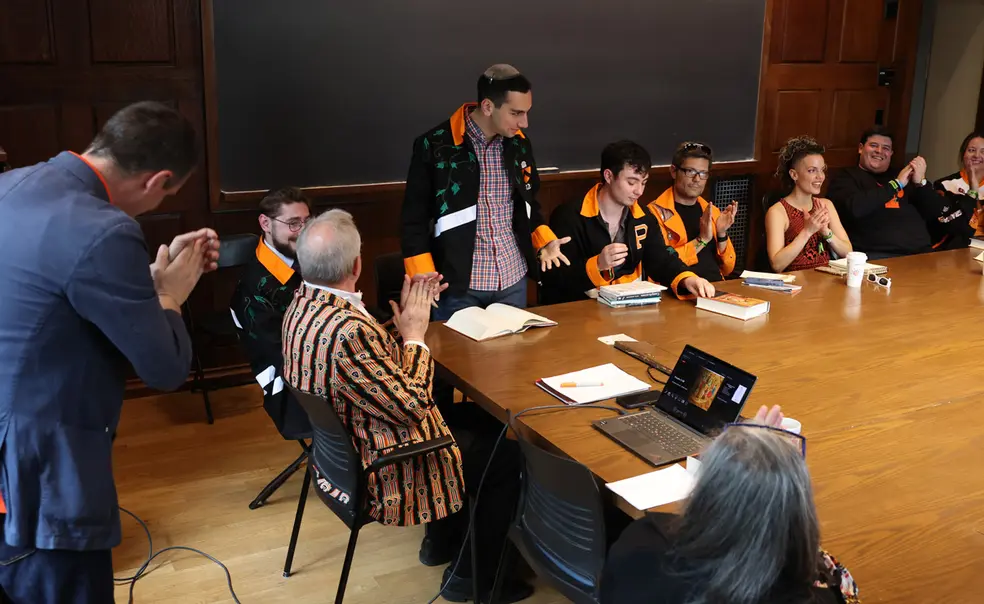

For nearly 50 years, Princeton’s annual Dante Reunions seminar has begun with a group recitation of the beginning of Inferno — from memory, in Italian. This year, in an East Pyne classroom, on professor Simone Marchesi *02’s signal, a chorus erupted with the opening line: “Nel mezzo del cammin di nostra vita … .”
One student, Jacob Davis ’26, kept going after the others stopped, earning himself a round of applause among the 40 or so attendees. Then Marchesi turned the group’s attention to cantos 10-12 of Paradiso, and the 90-minute seminar had started.
Robert Hollander ’55, a scholar of Dante and Princeton professor of French and Italian from 1962 to 2003, first held a Dante class at Reunions in 1977. He invited his former students to read the first three cantos of The Divine Comedy with him, then three more each year thereafter; 33 years later they had read all 100 cantos — and subsequently returned to the first page of Inferno. His devised reading schedule parallels the movement of Dante’s epic: Across its three volumes, the protagonist, a fictionalized Dante, accumulates the knowledge necessary to author The Divine Comedy. The result is a loop, with the ending of Paradiso segueing back to the beginning of Inferno.
Forty-nine years later, the tradition is going strong. In 2002, Marchesi, who studied under Hollander and first attended the Reunions event in 1997, began co-teaching the seminar. After Hollander’s death in 2021, Marchesi officially took up the mantle of Dante Reunions.
“It’s academic, it’s collaborative, like everything Dante at Princeton,” Marchesi said of the event. Hollander’s commentary on Dante frequently featured notes and citations from students who took his class; Marchesi has kept this spirit alive. To read Dante together is to produce knowledge together, he said.
“Dante wrote a text that’s like a score, a musical score. He knew that until and unless readers would engage with it to produce their own meaning to use the text for what they need it for, he would have not written a masterpiece,” Marchesi said.
Throughout the seminar this year, Marchesi periodically ceded the stage to other scholars in the room, including Alejandro Cuadrado ’16, a professor of Italian literature at Bowdoin College who specializes in Dante. And when the conversation broadened, more voices jumped in.
“There are some academics, but it’s mostly a group of people who are not reading Dante on a regular basis anymore,” said Susan Saltrick ’78. “Even if you’re engaged in a cerebral profession like law or medicine, it’s a different side of your brain that you’re using, and it’s just wonderful to reconnect with that spirit of inquiry.”
It’s also the only Reunions event that assigns homework, as attendees are asked to read the cantos that will be discussed.
“It’s a very Princeton tradition, to have a carved out intellectual space at our alumni Reunions,” Cuadrado said, underscoring that unlike panel events, the seminar “invites real participation from anyone.”
Dante lovers young and old come together to produce meaning from the text.
Frequent attendees include Georgia Nugent ’73, the former president of Kenyon College, and her husband, Thomas Scherer ’84,
as well as Saltrick and her husband, John Meyer ’77. Several members of the Class of 2025 were in attendance — and those from many class years in between.
“Everyone in that room has been taught Dante by either Simone Marchesi or Bob Hollander, and that’s just an incredible continuity,” said Cuadrado.
Princeton Dante also hosts retreats in Tuscany. Every two years, the group gathers in a countryside castle for an immersive week of Dante. Saltrick, who helps organize the event, describes it as “an absolute joy and treasure to be a part of.” The next retreat is scheduled for summer 2027.
Dante “was writing across time and across history,” Cuadrado said. “He knew when he was writing The Divine Comedy that 1,000 years later people would be reading him. We’re only at 700 right now, but in 300 years, if there’s still a Princeton University and there’s still a Reunions, my bet would be that there would still be a Dante reunion.”
Sofia Cipriano ’27 is a PAW student writer.
The Latest
See all


Related News
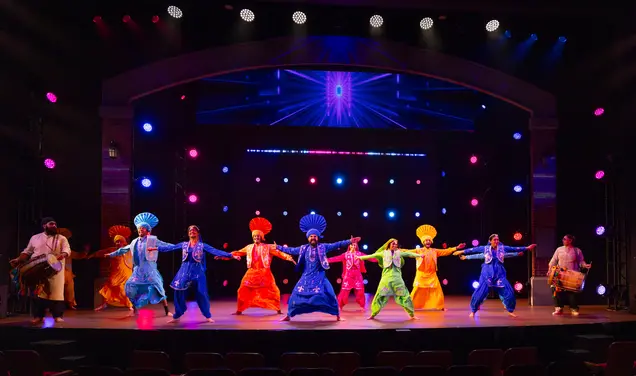
McCarter Theatre’s First South Asian Musical Took Me Back to Forbes Basement
A Beat of Our Own is about a college dance team not unlike Princeton South Asian Theatrics


1 Response
Jan Kubik ’70
3 Months AgoDante Seminar in Italy
Contact info for the 2027 Dante Seminar in Italy would be a welcome addition — especially if the schedule includes a group dinner at Macelleria Cecchini in Panzano, where owner Dario Cecchini is known to quote Dante to patrons!