

He Practiced What He Preached and Influenced Architecture
William Shellman Jr. *41 taught in the School of Architecture for 45 years
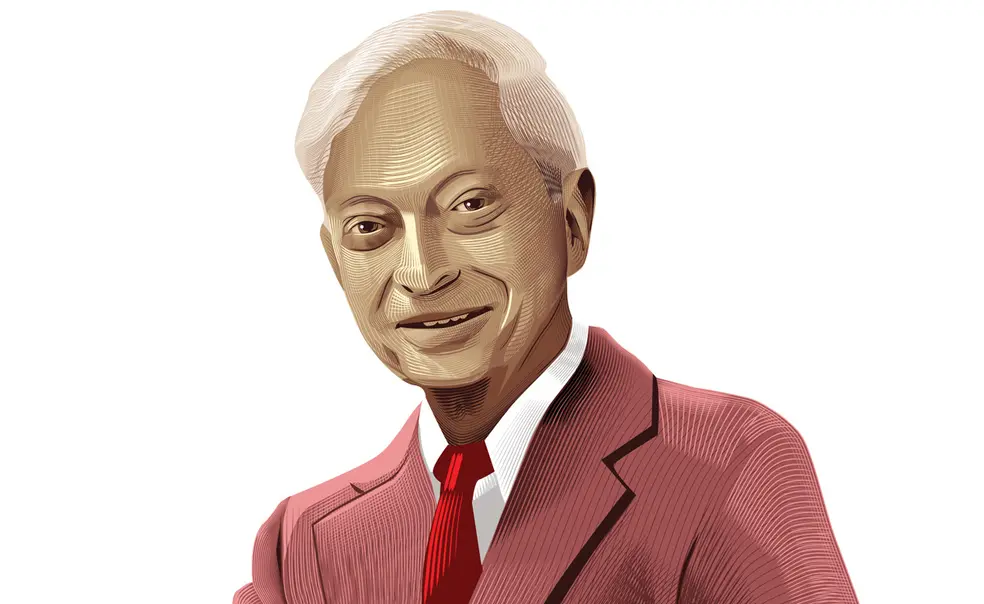

Within the archway between McCosh and Dickinson halls is an inscription attributed to classicist H.E. Mierow 1914: “Here we were taught by men and Gothic towers democracy and faith and love of unseen things that do not die.” To that, William Shellman Jr. *41, an influential architect and professor in the School of Architecture for 45 years, apparently rejoined, “You cannot learn democracy from a building.”
But many Princetonians learned how to design buildings under Shellman, known to his students as “Billy,” whose instruction helped elevate the architecture department from a purely theoretical school devoted to the minimalist precepts of iconic Swiss modernist Le Corbusier with more practical curricula that helped students become actual working architects.
Hailing from Savannah, Georgia, Shellman was the consummate Southern gentleman. As his former student Nicholas Moffett Pyle *71 wrote in a 1996 essay, Shellman “spoke in well-formed sentences spiced with Southern hyperbole” with a voice so gentle “that he had to emphasize his stronger sentiments with deeply furrowed frowns and belligerent juttings of the lower lip.”
Completing his undergraduate education at the University of Virginia, Shellman received his MFA at Princeton in 1941. After a stint working for a Savannah shipbuilding firm during World War II, he returned to Old Nassau as an instructor, where he remained until his 1986 retirement. According to Pyle, Shellman’s strength as a teacher was twofold: Not only did he help students learn how to sketch, he also helped them improve their ability in assessing the hidden elements of a structure through keen observation. “He knew that being able to see acutely, to understand what we [were] seeing, and to file that information away with all its possible connections [were] key to creativity,” Pyle explained.
Critical to Shellman’s approach was his rejection of the modernist style then in vogue, which was preoccupied with attention to function. Rather, he espoused a more well-rounded architectural education that also considered how buildings might express the values of their users.
These lessons resonated with his students, some of whom paved the way for the next era of postmodern architecture. Shellman’s pupils included Hugh Hardy ’54 *56, who supervised the renovation of Radio City Music Hall; Bartholomew Voorsanger ’60, architect of the National World War II Museum in New Orleans; and influential postmodern architect Robert Venturi ’47 *50, whose 1972 book Learning from Las Vegas, co-written with his design partner and wife Denise Scott Brown, radically transformed the field by relaxing the modernist architectural doctrine of stark glass and steel. “William Shellman possessed particular grace as a teacher,” said Venturi, who designed several Princeton buildings. “Many of us at Princeton learned from him about how to look at beautiful buildings with our eyes, hearts, and minds, and free of dogma.”
Shellman also practiced what he preached, designing several houses in Princeton, including his own on McCosh Circle near Lake Carnegie, to which he invited his students for lunch and often regaled them with his favorite recording of Gregorio Allegri’s hymn, “Miserere.” He also built houses as far afield as Georgia and South Carolina, and even built a garden in Spain for Princeton clients.
While Shellman asserted that Princeton’s Gothic revival buildings couldn’t instill democratic values, he believed that his alma mater, the University of Virginia, could foster democracy through Thomas Jefferson’s design for an “academical village” intended to facilitate discussion and community. Despite his reverence for Jefferson’s design, Shellman’s chief resource for his instruction, according to Pyle, was “the Princeton campus itself, a splendidly varied and eminently available trove of historical and historical-seeming architecture, landscape, and planning.”
To Shellman’s mind, one could only learn by experiencing as much architecture as possible, whether it was walking among the archways of Princeton or the grand boulevards of Paris and the Spanish Steps of Rome. “A man who can recover these and thousands of other images of previous sensory experience can select the tiny items that satisfy programmatic needs,” Shellman once argued in a lecture quoted by Pyle. “The sum or addition of these choices can add up to a new set of relationships, a new order.” By planting the seeds of postmodernism, he indeed created a new order.
The Latest
See all


Related News
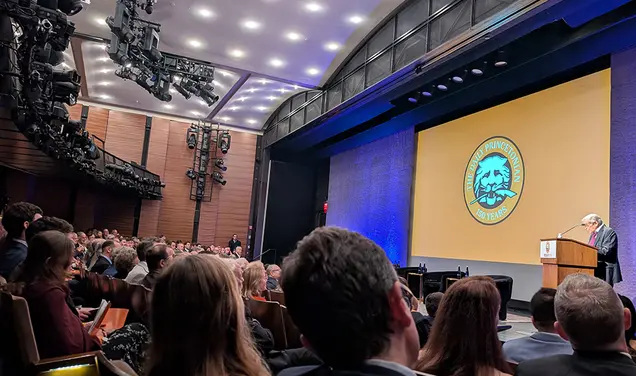
With Prominent Journalists and Hoagies, the ‘Prince’ Celebrates 150 Years
A gala at the New York Historical raised roughly $400,000 for the independent student newspaper

5 Responses
Rocky Semmes ’79
3 Months AgoMemorable Architecture Faculty
The “Portrait” piece of the June PAW chronicled the singularly sage and supportive William “Bill” Shellman, professor extraordinaire of the architecture department (“He Practiced What He Preached and Influenced Architecture”). Michael Graves was head of the department, and the gift of his direction was formidable and firm, but the department’s heart and soul rested in the warmth and kindness lent liberally to all there by Bill Shellman and his colleague Professor Heath Licklider.
Shellman’s skill with a pencil was performative, and five or six deft strokes from his hand could convey more than many an image of unlimited detailing by anyone else. And then, of course, there was the homespun sense and sagacity that spilled forth at random moments of his wit and wisdom.
The two classic bon mots of the studio that come to mind (and that might have been from either of the “two amigos,” Shellman or Licklider):
- “If any of you actually intend making architecture your career, it will help if you come from money.”
- “If any of you intend a career in architecture, start somewhere you don’t plan to stay. Doctors bury their mistakes, but the best an architect can do is cover them over in ivy.”
Jon D. Hlafter ’61 *63
4 Months AgoValued Perspectives on Creating and Preserving
The article about Professor Shellman in the June PAW kindled memories of his teaching me and others how to see and then remember the buildings and the places that made the Princeton campus so uniquely beautiful — a campus that he first experienced as a graduate student in the early 1940s, before the needs of a great University demanded more growth. For some, that ability to see and remember has created exceptional buildings and places that express changing needs. For others, it has preserved exceptional buildings and places in the face of changing needs. What Professor Shellman taught us encouraged both.
Jeffrey K. Graydon h’71 p’05
4 Months AgoMentor’s Students Were Great Mentors As Well
William Shellman’s heraldic Princeton banner.
Courtesy of Jeffrey K. Graydon h’71 p’05
The article about William Shellman caught my attention. While working with Michael Wurmfeld ’61 I learned a bit about Shellman as a professor and mentor. Michael and I became close while working with Bob Myslik ’61 and Jon Hlafter ’61 *63 to design and build the Class of 1952 Stadium in the early 1990s. Jon and Michael were roommates and students of Professor Shellman. We three collaborated on projects including Stevens Fitness Center at Dillon and the Squash Center at Jadwin. Michael told me about the student gatherings at Professor Shellman’s home on McCosh Circle and gave me the one and only Shellman-designed heraldic Princeton banner. I was told it was proudly flown during those gatherings. Before he passed, Michael gave me the banner and asked that it be displayed in some way at Princeton. I’m not sure how he managed to get it, but I’m glad he did. Happily, I was able to honor his request: The Shellman Banner is currently on display in Baker Rink. It continues flying in my former office, and it was featured in a Princeton hockey program some years ago. I recall too that we used the banner design to paint it on several doors in the Athletic Department. The article about William “Billy” Shellman gave me reason to reflect on how fortunate I am to have had mentors and friends like Michael, Bob, and Jon.
Sandra Vitzthum ’86
4 Months AgoProfessor Shellman’s Memorable Teaching
Your article on professor Billy Shellman was a great overview. I was one of his very last students and would love to share a couple of memories that hold valuable lessons for future architects.
Professor Shellman depended on reason and observation, eschewing ego and whim. He taught extremely detailed 3-point perspective — all by hand — as a way to train the mind. He started by sharing 7-foot-long sections through French Baroque gardens to demonstrate how surprises unfold as one walks through.
My final project was a 3-foot-by-5-foot 3-point perspective of an arched, vaulted gazebo interior. The vertical vanishing point was even further down, requiring gymnastics and a very long straightedge to draw. We worked lovingly on all the small details as well as getting every curve correct.
Professor Shellman was a scholar of landscape as well as architecture and craft. His modesty and insistence on a whole design free of artistic whim soothes the soul.
Brooks Washburn ’75
4 Months AgoAn Early Morning Lesson
I appreciated the Princeton Portrait on architecture professor William Shellman Jr. *41 in the last PAW. As a member of the Class of ’75 in architecture, I took lecture courses from him on aspects of architecture and design. Yes, as the essay described, he was a dedicated teacher and was maintaining a position on comparatively more “classical” tenets in architectural education as an older faculty member at the time, while there were other design currents flowing around too (professor Michael Graves, et al). Architecture students spent long hours late into the night and early morning hand drafting and sketching in those days on project assignments, and Professor Shellman’s lectures were morning classes. I remember well because one morning I drifted off during his class and he threw a piece of chalk at me (true story) and said “Washburn … wake up.” A lesson well learned.