

A New Way of Thinking About Modern Problems
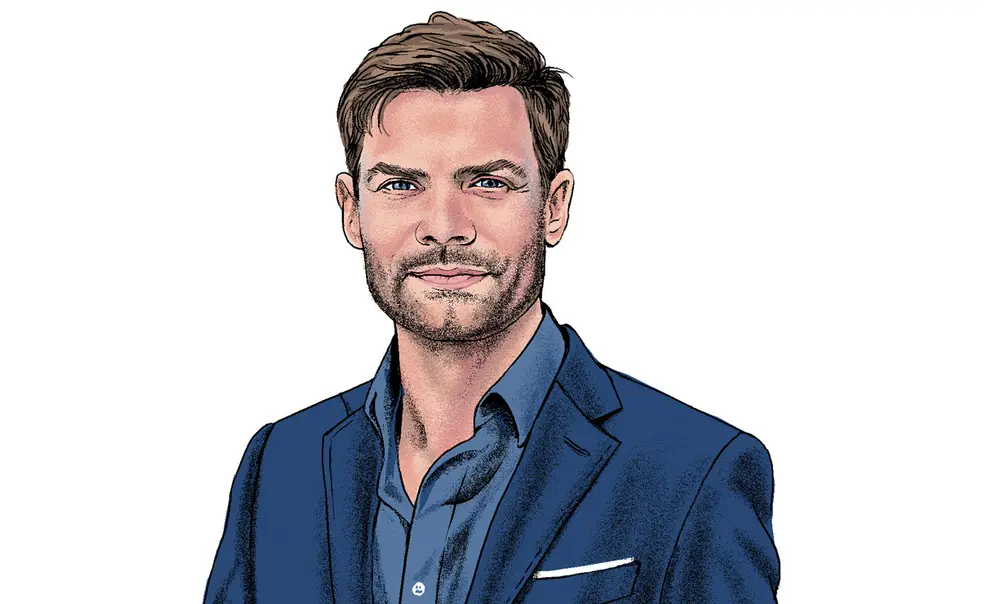

Michael Thate’s real education started with long summer days on a farm in his hometown of rural Fairmont, Minnesota. Thate would wash hog barns in the morning, bale hay in the afternoon, and harvest with a combine at night. “The cool thing is that on the farm, everyone’s a systems engineer, everyone’s an ecologist, everyone’s a mechanical engineer,” Thate says. “You just learn how to fix things and how to assess problems.”
This early lesson in the importance of addressing situations from multiple perspectives ultimately shaped Thate’s diverse, interdisciplinary career. With degrees in religious studies, ethical philosophy, design, systems engineering, and law, Thate describes himself as a systems engineer focused on “designing with the whole human in mind.”
Through his three academic appointments at Princeton — as a lecturer in the engineering department and at the Keller Center, and as a research scholar at the Faith & Work Initiative — Thate researches ways to infuse humanistic and ethical concerns into corporate strategy.
“I’m really interested in how it all comes together: the relationship between humans and the digital and computational,” he says.
Quick Facts
Title
Lecturer and research scholar for responsible tech and innovation
Time at Princeton
12 years
Recent Class
The History of Entrepreneurship

Thate’s Research: A Sampling
Earth As Shareholder
In law school, Thate learned that legal “personhood” was being granted to rocks, hills, and streams to mitigate land disputes in countries such as New Zealand and Ecuador. He began to wonder whether a similar approach might work in a business context — deeming planet Earth a “shareholder” in corporate activities and thereby embedding environmental caretaking directly into governance. “Earth has these tangible assets and has to be accounted for in all operations,” Thate says, noting that the risk corporations introduce to the planet is currently shouldered by Earth, not by the corporations themselves. In a 2025 essay published in Sage Journals, Thate proposes that as a shareholder, our planet is entitled to a voice for its resources and to compensation for this burden of risk — a framework that might require legal, judicial, and corporate innovation to implement.
The Stack Approach to AI Ethics
To better address our societal concerns about artificial intelligence, Thate suggests we reorient how we think about it. “Stop thinking about AI as a widget. Start thinking of it instead as a stack — a stack with five layers,” he says. The layers include geopolitical and legal foundations; energy and materials; physical infrastructure; models and training applications; and governance and values. “How do our concerns then cohere across the stack?” For example, when considering the effect of AI on the mental health of our children, we should assess the full environmental impact on their wellbeing from the entire stack — not only at the user interface level (“Is the chatbot persuasive, addictive, or anthropomorphic?”), but also at the model and training layer (“How is this chatbot trained? Does it reinforce harmful beliefs?”) and geopolitical and legal layer (“Are there regulations protecting minors?”). Thate is currently working with the National Institute of Standards and Technology on what a metrology (study of measurments) of AI would look like. “To me, this is a shock of realism as opposed to the doomerism and hand-wringing.”
Teaching Thinking
As technology evolves, the demand for our attention skyrockets, cybersecurity issues grow, and concerns mount over our collective abilities to think, reason, and solve problems. “This is both a hardware problem and a software problem,” Thate says — with the software being humans. In his forthcoming book Natural Prayers of the Soul, Thate argues that society — parents, elected officials, and tech companies — should be helping people develop and sharpen their mental capacities and instincts rather than simply multiplying policies to reduce error. “You need to help [people] form habits to learn to love what is beautiful so that they can choose for themselves what is beautiful,” he says, noting that he encourages this in his EGR301 class by inviting students to write a self-assessed values paper. “They can choose a future for themselves where they can flourish.”
The Latest
See all


Related News
With Prominent Journalists and Hoagies, the ‘Prince’ Celebrates 150 Years
A gala at the New York Historical raised roughly $400,000 for the independent student newspaper


No responses yet