

Secrets of a Two-Time World Scrabble Champ
‘I’ve always loved words, loved reading the dictionary,’ says Adam Logan ’95
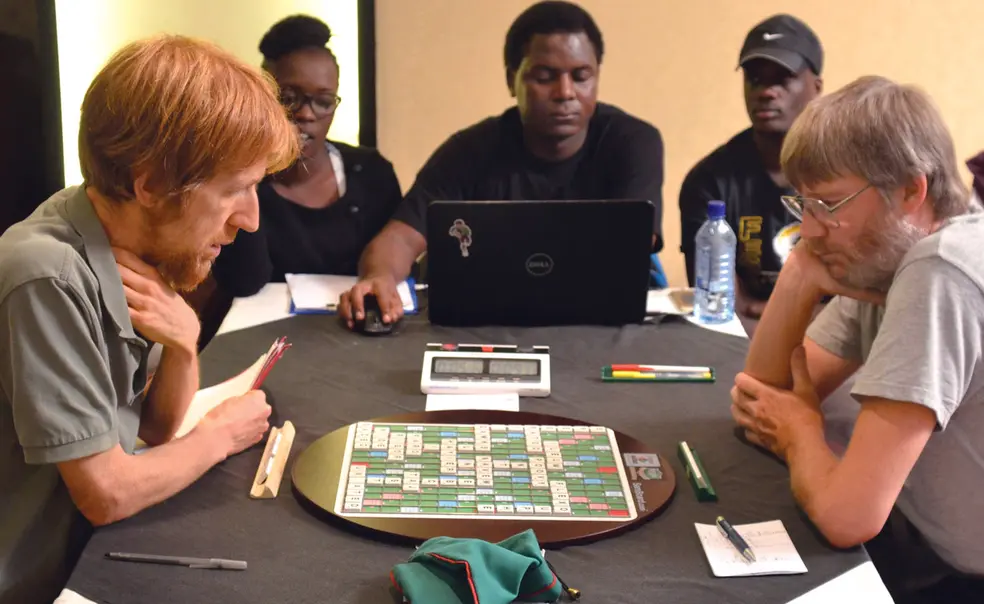

When Adam Logan ’95 was 9 years old, he read a book that changed his life. It was The Official Scrabble Players Dictionary, and he was entranced from the first page. He knew this was a game he would love to play as much as he could.
A year later, when his mother heard about a Scrabble tournament in Ottawa, Ontario, where they lived at the time, she convinced organizers to allow Logan to compete despite his young age.
Logan, now a Montreal resident, recalls, “I didn’t win the tournament, but I won three of my four games, and at that point, I was definitely hooked.”
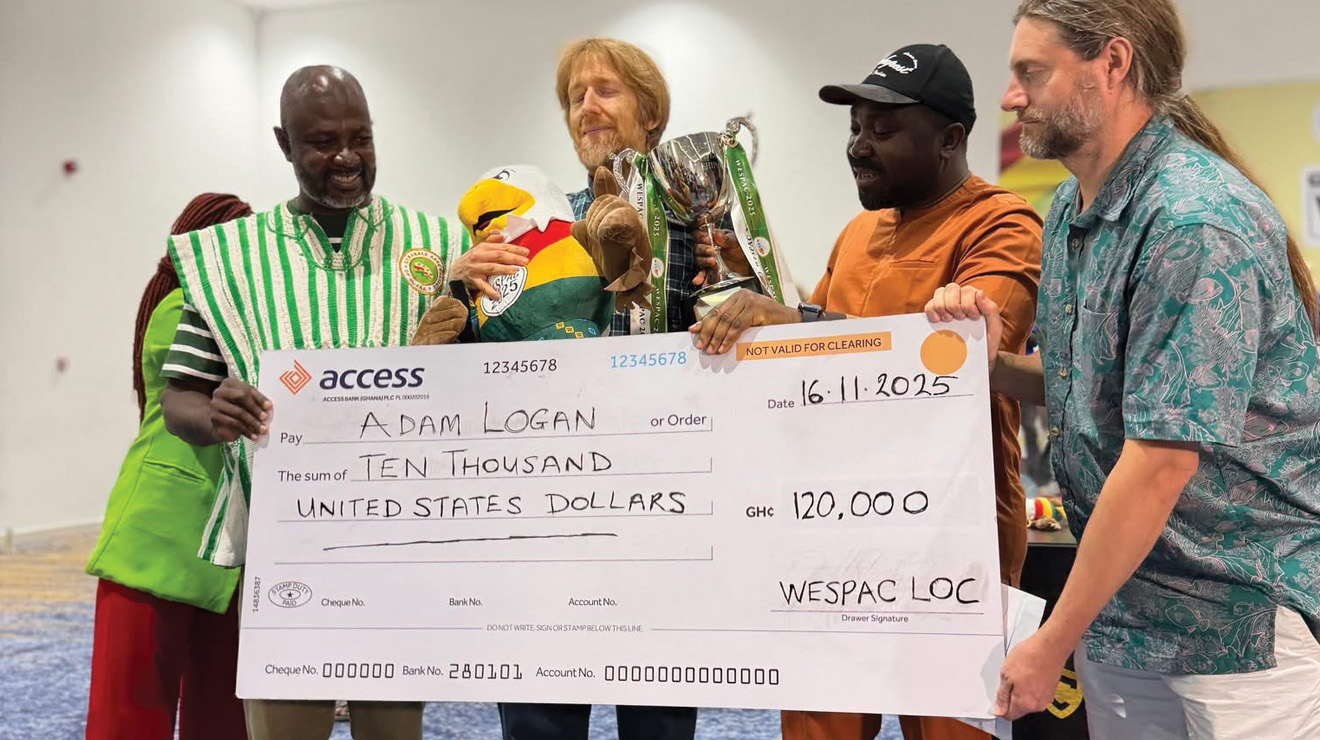
Around 2,700 games later, Logan is now one of the most celebrated Scrabble champions. Last year, he won the World Scrabble Championship in Ghana, his second win after his 2005 WSC crowning in London.
He has won around 69% of the games he has played at official tournaments.
Logan, who majored in mathematics at Princeton, speaks in a clipped, perfunctory manner, never wasting a word, and sometimes peppering mathematical terms into conversation, such as “median,” which isn’t a surprise considering his profession. While he used to teach math at both the University of Waterloo and McGill University, he’s now semi-retired and working for the Tutte Institute for Mathematics and Computing in “cryptography and secret stuff I can’t really talk about.”
What he’s happy to discuss, though, is his love of Scrabble. “I’ve always loved words, loved reading the dictionary,” he says. “And when it comes to my Scrabble wins, talent can only get you so far, but maybe talent produces early success, and early success motivates future hard work, which is necessary for later success.”
He can wax poetic on being eagle-eyed to find the right place for a triple-letter score, or the strategy he employs to use rare words that catch him in a bind, such as a word with very few vowels. But he also gets introspective on the innate qualities a strong Scrabble player should hone.
The more confident you are, the better you’ll be at winning at Scrabble, says Logan. “There are times when I have to accept there are games I’m not going to win, when the tiles go against you,” he says, “but there are other games when you’re close and you have to believe in yourself, to make the necessary effort, and concentrate as well as you can, and if you don’t believe that, you really shouldn’t be playing.”
Logan says he’s also learned how to spot when a competitor is being more defensive with the placement of tiles, or is waiting for a seven-letter word and playing cautiously. He sharpened his ability to not be too paranoid about a closed board near the end of a game, where it’s difficult to place a word, “because there could be opportunities right until the end.”
His approach to Scrabble play may also benefit from his knowledge of certain areas of mathematics. “It is helpful to have some basic ideas about probabilities,” he says, referring to figuring out the chances of pulling a certain letter from the tile bag based on what’s on the board already.
John Chew, the chief executive officer of NASPA Games, the nonprofit governing body for Scrabble in the U.S. and Canada, says he saw a star in the making when he began to watch Logan compete at tournaments. “Adam’s brain is intrinsically ideal for playing Scrabble in its ability to store large quantities of abstract information and rapidly analyze them,” he says. “And he has spent his life further optimizing it by playing the best players in the world.”
One of those players came in Logan’s final round of the 2025 WSC: five-time champion Nigel Richards. “You just have to expect that he will make the best move at all times, and you’re just constantly making as many of the best moves as you can,” says Logan, who ended up winning 4-2 in the best-of-seven series to take home his second WSC trophy.
A supportive community has blossomed from international and national Scrabble tournaments, Logan has found. “We’re rivals but not enemies, and we often socialize with each other after games,” he adds.
But come tournament time, Logan is training like any athlete would. He doesn’t pore over the dictionary so much as he uses a mobile app for Scrabble players that scrambles a word and asks users to find words amid the jumble of letters. He also ensures he gets enough sleep before a big game.
When Logan looks back on his years at Princeton, he values what he learned about himself. “As much as it really was a very good place to study mathematics, by the time I left I started to become someone who could have ideas of his own,” he says.
He also recalls the “colorful classroom” led by John Conway, who was on Princeton’s faculty from 1987 to 2013. Logan says he was intrigued by Conway’s “rigorous introduction to linear algebra, and I liked reading his very interesting books.”
Logan has competed in several tournaments this year, and won a few, but his attention is trained on the 2027 WSC, as it’s held every other year. “I feel a sense of moral obligation to defend my title,” Logan says with a grin.
The Latest
See all


Related News
With Prominent Journalists and Hoagies, the ‘Prince’ Celebrates 150 Years
A gala at the New York Historical raised roughly $400,000 for the independent student newspaper


No responses yet