

Why Princeton’s Black Lab, Coach, Is More Than Just a Good Dog
‘You couldn’t ask for a better partner,’ says Coach’s partner, Sgt. Alvan Flanders
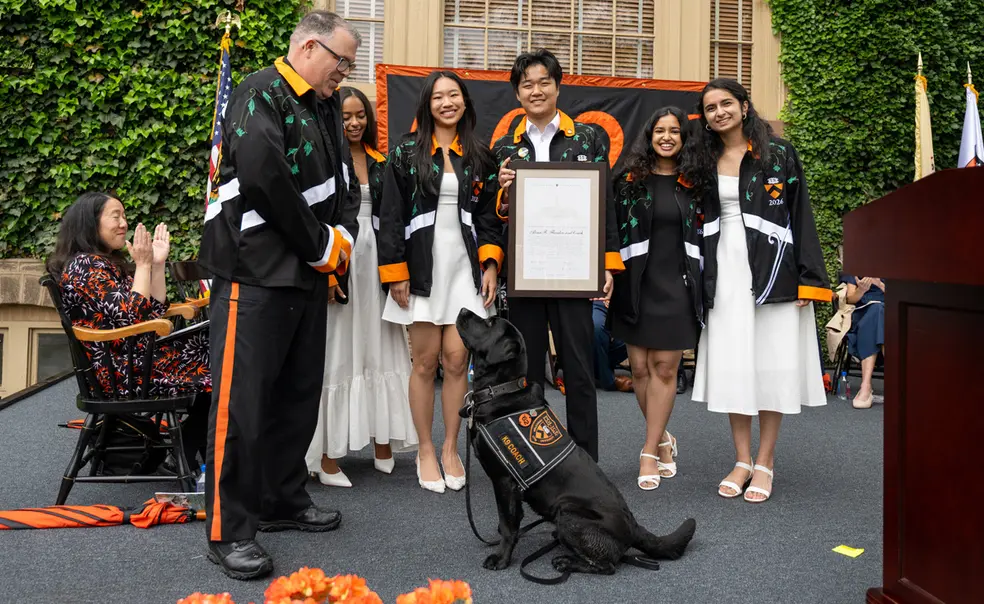

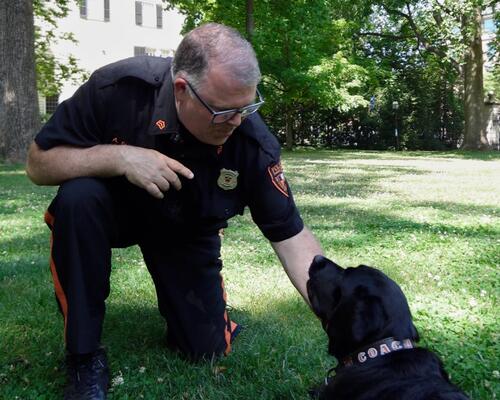
Sgt. Alvan Flanders of Princeton Public Safety and his canine partner, Coach, were recently named honorary members of the Class of 2026. PAW sat down with the pair to learn more about how Coach came to campus, and the impact she’s had on Princeton’s community over the past five years. This interview has been edited and condensed.
Can you start off by telling us a little bit about yourself, how you became an officer, and what ultimately brought you to Princeton?
This August will be my 32nd year here. I started in 1995 as a security officer and worked my way up through the ranks to patrolman, then detective, and then detective sergeant. About almost five years ago, I was lucky enough to acquire my partner here, Coach.
How did the idea of getting a canine partner come about?
It was sometime around COVID. I had always wanted to be a canine officer, and there was a lot going on at the time: COVID, the defund-the-police movement, George Floyd. I was trying to find a way to better bring our department in touch with our community. I thought no better vehicle for that would be a dog. So, I researched the idea of getting a dog on campus and reached out to a lot of police departments throughout the country, including university departments that had dogs. Not many had dogs solely for community relations, so it was difficult finding departments to talk to about that side of things. But I found that Yale University had started a program with their dog, Heidi, brought in for officer wellness and to bridge the community with their department. I reached out to that officer, who told me about an organization in New York City called Puppies Behind Bars. They breed dogs specifically for officer wellness, therapy work, service work, and for people who need dogs for PTSD.
I reached out to them and explained my idea of bringing a dog to Princeton, not just for my officers, but for the community. They loved the idea. I wrote a proposal to my boss at the time, Paul Ominsky. He liked it and vetted it through the channels here at Princeton, and it was approved. I went to a prison in upstate New York, Bedford Hills, that summer and trained with the female inmates to learn how to care for a service dog like Coach. I was awarded Coach and brought her back to campus 14 days later. It’s been probably the best thing that’s ever happened to me. It’s been remarkable.
What was that training process like?
It’s a unique process. Initially, they don’t pair you with the dog you’re going to get. The first day, you have a dog, work with it, hang out with it, and take it back to the hotel with you overnight. The next day you get a different dog. I only had Coach for a short period one morning, so I wasn’t sure if she was going to be my forever dog. But the moment they told me she was mine was very emotional. I knew she was a perfect fit for Princeton: beautiful, orange eyes, great disposition, very social, very loving. She’s been remarkable ever since.
What does a normal day look like for Coach?
She’s with me all the time. She lives with me and my family at home. We have another little dog there too. Once she’s off work, she’s just a regular dog. She wakes up at 5 a.m., goes out, comes back in, and goes back to bed while I get ready. Then we usually take her for a two-mile walk in the morning. She comes back, has breakfast, and then we get ready for work. She knows the moment I put my uniform on that it’s time to go. At work, we meet whoever’s in the building, and she hangs out there throughout the day, going out several times. I usually exercise her a bit in the afternoon, some off-leash time and some walking. We try to meet with the community as much as we can. She’s with me all day long, whether in the department or out and about, and it’s been a real success.
What kinds of events and interactions does Coach take part in?
We try to go to as many of the big campus events as we can: football games, basketball games, whatever’s happening. We also get invited to different events, including ones other departments hold, or study breaks that student groups organize. Occasionally we get called to one-on-ones at the infirmary for someone in crisis who needs a dog. And sometimes people just walk into our building and ask, "Is Coach here? I need some time with Coach.” She’s always more than happy to come out.
How has having Coach by your side changed the way people interact with you?
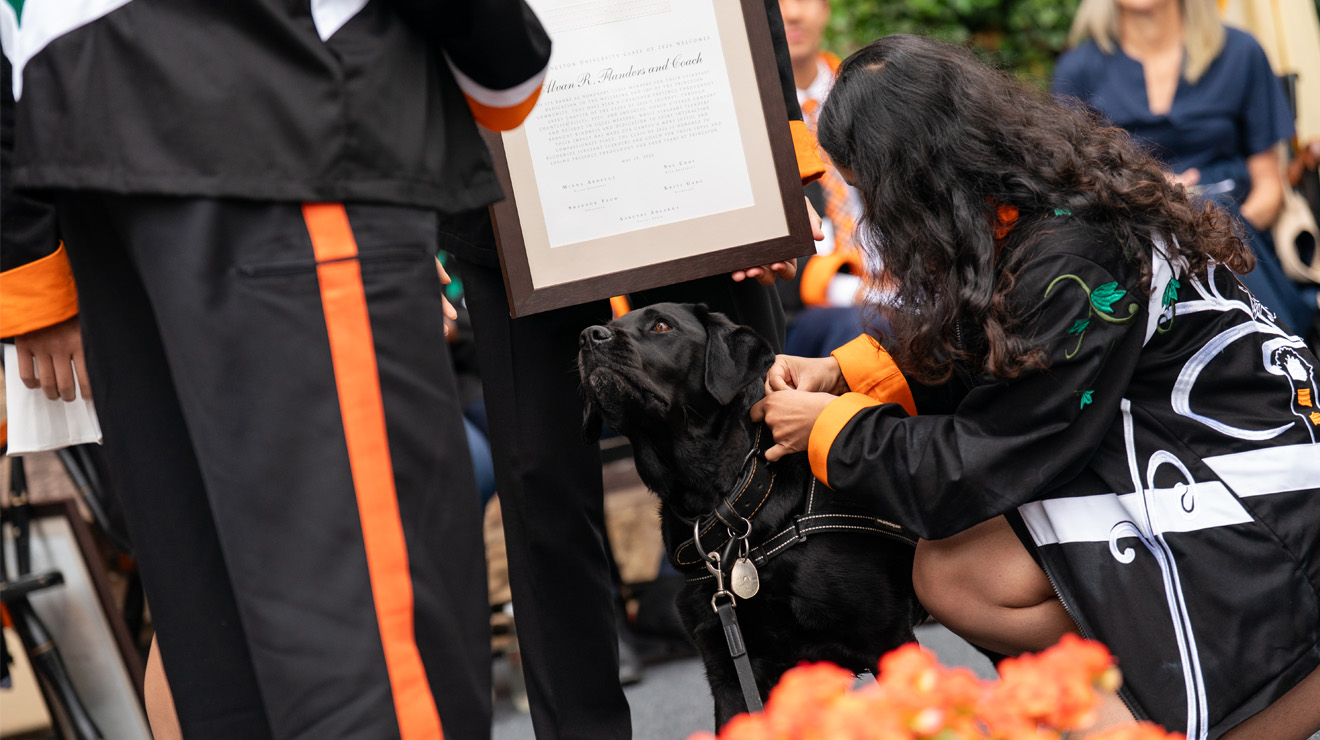
I’ve been in a lot of positions in our department, in plainclothes, in a suit and tie, in uniform, and I’ve walked through these buildings many, many times over the years. Before Coach, people often didn’t really recognize me. They’d wonder, “What’s Public Safety doing here? Is something wrong?” But as soon as I walk out the door with Coach, I’m immediately greeted by people who recognize her and want to come pet her. Students have told me they miss their dog back home and just want to spend time with her. It’s remarkable how many people recognize her, partly because of her social media presence, but mostly just from her being out there.
Is there a moment that really stands out to you?
When I first got her, we were at student orientation, my first time really dealing with the broader University public with a dog. She was going around greeting incoming students, and one student came up and asked if she could pet Coach. She and her family wanted to know a little about her, so I told them about her background and purpose. The girl sat there petting Coach for three to five minutes, then told me, “This just made my day.” That was amazing to me. This girl had just gotten into Princeton, it was her first day on campus, and this dog made her day. It really showed me the effect these dogs can have on people.
We also heard Coach was part of a thesis project. Can you tell us about that?
About a year or two ago, a student asked if Coach could be part of her thesis project. I didn’t know all the details, but the project looked at the effects a dog’s presence has on students taking tests. We went to a couple of study sessions, some with Coach there, some without, and the students took a mock test and answered a set of questions. The findings were remarkable: Her presence left students feeling a lot more comfortable.
When you first researched bringing a dog to campus, what did you find, and why do you think this kind of program matters?
When I first started researching, the idea wasn’t very popular. Having a dog specifically for officer wellness or community engagement wasn’t really “a thing” at the time. I believe we were among the first in the area, and the second in the Ivy League after Yale. But it really does bring more awareness to the community about policing and about our department. We have much better engagement with the community now. Before, people wouldn’t even know my name after 30 years here. Now they know Coach. She’s very popular. It gives our department a kind of head start when we’re dealing with the community, and more buy-in, because we’ve invested in a dog to help bridge that gap between our department and the University community.
What has Coach taught you?
Patience. I’ve always been a caring person. I have four daughters, so you develop that instinct. But she’s really taught me that there’s a lot more to being a police officer than the black-and-white issues of right and wrong. There’s a lot to speaking with people, understanding their stories, and really talking to them. I’ve always liked communicating with people, but not everyone wants to talk to police. Now she gives me an in, a way to let people know what we’re all about.
How do you and Coach support each other, especially on harder days?
Even though we’re on a very safe campus and our jobs are relatively low-risk, we still deal with a lot of emotional and hard moments here, just like any community does. As a detective and detective sergeant, I’ve been involved in some upsetting situations affecting our community, and Coach has always been there. She senses people’s feelings. When I’m driving home after a tough day, she’ll sit in the back and start nudging my arm, just to let me know she’s there and she cares. But she senses other people’s emotions too. When someone’s having a rough day, even if they don’t quite realize it the selves, she’ll go over and lay at their feet, offering support the same way she does for me.
Can you tell us about becoming an honorary member of a graduating class?
I was made an honorary member of the Class of 1962 and that was pretty cool. During the ceremony, one of the presenters said this wasn’t going to be Coach’s only recognition like it. Not long after, I got an email from the Dean’s office saying they’d like Coach to be an honorary member of another class as well. I was thrilled. It’s a lot to balance my normal nine-to-five job with everything having Coach involves, but I was honored and amazed that they would recognize her that way. Getting up on stage during Class Day and receiving the jacket (she even got a little pin) was a really cool experience.
What’s it like balancing having Coach at work with your everyday responsibilities?
It’s twofold. I love having her at work, love her being there, but on the days she’s not there, I really miss it. You get used to having somebody by your side. When she is there, I’m doing my normal job while also always keeping an eye on her, making sure she’s safe. She stays in the office, but you’ve always got to watch out for her while still getting your own work done. But she’s a remarkable dog. You couldn’t ask for a better partner.
Is there anything else we should know about Coach?
She comes from a remarkable organization called Puppies Behind Bars, which does wonderful work with their dogs across campuses and communities. I’d encourage anyone with an interest to look them up. What they do with incarcerated individuals is remarkable, and it really gives those puppy-raisers a purpose. I’m grateful to them for the opportunity to have a dog like Coach, grateful to my department for allowing me to have her and work with her every day, and grateful to the University for welcoming her and letting her be part of the community.
Interview conducted by C.S. and condensed by J.L.
The Latest
See all


Related News


McCarter Theatre’s First South Asian Musical Took Me Back to Forbes Basement
A Beat of Our Own is about a college dance team not unlike Princeton South Asian Theatrics


1 Response
Peter D. Kinder ’70
1 Month AgoPraise for Puppies Behind Bars Programs
I’ve had the privilege of attending Puppies Behind Bars events at the Green Haven maximum security prison in Millbrook, New York. As the article indicates, the dogs are most impressive. But even more so are the 20 men who train them. All three visits were highly emotional for different reasons. The men have made radical changes in their lives before they were accepted for the program. Thanks to Puppies Behind Bars and corrections personnel with vision, their progress continues.