
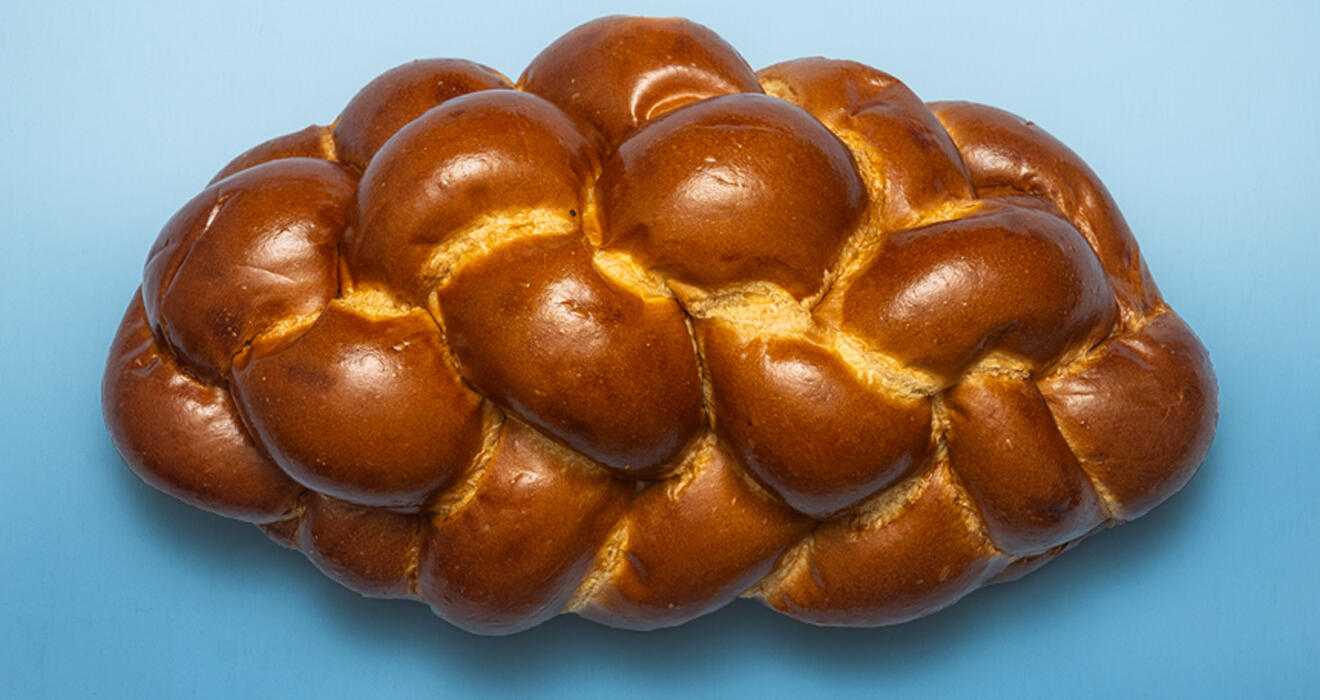
The Braids That Bind
Inside the difficult conversations Princeton’s Jewish community has had in the three years since Oct. 7

For zach ducorsky ’26, spending time at the pro-Palestinian encampment in the spring of 2024 was an important way to show solidarity with the movement as a Jewish student at Princeton.
“A lot of good things came of the encampment … good interactions, good conversations, good arguments as well,” says Ducorsky, who adds that he did not participate in protests but wanted to be present to challenge the perception that Jewish students felt uncomfortable on college campuses as activism surrounding the Israel-Hamas war reached a peak at Princeton and across the nation.
“When there’s no Jewish voice that’s opposing the narrative, then it becomes … easy to weaponize antisemitism” and assume that “all Jews on campus monolithically believe X. And when there’s at least one opposing voice, then the conversation can’t be had that ‘All Jews feel X, Y,’” he adds.
One Friday night, Ducorsky headed from the encampment to the Chabad House, where he was a member of the student board, for Shabbat dinner with his classmates, many of whom held different views about the protests. Leah Powell ’26, who later became president of Chabad, was among them.
“We did talk about why he was [at the encampment], and we did get into a little bit of a friendly argument about what his goal was in doing that,” she says. “But he still came to Chabad and felt comfortable in the space, and I thought that was very special.”
Their interaction is emblematic of the difficult conversations many Jewish Princetonians have been having since Oct. 7, 2023, the day Hamas attacked Israel, killing about 1,200 Israelis and foreign nationals and taking 251 people hostage. The ensuing war has resulted in the deaths of more than 70,000 Palestinians and drawn intense scrutiny to Israel, while also contributing to rises in antisemitism and Islamophobia.
As in Jewish communities outside of Princeton, those conversations have meant navigating different perspectives on whether Israel is committing war crimes, how central Israel is to Jewish identity, what it means to stand in solidarity with Jews and Palestinians, and what does or does not constitute antisemitism. Those differences have tested friendships, families, and communities.
Yet PAW found that conversations within Princeton’s Jewish community — on campus and in alumni circles — have often, though not always, taken a more measured and civil tone, perhaps in part because the Princeton experience aims to value differing viewpoints.
Related coverage
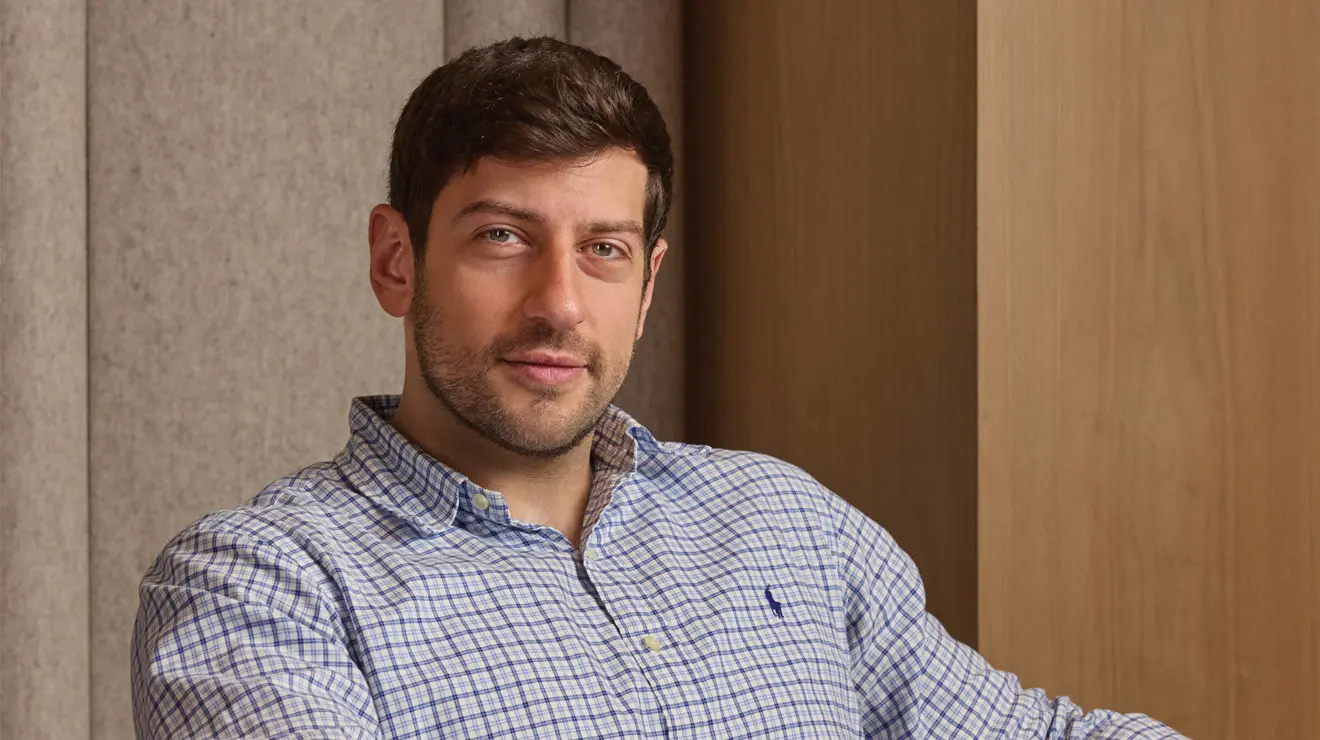
Alumni, Students Work to Foster Princeton’s Muslim Community
Mohamed El-Dirany ’18 *19 is among those focused on “consolidating Muslim alumni together and focusing on getting that community really strong”
PAW attended a Reunions panel on the topic and spoke with the heads of the University’s two largest Jewish spaces, Chabad and the Center for Jewish Life (CJL), as well as current Jewish student leaders and alumni. The group included people spanning generations and perspectives: from the Class of 1964 to the newest graduates; from the political far left to conservatives; undergraduate and graduate alumni; Americans and Israelis; and people working on the ground in the Middle East and in Washington, D.C.
Perhaps the only thing everyone agrees on is that it’s impossible to agree. That’s partly because Judaism is not just a religion — and some Jews don’t consider themselves religious — but also an ethnicity, an ancestry, an identity, and a culture. For some, Jewishness is central to their lives; for others, it is less so.
Ducorsky put it like this: At Princeton, “most of the people I spoke to were able to have a reasonable, rational conversation, even if they disagreed.” He says that may help explain why Princeton’s protests looked different than those at other schools, such as Columbia — because Princetonians “were willing to have an actual conversation and actually did have some factual basis and understanding of what they were protesting for or against.”
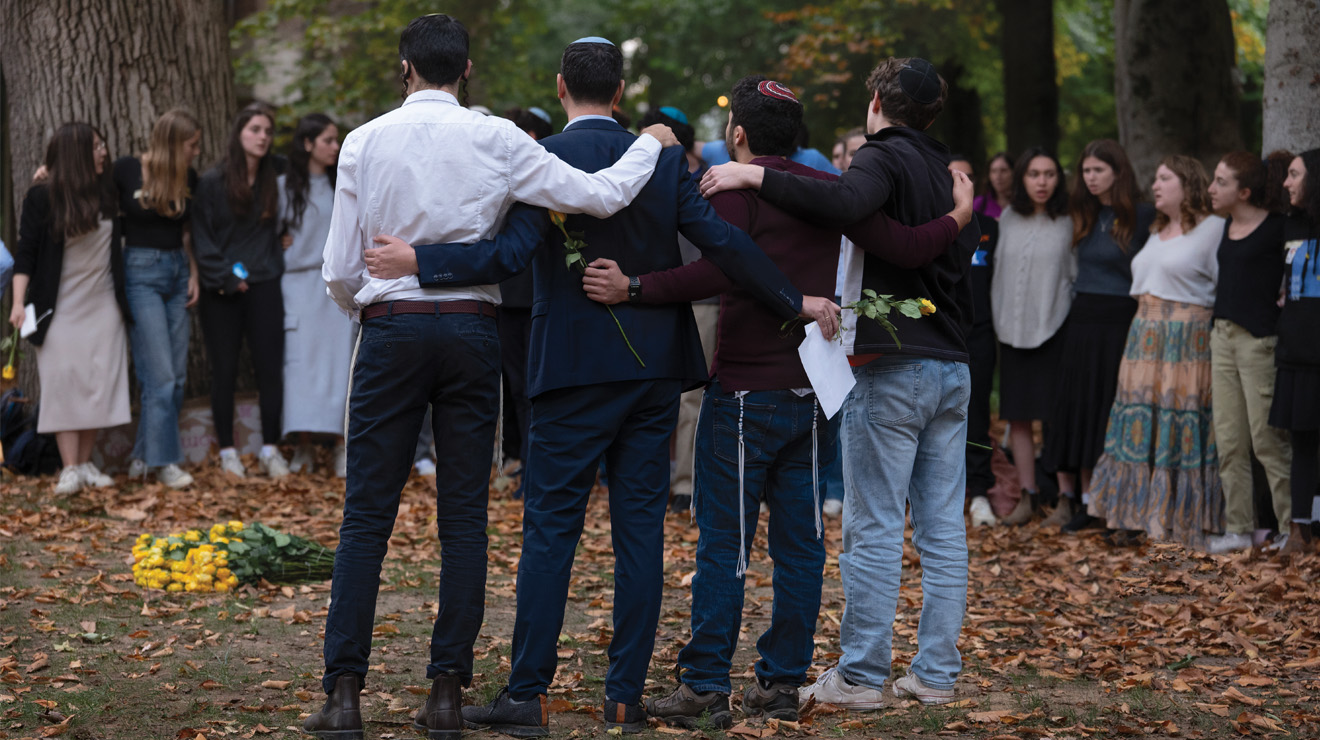
Directly after the October 2023 attack and the start of the war, studies found, many Jews drew closer to one another and Judaism in what the Jewish Federations of North America called “the Surge.” The same was true at Princeton. Jewish student groups saw higher turnout and hosted more events in the months that followed.
Rabbi Gil Steinlauf ’91, Jewish chaplain and executive director of the CJL, said Oct. 7 and the aftermath “underscored just how important a strong Jewish community is” for many. Since 2021, Jewish students have also reported an increased sense of belonging to the campus community, according to University surveys.
The student group B’Artzeinu was created as a direct result of Oct. 7 and describes itself as “Princeton’s premier Zionist club,” focused on pro-Israel advocacy and education. The group drew as many as 150 attendees at some events, but its president, Perry Wolf ’28, says turnout was smaller this past spring, in part because the group hosted fewer events and featured less-well-known guest speakers. She also believes the decline may reflect the amount of time that has passed since Oct. 7.
Some Jewish student groups have shifted their focus since 2023 and 2024. The Alliance of Jewish Progressives (AJP), which formed in 2014, stepped away from “the political side of things,” although Ducorsky, a former co-leader, says that was not the result of a formal decision but rather a response to what students said they wanted.
“I think [members] just wanted more text study, more cultural events,” Ducorsky says. “In general, there’s the idea that there’s not as much of a need for protests or these very strong political voices.”
Jordan Green ’29 is co-president of Tigers for Israel, formerly the Princeton Israel Public Affairs Committee, and says the group was less active last year. This summer, she wrote a new club constitution focused on education and nonpartisan advocacy, rather than counterprotesting, which had previously been one of the group’s primary activities.
Green served in the Israel Defense Forces for nearly three years before coming to Princeton. She was working at the University’s pre-orientation program for transfer and veteran students when she spoke with PAW and says she received many questions from student veterans who learned about her mandatory service.
“I’m happy to discuss it as long as the dialogue is civil and polite, because I’m not about to get into a fight with someone,” she says. “That’s just unnecessary, disrespectful, and I think goes against everything Princeton stands for.”
The Jewish alumni community has seen a similar increase in dialogue and participation since Oct. 7.
Steinlauf says “the climate after Oct. 7 contributed to the desire among Jewish alumni for a stronger and more organized sense of community.” He says those deepened bonds “are still very much present today.”
“I’ve never been more connected to Princeton Jewry, if you will, than I have in this period since Oct. 7,” says Ilya Shapiro ’99, director of constitutional studies at the Manhattan Institute, a conservative think tank.
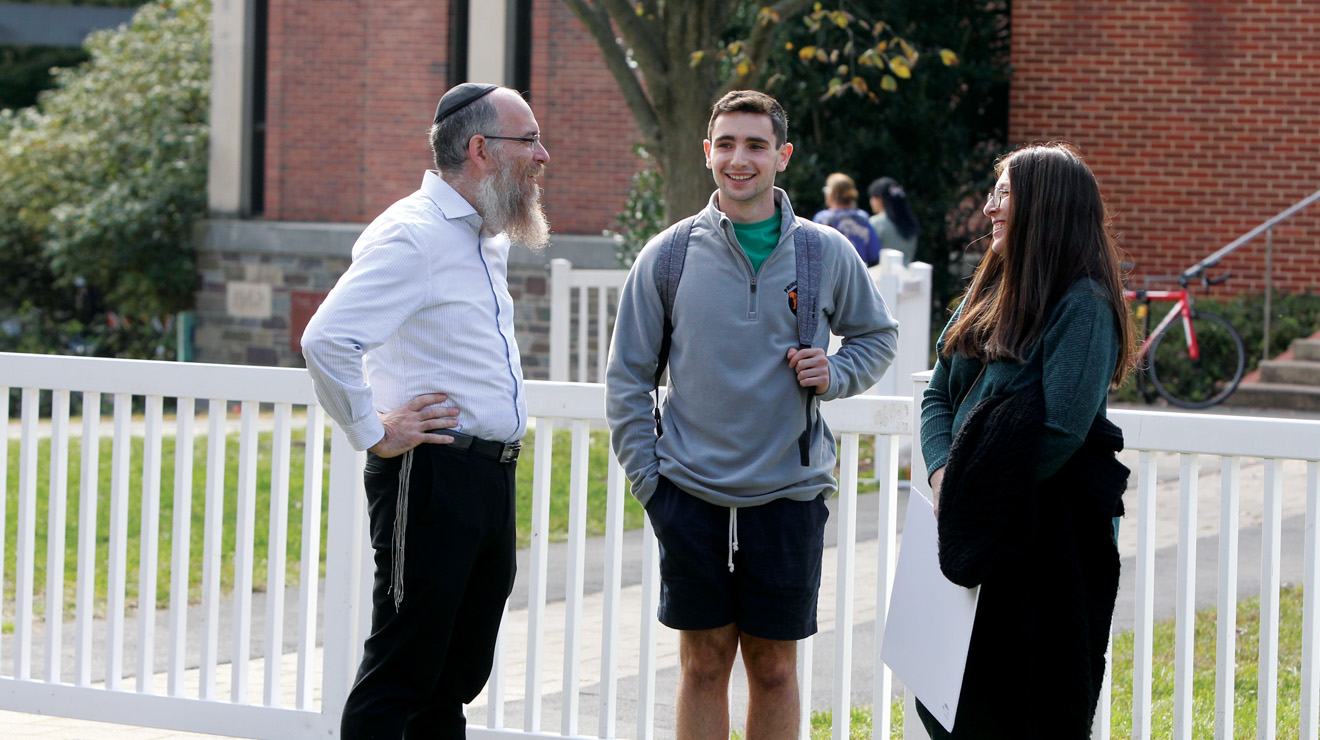
One major avenue of connection is the WhatsApp groups run by Rabbi Eitan Webb, Jewish chaplain and co-founder of the Chabad House. As opposed to the pluralistic CJL, which falls under the Hillel International umbrella and has roots on campus dating to 1947, Chabad was established at Princeton in 2002 and is part of the Chabad-Lubavitch wing, a Hasidic movement within Orthodox Judaism.
In the days after Oct. 7, Webb and his wife, Gitty, Chabad’s program director, were walking along a beach in Florida when they agreed they had to do something. They decided to expand a group chat they had created for around 30 alumni who lived in Israel to include anyone interested. Within a day, the group Princetonians for Israel had about 350 members; at its peak, it had around 800. The chat now has about 600 members and generates roughly 20 to 30 posts a day, according to Webb.
The original purpose of the chat was to share information, but Webb says people soon started sharing needs and offering resources. Michael Bayme ’85 says that his sons in the Israeli army were short on materials and received offers of help from many “very generous” alumni.
Others who were newly embracing or deepening their relationship with Judaism had basic questions about Israel. Then came the political opinions. Soon, the volume of posts became impossible to keep up with.
Webb says he’s “not a big moderator guy,” but some people “can hog the microphone, and you have to figure out how to operate it in a way that people are able to hear everybody.” At times, he temporarily shut down the chat. Eventually, he instituted a strict three-posts-per-day limit per person and introduced sub-chats, with groups for advocacy, philanthropy, understanding the war, news, and other topics.
Sometimes when the chatter gets loud — less of a problem these days — Webb posts about a Jewish holiday or value to help re-center the conversation.
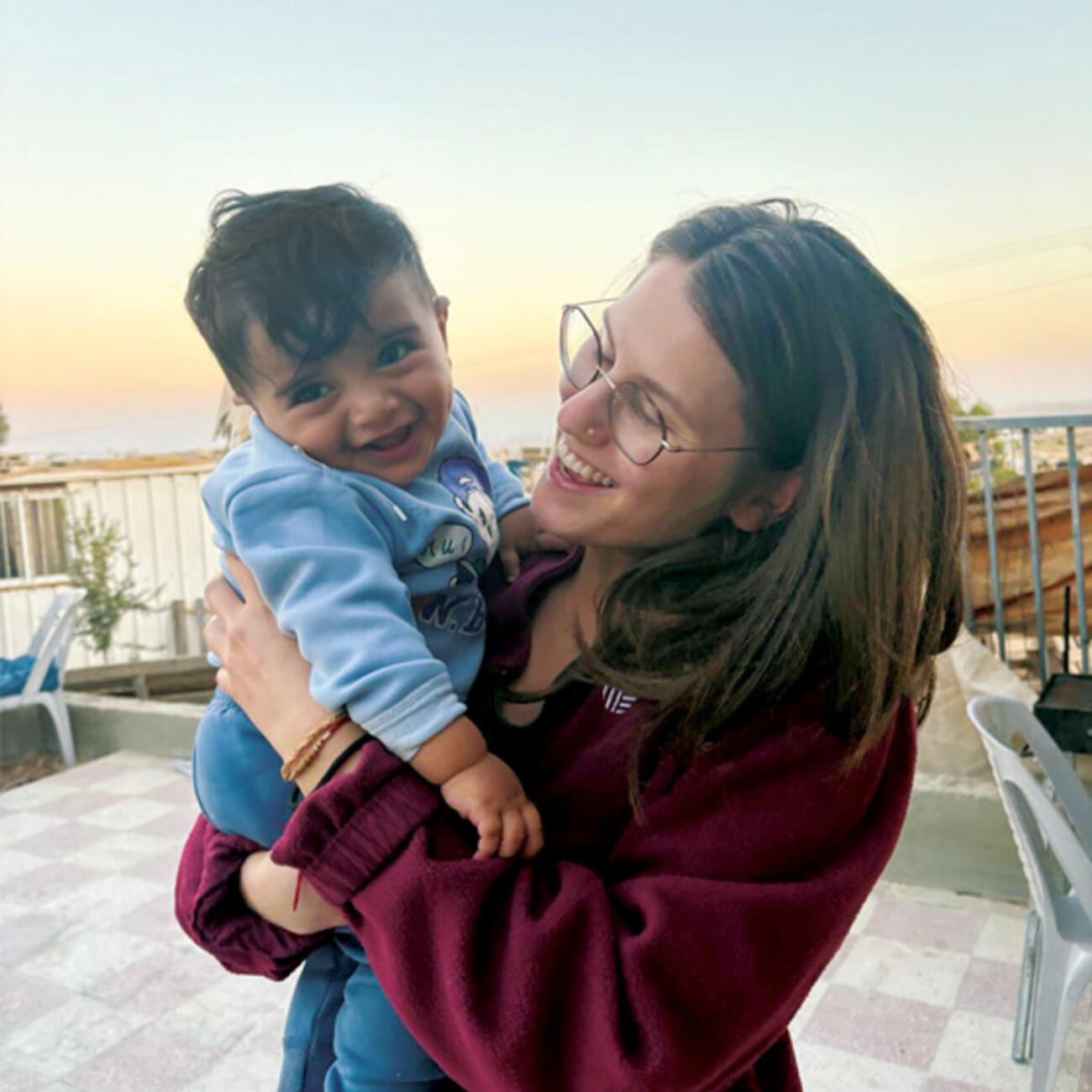
Emanuelle Sippy ’25 says tension within the Princeton Jewish community has also crossed lines.
A former president of AJP, she was a vocal participant in the pro-Palestinian protests on campus in 2023 and 2024. Sippy says she was grieving after Oct. 7 but felt alienated when the CJL put up Israeli flags, which she viewed as a sign of support for Israel’s military action in Gaza.
After participating in pro-Palestinian protests, she says, she received hate mail, including “one email in particular that stands out to me to this day — from a person who identified themselves as a parent of a CJL student, my peer, saying that I should not be allowed in the CJL.”
She says she felt uncomfortable and unwelcome at the CJL, but as a practicing Jew, she continued to attend so she could pray and participate in services. She says she wasn’t the only one to feel this way, and that some people stepped back from Jewish communities on campus as a result.
Sippy felt more at home in interfaith spaces, like the Religious Life Council, which she co-convened one year. “I think that there’s not a ton of interfaith stuff happening on Princeton’s campus, but where it is happening, in my view, it’s with quite a bit of depth,” she says.
These spaces tend to move at a slower pace, according to Sippy. “We spent days listening to each other, sitting in silence, learning about each other. There was not a posture of, like, ‘Now I’m going to speak for the Jewish people,’ but a posture of, like, ‘Hi, my name’s Emanuelle, and this is my story.’”
Sippy spent the past year primarily in the West Bank working with nongovernmental organizations such as Solidarity of Nations, which forms partnerships between Palestinians and Israelis, and remains as passionate as ever. She tells PAW she agreed to an interview primarily to try to bring attention to the “urgent and pressing” and “worsening and worsening” situation in Gaza and the West Bank.
Related coverage
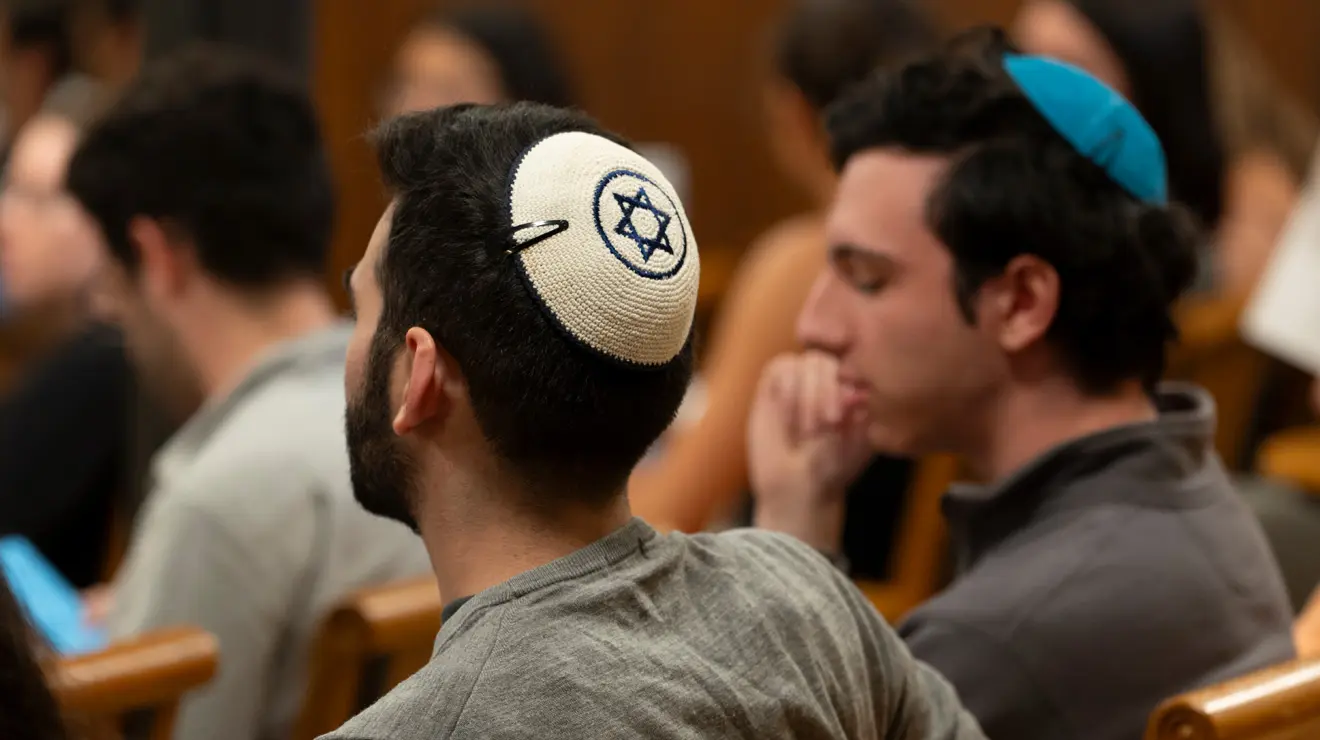
Behind the Story: Reporting on Princeton After Oct. 7
Carra Glatt ’09 says she doesn’t feel as welcome at Princeton or in higher education in America since Oct. 7. A senior lecturer of English at Bar-Ilan University who moved to Israel nine years ago, she says that she and some of her Jewish American expat colleagues have been so discouraged by pro-Palestinian activism across American college campuses over the past few years that “there are periods where there are bombs falling [near her in Israel], there are sirens, and we’re like, ‘Oh my God, I’m so glad I’m not teaching in America right now,’” she says.
Glatt says she has directed her philanthropy to Princeton’s Jewish life programs rather than Annual Giving since being disappointed by the University’s response to pro-Palestinian protests.
On the other hand, Jake Brzowsky ’21, a manager of community research at the United Jewish Appeal-Federation of New York who spoke to PAW in a personal capacity, says that “Princeton’s administration does strongly support the Jewish community on campus” while also balancing competing interests.
Tensions flared again this year when it was revealed that the spring 2026 course catalog included a gender and sexuality studies and anthropology class by visiting professor Nadera Shalhoub-Kevorkian, a feminist scholar who studies Palestine, called Gender, Reproduction, and Genocide, “with a central focus on the ongoing genocide in Gaza.”
Dror Futter ’86, senior presidential counsel at Touro University, a private Jewish institution in New York, says Princeton moved beyond academic inquiry in offering the course. “If Princeton had had a course saying, ‘Did Israel commit genocide in Gaza?’ to be honest, I would not have been thrilled, right? But I understand why that falls within the rubric of academic freedom. This course took [genocide] as an established fact.”
The Association of Jewish Princeton Alumni (AJPA) was in the works before Oct. 7, with planning meetings held over Zoom after Alumni Day in February 2023. But according to the AJPA website, the attack “was a wake-up call for many of us about the importance of deepening our ties within the worldwide Jewish community, celebrating our Judaism together, and sharing this light with the world around us.”
AJPA officially launched in May 2024, and the first AJPA Class Notes column in the January 2025 issue of PAW reported that “the AJPA community has already grown to almost 700 strong.” AJPA President Jason Gold ’81 says there are now about 1,000 people on the mailing list.
According to Gold, there was initially friction over whether the group would be political in nature or focused solely on community-building. Some left the group over the issue, but those who remained reached a consensus: “We don’t promote a specific perspective on [the war] or advocate a specific viewpoint because we represent an extremely diverse constituency, diverse along many different lines” of politics and viewpoints, Gold says.
Others have ended arguments with Gold, but not often: “One of the amazing things about the Princeton community is that I have conversations all the time, real conversations with people with whom I disagree, and rarely does somebody say, ‘Well, that’s your opinion,’ and walk away.”
Still, Sippy says she has no interest in joining the AJPA: “The same people who send me hate mail are going to hand me a glass of wine at an alumni event.”
As an example of Princeton’s commitment to difficult conversations, Gold points to the Affinity Roundtable, a monthly meeting of the presidents of all alumni affinity groups. “Stuff gets revealed and stuff gets hashed out, but mostly it’s about supporting one another to be better affinity groups,” he says.
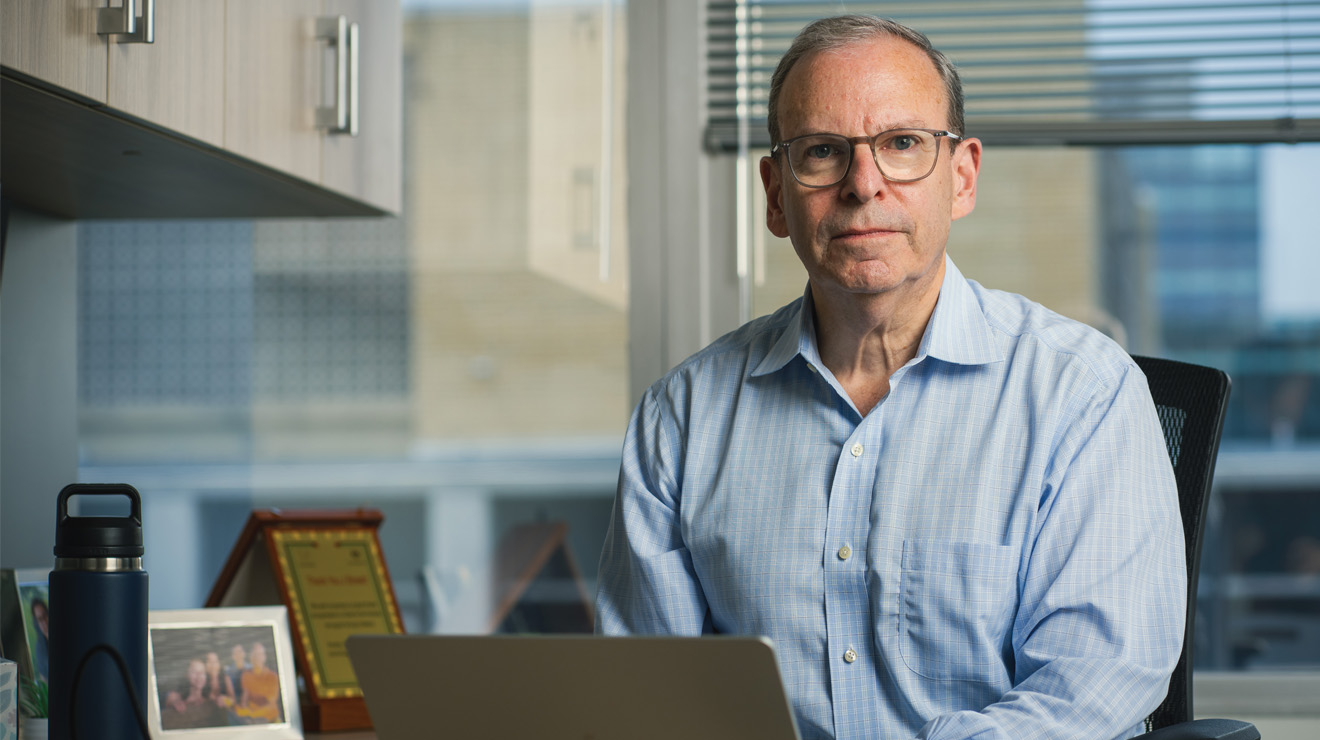
Jeremy Ben-Ami ’84 has experienced how heated conversations can get outside the Princeton bubble in his role as founder and president of J Street, a pro-Israel, pro-peace advocacy and lobby group.
He has been engaged in Jewish issues for decades. He knew several people who were killed on and after Oct. 7. He visited the site of the music festival in Israel that was attacked that day, where the children of some of his friends were killed, and found it “so deeply, deeply moving and so horrible.”
Ben-Ami has been critical of Israel and Prime Minister Benjamin Netanyahu, including calling earlier this year for an end to U.S. military aid to Israel. Israeli ambassador to the U.S. Yechiel Leiter responded by calling J Street a “cancer within the Jewish community.” More than 500 rabbis and other Jewish leaders signed a letter condemning Leiter’s remarks.
“Israel’s representatives should embrace disagreement within our community and recognize that dissent and debate are integral to Jewish tradition,” Ben-Ami says.
He adds: “Whether it is internal to J Street or it’s internal to the Jewish community or it is in the context of American politics, we believe that it is really important to engage with the people one disagrees with.”
He says he has been happy to hear from Jewish Princeton students that despite the contentiousness of the issue, “they don’t go to college to be made comfortable.”
Part of J Street’s goal is to “help both sides to realize that we need to work toward sort of a win-win end of this conflict where both peoples get what they want,” says Ben-Ami.
Halfway across the globe, in Israel, Yadin Kaufmann ’80 recently started an English-language podcast, Unlikely Partners, to initiate conversations among those who are seemingly on opposing sides. Each episode highlights cooperation among “Israelis and Palestinians who are working together … to build a better future,” according to Kaufmann.
Kaufmann has been passionate about this work for years. In 2014, he started the Palestinian Internship Program, which gives Palestinian college graduates opportunities to work in Israel, which has a stronger economy. The program continues today.
“If we want things to be different and we want to prevent future Oct. 7s, we have to try to do things differently, and we have to try to work together and live together,” he says.
Still, the fighting goes on, and things are far from settled in either the Middle East or the U.S.
Princeton, meanwhile, has not become entangled in the federal government’s battles with other universities over allegations of antisemitism. In 2025, Columbia settled with the federal government for $221 million — $200 million to the government, and $21 million to resolve allegations of discrimination against Jewish employees. In August, a federal judge dismissed the Trump administration’s lawsuit accusing Harvard of failing to protect Jewish and Israeli students from harassment. Also, a whistleblower filed a complaint alleging that federal antisemitism investigations of the Ivy League had been predetermined.
At Princeton, at least for now, tensions in and outside of the Jewish community have cooled. Webb says stressors haven’t gone away, “but there’s nothing to itch right now.” And not all Jews care about the war or follow it closely. To some degree, the world’s attention has moved to the Iran war and other geopolitical events, though with Israel’s next election on Oct. 27, the conversation may shift again.
No matter what comes next, Princeton’s Jewish community will attempt to navigate it together. Gold, the AJPA president, says, “Every single person, no matter what their political viewpoint is, is Jewish, is just as Jewish as anyone else. … We really have to value every single member of not just our organization, but our community.”
Julie Bonette is PAW’s writer/assistant editor and a Unitarian Universalist.
Related News
With Prominent Journalists and Hoagies, the ‘Prince’ Celebrates 150 Years
A gala at the New York Historical raised roughly $400,000 for the independent student newspaper

3 Responses
Donald R. Kirsch *78
2 Weeks AgoA View of the Situation at Columbia
I am pleased that Princeton was spared fines and allegations of antisemitism by our government.
Until early this year I was an adjunct lecturer at Columbia. I thought that Columbia managed Oct. 7-related issues of freedom of speech and respectful treatment of community members in an evenhanded fashion.
There was a pro-Palestinian “Gaza Solidarity Encampment” on the Columbia campus and much pro-Palestinian chanting. On the other hand, a student who posted “Zionists don’t deserve to live” was barred from campus, and New York City police were called in to arrest students who occupied Hamilton Hall (where I taught) and who took over a reading room in Butler Library. (Despite these things, Columbia University paid $221 million to the Trump administration to resolve investigations into campus antisemitism.)
I worked on campus and never experienced antisemitism. As the article states, “a whistleblower filed a complaint alleging that federal antisemitism investigations of the Ivy League had been predetermined.” This is the way it looked to me at Columbia.
Leanne Tobias *78
2 Weeks AgoRespectful and Contemplative Coverage
Thank you for PAW’s October 2026 cover story on the Jewish community at Princeton since October 7.
No easy answers and many perspectives — which is appropriate in the circumstances. I appreciate the respectful and contemplative tone of the piece, as well as the fact that it was published as PAW’s cover story. That PAW chose to report on Princeton’s Jewish community in depth is notable and speaks to the absence of such coverage elsewhere.
On a personal note, many of the themes explored in PAW’s reporting resonate with me. Since October 7, I have become more interested in the Jewish community, have forged closer ties with other Jews, and have grappled with my support for Israel in the face of my unhappiness with the Netanyahu government’s actions in Gaza and on the West Bank. I’ve taken the following position: I oppose the Netanyahu government, but continue to support Israel’s existence as a Jewish state and the pursuit of a peaceful two-state solution.
Harold Scott Gurvey ’73
1 Week AgoChallenging Times for Jewish People Worldwide
I appreciate PAW’s presentation of a thoughtful article on the challenges faced by Jewish members of the University community in the wake of the horrific attack in Israel on Oct. 7, 2023. These challenges are felt not only on campus, but wherever Jewish people live in the nation and the world. I am not sure however that a challah with a reference to the twists of its braids is an appropriate image for this story. Nor do I understand the University’s position on this subject. It did reject the ridiculous petition to divest from companies with ties to Israel, but at the same time it offered GSS 245, a strange course titled “Gender, Reproduction, and Genocide” with a description beginning, “This seminar explores genocide through the analytic of gender, with a central focus on the ongoing genocide in Gaza.” This is offensive on many levels.