
Princeton SPIA Event Dissects New Polling Data on Palestinian Attitudes
Dean Amaney Jamal, co-founder and co-principal investigator of the Arab Barometer, called the results ‘unsurprising’


At a moment of deep uncertainty across the Middle East, panelists at a March 31 event at the Princeton School of Public and International Affairs (SPIA) center in Washington, D.C., released new public opinion polling suggesting that the war in Gaza has reshaped Palestinian political attitudes, trust in leadership, and broader regional dynamics.
The discussion, hosted in partnership with the Arab Barometer, the Center for Political Studies at the University of Michigan, and New Lines Institute, focused on Palestinian survey data collected in 2025 and examined changes to security, competition, and escalating conflict across the Middle East and North Africa region.
The Arab Barometer has been surveying public opinion since 2006, and the most recent edition of its survey, Wave IX, collected data from the West Bank and Gaza in the immediate aftermath of the October 2025 ceasefire.
Khalil Shikaki, director of the Palestinian Center for Policy and Survey Research and co-founder of the Arab Barometer, highlighted Palestinians’ increased trust in Hamas (17% in 2023-24 to 24% in 2025-26) and decreased trust in the Palestinian Authority, or Fatah (30% to 18%), as well as an overall increase in public interest in politics (29% to 39%) from Wave VIII to IX. While Gazans are angry at Hamas, those in the West Bank are less so, Shikaki said.
SPIA Dean Amaney Jamal, co-founder and co-principal investigator of the Arab Barometer, called the results “unsurprising,” referencing what the Palestinians have endured in the past four years and beyond, and the lack of viable alternatives.
“They’re currently very underwhelmed by the Palestinian Authority as a representative government, and the fact that the only alternative that they still sort of have some trust and faith in is Hamas does pose a paradox in terms of this issue of internal Palestinian governance moving forward,” she said.
The panelists pointed toward this broader crisis of governance and the uncertainty of how a governing body would move forward to represent the Palestinian people.
Overall, Palestinians preferred a two-state solution, with 1967 borders (support increased from 51% in Wave VIII to 59% in Wave IX) over other proposed alternatives that saw decreasing preferences, including a one-state solution (which dropped from 10% to 6%) or a confederation (from 12% to 7%). Those in the West Bank overwhelmingly opposed the normalization of relations between the Arab states and Israel (94% oppose, 5% support), while those in the Gaza Strip also were largely opposed (81%, 18%).
Support for Arab-Israeli normalization if Israel recognizes Palestine with 1967 borders and East Jerusalem as its capital was higher, with 37% supporting and 61% opposing.
“If you’re a Palestinian, the choice between what you’re experiencing today and having a state is not even close,” said Robert Malley, senior fellow at the Yale Jackson School of Global Affairs and former U.S. special envoy to Iran. Yet panelists acknowledged that political and geographical realities make that possibility unlikely.
Beyond Palestinian politics, the data pointed to a broader regional shift in attitudes toward global powers. A third or fewer Palestinians expressed a positive view of the United States, while considerably more showed support for China, Russia, and Iran.
Shikaki said that though Iran poses a threat to the region, the fear of Israel is larger.
“If we take Iran’s commitment to the Palestinians or the Israelis during this conflict, we see that in all cases, basically, Iran is widely seen as siding with the Palestinians,” said Michael Robbins, director and co-principal investigator of the Arab Barometer.
For panelists, the data underscored two key points: Public opinion is shaped by what is happening on the ground, and political perceptions across the region remain in flux.
The Latest
See all


Related News


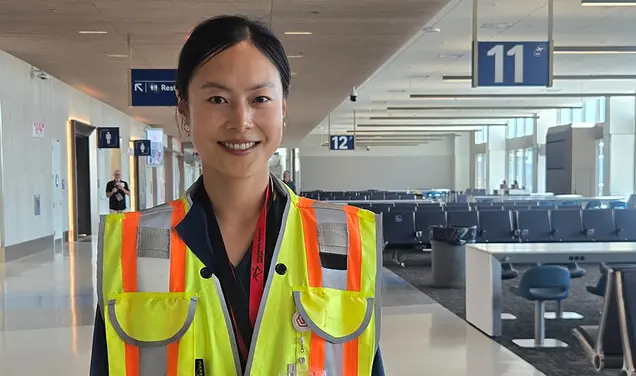
Janice Lee ’09 Worked to Renovate One of Hollywood’s Best-Kept Secrets
An engineer by training, Lee has been deputy project manager on the renovation of Hollywood Burbank Airport

1 Response
Seth Akabas ’78
4 Months AgoDisappointing Polling Results
Sadly shown is that, even if Israel retreated to armistice lines from almost 60 years ago and from half of its capital city, an indigenous Jewish city and capital millennia ago, then, even after such concessions, a strong majority of the Palestinian Arabic community (61%) would still oppose recognition of Israel. Especially disappointing given those concessions (and more) were available a century ago, 78 years ago, even half-century, but universally rejected by a vocal majority’s centuries-long refusal to accept any Jewish people there, and now they’re impossible.
Also disappointing: The study’s report indicated no question was asked regarding realistic settlements — each sides’ accepting current boundaries, maintaining a democratically elected government as the only authorized armed forces, and robustly preventing incursions from its side.
Also, people living in Gaza appear significantly more inclined to accommodate than people not on the “front lines.” This disparity appears often in wars and is certainly seen with segments of the “pro-Palestinian” movement abroad, where many advocate elimination of Israel, “from the river to the sea,” “by any means necessary”; none of them suffers directly from the inevitable horrific casualties that result from that sort of armed confrontation, deeply embedded among civilians, that Hamas is perpetrating on Israel. A different truly “pro” position might be supporting Palestinian accommodation and rejection of Hamas.
All is troubling with magnification of hatred against the tiny Jewish minority (0.01%) left surviving three millennia of a large portion of the world’s hating, and almost 1.5 millennia of a large portion of the Islamic people’s hating, on them.