
25 Years In, Josh Marshall ’91 Is Still Going Strong at Talking Points Memo
Marshall says there are reasons why the inside-politics website survived while its competitors faded
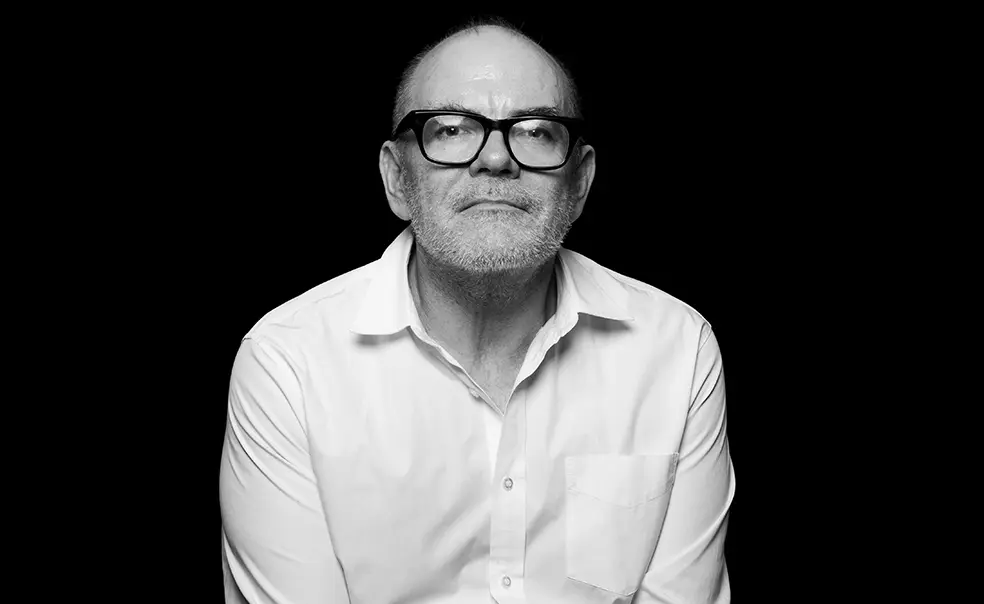

Josh Marshall ’91 isn’t surprised that Talking Points Memo, the political news and analysis website he started as a one-man blog back in 2000, is still standing — even as the journalism industry is littered with the carcasses of digital-first sites that launched around the same time as his.
Most of those publications, even the ones that reached astronomic heights (think: Buzzfeed News, The Huffington Post, Vice, Grantland, the Gawker empire), have since closed up shop, or are limping along as mere shadows of their former selves.
TPM, however, hasn’t just survived. It continues driving conversation in progressive circles, breaking news, and often outpacing long-established (and better funded) news organizations.
“It was really [bleeping] hard,” Marshall says, “but we were able to do it.”
A lot of TPM’s success can be chalked up just to the fact that it didn’t make the same mistakes as so many of its peers.
The first is that TPM remained independent. When money came sniffing around digital startups in the late 2000s and early 2010s, in the form of venture capital and corporate acquisitions, Marshall chose not to bite.
“Part me wanted TPM to become huge,” he says, sharing that he did meet with investors. “But I was able to figure out pretty quickly there were lots of ways I could lose control of the company.” Which is, of course, what later doomed his peers, when the economics their new partners were expecting failed to pan out.
Second, Marshall never made TPM dependent on social media. In the 2010s, publications old and new placed big bets on sites like (then) Twitter and Facebook, believing that engagement there would drive traffic back to their own properties.
But the tech companies, which did initially work on luring the news media into populating their platforms with engaging content, kept tweaking their designs and algorithms to keep audiences inside their own apps, rather than sending them to the news sites.
“We didn’t have tons of money,” Marshall says, explaining why TPM didn’t invest in that strategy. “When all that wreckage happened, it never really affected us.”
Lastly, staying small also meant that Marshall, by necessity, had to keep his ear close to the ground on the business side. “Legacy institutions can survive failing for decades. They have immense inertial mass,” he explains. “But if you’re small and independent, you need to remain hyper-aware of what’s going on … because you’re going to be the first one to sink.”
Thus, Marshall sensed long before his peers that the digital advertising so many depended on would eventually crater. He began feverishly working on a membership strategy, hoping it would come to fruition fast enough to replace the fading ad revenue.
Today, 91% of TPM’s income comes from members. “Subscriptions saved us,” Marshall says of the 35,000 readers who pay between $52.50 and $105 annually. “That’s why we still exist.”
The dedication of those readers is the result of TPM’s constantly triangulating on the editorial side — figuring out what they could offer political junkies that isn’t available anywhere else.
“It’s always been important to me for us, as an organization, to remain in an upstart, outsider mode,” Marshall says. “Changing with what the moment demands has allowed us to survive.”
In the 2000s, most political reporting at mainstream news organizations still operated on the 20th century model. Reporters wrote a single story at the end of the day, which would be printed in the next day’s (physical) paper. Marshall, on the other hand, dove into the real-time world of the (still new) Internet, keeping readers hooked by whipping out nuggets as they happened. (It’s hard to remember that was once a shockingly novel idea.)
In the mid-2010s, once legacy media had caught on to the new rhythm, TPM shifted gears, investing more in “explainers” that laid out the significance of what was happening.
“We just kept innovating, coming up with new ways of doing things,” Marshall says.
Marshall’s winning intuitions probably benefitted from the fact that he hadn’t come up through traditional journalism. His sense of possibility was never limited by conventional notions about “the right way” to cover politics.
A history major at Princeton, Marshall went on to Brown for a Ph.D., while running a business designing websites and writing online about internet law. In the late ’90s, he began working for The American Prospect, but parted ways due to clashing editorial perspectives.
Marshall started his own blog during the 2000 Florida recount and gained a following for his brash and engaging, as well as thoughtful and perceptive, writing. “I came in with things I wanted to talk about,” he says, “and I was looking for a format that worked for me.”
TPM, which today employs about a dozen staffers, has always approached politics with an unapologetically tabloid sensibility. “We like headlines that kind of knock you in the face. We like being over the top,” Marshall says. “That’s not inconsistent with doing really good journalism.”
Because digital-first news neither looked, nor operated, like traditional journalism, the mainstream media long failed to appreciate its significance. Even in 2008, after TPM won one of journalism’s highest honors, the George Polk Award, for breaking a scandal in the George W. Bush administration, a New York Times headline still referred to Marshall, then being recognized as one of the country’s top investigative reporters, as a “blogger sans pajamas.”
But again, unconstrained by traditional notions of what to cover, Marshall and his staff picked up on the rise of the far right — and its merging with mainstream conservatism — more than a decade before traditional journalism clocked the enormity of the phenomenon.
As a result, TPM recognized early on how candidate Donald Trump was connecting with Republican voters. Marshall even predicted in 2015, at a time when traditional news organizations were still treating Trump as an unserious novelty, that he would become the GOP nominee.
Writing in The American Prospect in 2024, historian Rick Pearlstein observed that TPM’s editorial instincts on the mainstreaming of extremism “could have become a model for the rest of the news media.” It didn’t, of course, and Pearlstein laid a big chunk of responsibility for the unprecedented challenges American democracy is facing today at the door of “the failings of elite political journalism.”
Today, Marshall is excited about the trend of small groups of journalists banding together and creating new businesses on their own, such as Puck, The Bulwark, Bolts magazine, and The Downballot.
“Those are never going to replace legacy media,” he says, “but I think we’re moving into a future where there will be a lot of these smallish organizations that are important parts of the political conversation.”
Like TPM?
“Yeah, they look a little like us,” he says. “It’s basically the first time in our history that there are a number of publications that are at least kind of like us in structure, scale, and reach.”
The Latest
See all


Related News
With Prominent Journalists and Hoagies, the ‘Prince’ Celebrates 150 Years
A gala at the New York Historical raised roughly $400,000 for the independent student newspaper


No responses yet