

As Princeton Adds Undergrads, Students Say Tutoring Is Not Keeping Pace
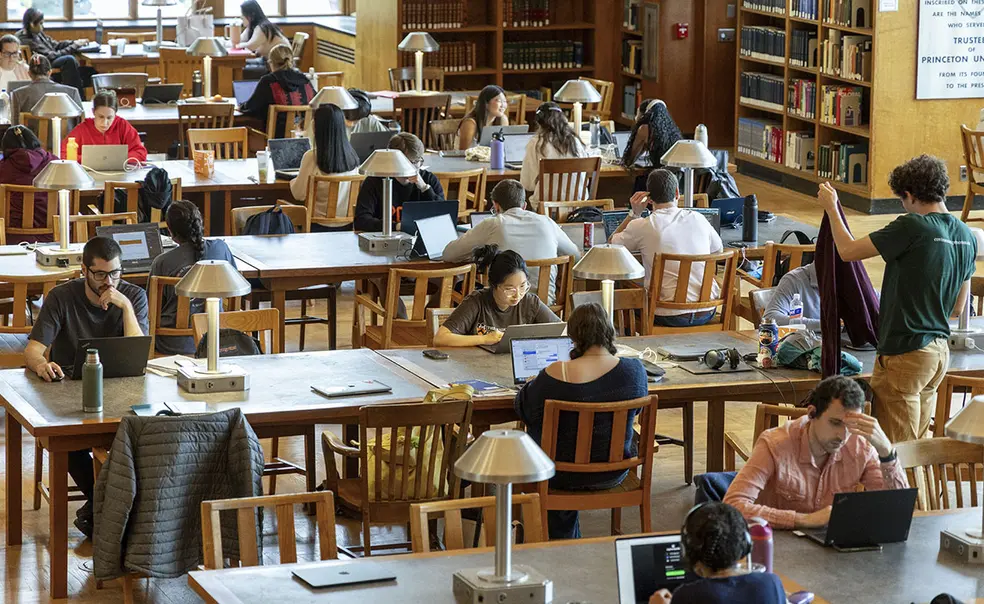

The arrival of Princeton’s Class of 2029 completed a four-year expansion of the undergraduate student body, ushering in 1,408 new undergraduates and raising the total number to 5,825 — an 11% increase from the 5,240 undergrads on campus at the start of 2021-22. At the same time, the University is currently juggling budget cuts of 5% to 10% for each department. While the number of students has increased, the resources at the Writing Center and the McGraw Center for Teaching and Learning have not kept pace. This year, they’ve decreased.
The University’s Office of Communications told PAW that in the last six months, the McGraw Center hired fewer new students than it did in a typical year, resulting in four fewer academic life and learning consultants than last year (when there were 20). It also hired one, rather than two, full-time learning fellows. The number of tutoring hires was almost identical to the previous year.
Students who spoke with PAW described their experiences seeking academic help and encountering limits to the tutoring resources available.
Luanna Huang ’29 said she repeatedly had trouble getting help from the McGraw Center, particularly for introductory courses, which are often required for students wishing to pursue certain majors. When she was able to schedule a tutor, she said, “The girl that was supposed to tutor me was sick that day, but I couldn’t find any other available time slots and I had a quiz in two days.” The tutor did not attempt to refer her to another tutor despite the McGraw Center’s typical procedure of finding a replacement in the same time slot.
At the Writing Center, Ethan Gotthold ’29 tried to get help during reading week and found all the slots filled so instead, he signed up to be notified whenever a slot opened up. It took him four tries before he was able to secure an appointment. On the bright side, when Gotthold was able to make his appointment, “The tutors were very helpful.”
This influx of students without matching tutoring hires has also placed strain on the existing tutors, who earn about $19 an hour. Wendy Wang ’28, a Writing Center fellow, told PAW that her schedule for tutoring is often booked, especially before major writing seminar deadlines. “Sometimes, when everyone’s fully booked, our manager will also send an email saying, ‘If you have some extra time, we would really appreciate you offering some extra hours,’” Wang said, listing the times when those emails are most likely to arrive: before midterms, before reading period, during reading period, and during finals week.
Issues with tutoring sometimes go beyond scheduling. Joe Sherrod ’28 has been working at the Scholars Institute Fellows Program math table since fall, a lesser known resource created for low-income and first-generation students. He told PAW that McGraw Center tutors often don’t know how to explain content to those who have no experience with it, which tends to be those from more marginalized backgrounds who may not have had access to the same educational resources.
“I’ve noticed a very strong difference in effect in terms of how [the McGraw Center] tutoring impacts first-gen low-income students,” Sherrod said, “compared to how it has affected other people in my life, especially freshmen who are using those services who aren’t first-gen low-income.”
To ensure that students have the resources they need to succeed, Sherrod said he would like to see more tutors from low-income and first-generation backgrounds, as well as more comprehensive training to allow them to handle students of all experience levels.
The Latest
See all


Related News

Janice Lee ’09 Worked to Renovate One of Hollywood’s Best-Kept Secrets
An engineer by training, Lee has been deputy project manager on the renovation of Hollywood Burbank Airport


No responses yet