

Connor Martin ’13 Debuts a Thrilling Espionage Novel


The Book: A fast-paced, propulsive espionage novel, The Silver Fish (The Mysterious Press) follows American journalist Danielle “Dani” Moreau as she travels to Ghana to investigate corruption in the local oil industry, only to discover a far more dangerous global conflict. As Dani becomes entangled with a Ghanaian political family, a shady American operative, and a web of double agents, she is drawn into a high-stakes struggle between the United States and China over the control of undersea fiber optic cables — the hidden infrastructure powering the modern world at the speed of light. Moving across crowded markets, ports, and dense jungle terrain, the narrative unfolds through sharp twists and mounting tension as Dani and her crew must make decisions with deadly consequences. Ultimately, the novel reveals how the pursuit of truth can entangle individuals in forces far larger — and more dangerous — than they ever imagined.
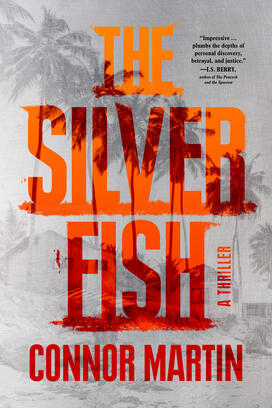
The author: Connor Martin ’13 is an author and former senior U.S. national security official who most recently served as deputy director of the Committee on Foreign Investment in the United States at the Treasury Department. He is also a term member of the Council on Foreign Relations and divides his time between Washington D.C. and Brooklyn. The Silver Fish is his debut novel.
Excerpt:
Prologue
He wasn’t supposed to be here.
An hour passed before they found the body. Billy Demirjian should have been long gone. Instead, he was across the road, watching through the railing on the second floor of the neighboring building.
Traffic buzzed by in both directions. Coach buses, tro-tros, mopeds beeping past hand-pulled carts. Billy crouched low, hidden in shadow, with a good view to the car where a Nigerian telecom executive named David Ibrahim lay dead in the front seat. The sky was hazy, reddened by the harmattan winds. Billy waited, motionless. The wind coated Ibrahim’s car with a thin layer of dust the color and consistency of cinnamon.
Then people began to yell. A sudden crowd congregated around the car — men pushing to the front, scolding each other excitedly, banging on the hood and the windows with the flats of their hands. The door was wrenched open; the dead man pulled from the passenger seat. He was big. They could only get him halfway before he slipped from their grip and his torso flopped onto the pavement.
Billy felt empty. Shocked. It wasn’t the killing: during his three tours of active duty, he had been personally responsible for removing four people from this life, that he knew of. It was the killing like this. Up close and intimate. With his hands. In the quiet of a parked car, twenty feet away from where ordinary people were walking down the street.
This had started three days ago, when his case officer had sent him a signal for the first time in months. Billy had been visiting the same café he was required to report to every morning for exactly this purpose. He’d taken a bite of his bread roll and was stirring powdered milk into his Nescafe when the vendor had said, behind his back, “Did you hear? A ship sunk in the harbor last night.”
Billy had turned around slowly. “Run aground?” he asked.
“Capsized.” The vendor’s face was stenciled with a lifetime of poverty. He shook his head, convincingly rueful. “Bad weather.”
By these codes, Billy knew which drop spot to check for his orders. When he did, he couldn’t believe what he was seeing. David Ibrahim was a big deal in West Africa’s telecom industry. He imported millions of dollars’ worth of the equipment that made cell phone networks functional and kept the internet online in Ghana, Nigeria, and Senegal. And according to the paper Billy held in his hands, he was being run by Chinese intelligence. Targeting somebody like this was a major escalation. But it wasn’t Billy’s job to question. He was the sharp end of the stick, and the protocol was clear.
Do it quick, do it clean, and be gone.
Last night, his case officer, a man who went by the name of Ford, had met with him to review the plan. Follow the target to his girlfriend’s house, where he spends an hour every Tuesday and Thursday after work. Slip into his car while he’s inside. Hide in the back seat. After an hour, the target will get back in the car and close the door. He’s thinking about going home to his wife, he’s rehearsing answers to her questions. He’s freshly showered, as he always is at this hour.
“And then you do it,” Ford had said. “Knock him out, no drama. In his pocket there will be two cell phones. They never leave his side. You secure them, and you bring them to me.”
Quick, clean, gone.
After Ford had left, Billy had stayed awake until dawn, turning the orders over in his hand. The manila envelope had contained two sheets of paper, with information on Ibrahim corroborated by a double agent, who was pretending to work for the Chinese while funneling information to the United States. There was something touching and insubstantial about this packet. He wondered whose soft hands had pressed down the stapler, in what hushed office. The small, precise motion — as conclusive, as violent as anything that Billy would do afterward.
The instant Ibrahim had shut the door to his car, Billy had hinged upward from the floor of the back seat where he’d been hiding and in the same motion grabbed Ibrahim’s throat from behind and pulled it against the headrest. Ibrahim was a big man. But when you surprise someone there’s nothing they can do. Their hands fly to their throat. They don’t even realize yet what’s happened — only that something is wrong with their body, very wrong, which they are desperately trying to fix. Soon enough the lack of oxygen causes them to pass out.
But that was when the plan had stopped working. Ibrahim had continued to struggle, his large hands grabbing blindly at Billy’s face, scratching, pulling, twisting. A finger dug into Billy’s eye. Reaching across the steering wheel Ibrahim managed to pop open the glove compartment, and a long knife fell out of it onto the passenger seat. Billy could feel that this man was still strong, still dangerous. He was fighting for his life.
And then something happened inside Billy that had never happened before. A blank white space opened up. A sensation of falling.
Suddenly he was leaning over the front seat, and the knife was in his hand, and with a burst of energy he was stabbing Ibrahim through the neck and ribs again and again and again and again and again. He heard shouting — heard himself screaming the names of Ibrahim’s wife and children and cursing them and promising that before today was over he was going to kill them all too.
Finally the man died.
In the abrupt silence, Billy’s panting had filled the car. He had looked down at his dark T-shirt, slick with gristle. Startled, he threw himself to the floor of the back seat, away from the glare of the daylight that was now pouring through the car’s windows on all sides. The silence rang like a bell. He felt watched, as though by an audience that refused to applaud. He felt, in a strange way, humiliated.
Be gone, the protocol said. Ditch your clothes and your weapon, now. Resume your cover identity and await your next order, as though nothing has happened.
Prepare to wait a long time.
But when the body was finally found an hour later, Billy was still there, crouching on the second floor of the deserted laundromat across the street, frozen, Ibrahim’s bloody phones in his pocket.
Everything had happened just like the intelligence had indicated. Which meant they were now in business with an honest-to-god double. As he watched the growing commotion, watched as the world discovered what his hands had done, Billy thought about this Double. What would he think of the scene inside the car?
Of course Billy had never met the Double. Intelligence wasn’t his job; if anything, he was the last to receive it. Only Ford saw the whole picture. It is the case officer who approaches somebody like Ibrahim. Say they learn that the target likes to play golf on Saturday mornings. They show up the next weekend with a terrible swing. Shank one shot after another, until the target takes pity and comes over to give him some pointers. Maybe the target and the case officer shake hands. The next Saturday, maybe they go for coffee afterwards and talk about their wives. The officer makes sure his golf swing doesn’t improve too quickly.
It doesn’t always end in violence. More often, the case officer will try to turn the target — bring him on the payroll. When that fails, somebody like Billy gets the call.
And when Billy fails?
Because that was what was bleeding all over the car seat: Billy’s failure. Nobodyhad told him to murder David Ibrahim. He had lost control and disobeyed orders.
He was sure there would be blowback. Billy wasn’t dumb, no matter what Ford and people like Ford thought of him. In the 48 hours that he had tailed David Ibrahim prior to killing him, he had observed plenty. At least once a day, Ibrahim had passed in and out of the offices of a Chinese-owned shipping company called Dongsha, near Madina Market in the city center. He had worked out at a public gym by the beach.
Pull-ups, push-ups, sit-ups by the hundreds. And he had liked to dress stylishly, expensively — especially on the days he visited his girlfriend. On the afternoon he was killed, Ibrahim was wearing a pair of pressed chino trousers that stopped well short of his ankles, and a green satin coat with wide lapels, like a smoking jacket. On his feet were immaculate white Adidas trainers. As Billy watched the crowd haul him out of the car, his open throat flapping, a little boy, whom nobody knew, pulled off one of the trainers and ran away with it, evading outstretched hands.
Excerpted from The Silver Fish by Connor Martin. Copyright © 2026 and published by The Mysterious Press.
Reviews:
"What an impressive debut. Set in the teeming streets of Ghana, Martin's intricate tale plumbs the depths of personal discovery, betrayal, and justice. Colorful characters, a gritty setting, high international stakes, and a healthy dose of deception — what more could one ask for in a spy novel? From the first page to the shocking ending, Martin's twists and turns through today's complex geopolitical landscape deliver in spades." – I.S. Berry, author of The Peacock and the Sparrow
"A young American journalist’s curiosity about millions missing from an offshore Ghanaian oil transaction leads her down a dangerous path uncovering official corruption and a series of murders at the hands of Chinese and American spies. The Silver Fish, Connor Martin’s debut novel, has a twisting and turning plot that plunges the reader into high stakes international intrigue played out in tropical West Africa." – Paul Vidich, author of The Poet’s Game
The Latest
See all


Related News

With Prominent Journalists and Hoagies, the ‘Prince’ Celebrates 150 Years
A gala at the New York Historical raised roughly $400,000 for the independent student newspaper



No responses yet