

O.O. Sangoyomi '23 Writes YA Debut Dark Academia Inspired by Time at Princeton


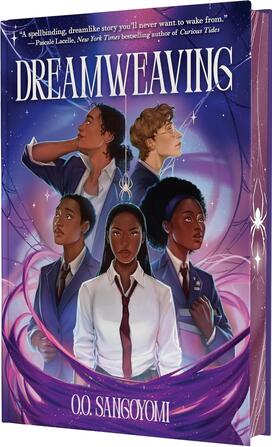
The Book: Dreamweaving (Page Street YA), O.O. Sangoyomi ’23’s second novel, takes readers to the prestigious Tanglewood Preparatory School, where two students find themselves drawn into a mystery reaching deep into the school’s history. Deja Freeman, descended from a long line of witches, was deliberately kept outside the family’s magical tradition after her mother’s untimely death. Tóbi Ẹkúndayọ̀, a driven, straight-A student determined to become junior class president, seems to have little in common with Deja. But suddenly, both girls begin to experience the same unsettling dreams. When one of Tanglewood’s top students disappears, the dreams point Deja and Tóbi toward a concealed history involving magic, murder, and secrets the school would rather keep buried. Together, with an unlikely team of friends, the girls must piece together the mystery before they become its next victims.
The Author: O.O. Sangoyomi ’23 is a Nigerian American author whose work draws on African mythology and history. At Princeton, she majored in English and earned a certificate in creative writing. Sangoyomi began researching pre-colonial West African history the summer after her freshman year, eventually drawing on that research for her debut novel, Masquerade (Forge Books). In 2025, she was named a Forbes 30 Under 30 honoree and an Ebony Power 100 honoree.
Excerpt:
CHAPTER 1
WELCOME TO TANGLEWOOD
Deja was a strong advocate of eating the rich, but she had to admit: they had some cool aesthetics.
This time of year, the campus of Tanglewood Preparatory School was a rippling sea of red, orange, and yellow leaves. Stone buildings with moss-stained walls were topped by tall spires, the tips of which were lost amidst a low-hanging fog. In the distance loomed vaporous mountains, like a trembling shore. Clouds swallowed the autumn sun, enveloping the afternoon in a chilly gray.
“So, this is New England?” Deja asked. She turned away from the window. “It’s mad depressing up here.”
Across the small room, an elderly woman sat at a desk. With her graying pixie cut and dark pantsuit, it looked as though she had absorbed the dreary weather. Her attitude must have been affected too; she glared at Deja.
Unfazed, Deja dropped onto an overstuffed couch and propped her feet onto an ornate coffee table. Her brown sneakers—which had definitely not been brown when she got them—showered dirt onto the polished surface. The gray woman made a small, indignant squeak that Deja ignored.
She subtly placed a hand below her collarbone. Aunt Cybele was scared of planes, and anyway she was too busy with her salon, so she had been unable to drop Deja off at Tanglewood. But through the mystical ways of their family, Deja’s aunt had found other ways to make sure she was not alone. And as Deja felt the necklace hidden beneath her shirt, she felt reassured; the small charm was a reminder that her family’s support was with her everywhere she went.
Deja extracted her phone from her pocket, and her gratitude turned into irritation. The cracked screen showed that it was now 10 minutes past the time she was supposed to meet with Headmaster Egleston. As the headmaster of the best secondary school in America, Egleston was a highly educated man. He had an M.Ed., a Ph.D., and probably other parts of the alphabet too. But as educated as he was, apparently, he had never learned punctuality.
Deja leaned onto the armrest, straining to hear what was happening on the other side of a nearby wooden door.
“This is your fourth year at Tanglewood,” said the muffled voice of a man who must have been Headmaster Egleston. “Even though you skipped a grade, you’ve had plenty of time to adjust. Yet from your record, I see you haven’t joined any extracurriculars. Tell me, is it ego or disinterest that keeps you from participating in school organizations?”
The person to whom Egleston spoke was too quiet for Deja to hear. After a moment, Egleston sighed. “Although strongly encouraged, extracurriculars are not required. If you wish to continue making excuses for your antisocial behavior, there is little I can do. I just hope you know that being a bright student does not justify narcissism.”
A moment later, the door swung open, and out walked a girl. Like the other students Deja had glimpsed earlier, the girl wore a black, violet-trimmed blazer over a white-collared shirt, a violet tie, and a black pleated skirt. Deja thought the girl was pretty, with her short afro hair and skin the same color as brown sugar. Her most striking feature was her large brown eyes, which quickly found Deja.
“You’re new,” she said to Deja.
Deja was surprised to hear the girl had a New Orleans accent; she had not expected to meet anyone from her home state, Louisiana, all the way up here in Connecticut.
But it was clear the girl was a different type of Southerner. Her accent was round and regal, much like a Southern belle. Deja, on the other hand, had the type of country accent that, well, made elderly secretaries turn their noses up at her.
“And you’re a narcissist,” Deja replied, using what she had heard the headmaster say against the girl.
Too late, Deja remembered she had promised her aunt that she would at least try to make friends at her new school. You always jump at the slightest spark to set yourself on fire, Aunt Cybele once told her. It ain’t cute. You burn everyone around you.
But in this moment, Deja did not care. She was annoyed about her delayed appointment with the headmaster, and the girl was the easiest person to blame for that.
She expected the girl to huff and storm away. That was what most people did after speaking to Deja. But the girl merely shrugged at her rudeness. “Not really,” she said. She looked Deja over. “I like your shirt.”
Deja glanced down at her oversized tee, which displayed a large picture of Malcolm X. “I bet you do,” she said.
She watched closely, gauging for some sort of reaction. The girl’s expression remained neutral. Contemplative.
“Hm,” was all she said, then she walked away.
Deja did not know what was most irritating about the girl: that she had held up Deja’s appointment with the headmaster, or that she had been admirably calm in the face of Deja’s goading.
As she moved around Deja to the office door, Deja turned in place to watch her leave. She only realized she was doing this when the girl paused at the door to give Deja a small smile. Shock jolted Deja, and she quickly looked away.
She pushed aside any lingering thoughts of the girl as a second person emerged from the adjacent room, this time an old, portly man. He was bald, but as though his hair had migrated south, his round face sported a salt-and-pepper goatee.
The gray woman said to him, “Your next appointment is here, Headmaster Egleston.”
The man smiled at Deja. “Ah, yes, Miss Freeman. Come in, come in.” To the woman, he said, “Thank you, Ophelia.”
“Yeah, good girl, Ophelia,” Deja said, following Headmaster Egleston into his office.
She smirked as the door closed behind her on a scowling Ophelia. At least she had gotten a rise out of someone.
Like the previous room, the headmaster’s office was lined with floor-to-ceiling bookshelves. Draped over the dark wood floor was a rug so shabby that it must have cost a fortune. Opposite the door, sandwiched in between two bookshelves, was a handsome mahogany desk with a large leather chair behind it.
“Miss Freeman,” Headmaster Egleston said, “it is my absolute pleasure to finally be able to say, welcome to Tanglewood Preparatory School.”
He offered her a pudgy hand. In her mind, she heard her aunt’s voice nag her about manners, and Deja reluctantly shook his hand. Her palm tingled.
Warm sunlight filtered in through the headmaster’s office. Egleston, much younger with tufts of brown hair atop his head, stood at the center of the office. He extended his hand to a preteen girl who looked just like Deja — her mom, at a younger age than Deja was now.
“Welcome to Tanglewood Preparatory School,” the younger Egleston told Deja’s mom. She grinned as she shook his hand. With a gasp, Deja wrenched her hand away. No matter how many visions she received over the years, she still never knew when they would pop up or what they would show. An image of her mom was the last thing she would have wanted to see in this moment. The sudden glimpse of the past caused resentment to surge within her. The gray light of the present, cloudy day replaced the sunlight from her vision, and Egleston was once more an older, bald man, staring at Deja.
Suppressing her shock and anger, Deja walked away. The floor boards creaked as she stopped at the nearest shelf and ran a finger along the spine of a leather book. She was unsurprised to see a layer of dust now coating her skin. Tanglewood seemed like a school that cared about books more for decoration rather than function.
Visibly confused but recovering quickly, Egleston walked to his desk. “I apologize for the delay in your enrollment. There were difficulties transferring all your credits from your former high school. However, I am happy that you are finally here, even if it is two weeks into the term. You’re coming from a public high school in Sweetwater, Louisiana, correct?”
“Yup.”
Headmaster Egleston waited, probably expecting Deja to elaborate on her accomplishments at her old school, or how excited she was to transfer. But she was still thinking of the vision of her mom. Speaking with the headmaster all those years ago, she had looked happy to be here — which made Deja feel the opposite.
When he realized that was all she had to say, he cleared his throat. “Great. Naturally, then, I expect this will be a bit of an adjustment for you, given that Tanglewood is a boarding school for grades seven to 12. We strive to make all our students feel welcome, so if you need help finding your place here on campus, please, don’t hesitate to reach out to me, your teachers, or any of the counselors at our wellness center.”
As Egleston spoke, Deja had slowly made her way around the room, inspecting the books, plaques, and trophies clustered on the walls. Now, instead of responding, she paused at a plaque that caught her eye. Across the top, in bold letters, was Outstanding Junior Award. Below was a list of names, one for each school year. It ranged as far back as the early 1900s. She reached out and ran a hand over the award recipient from 17 years ago.
“Right, then,” Egleston said after another uncertain pause. “Well, as you know, Tanglewood Prep is known for our commitment to students’ academic, creative, and all-around excellence. This is exemplified by our motto: et nos in via lux. It means—”
“‘We light the way,’” Deja finished for him, still examining the plaque. The Latin phrase had persistently come up during her thorough research of this school.
“Precisely. The torch is our emblem because ever since 1734, Tanglewood alumni have lit the way for each generation. We have produced some of the finest leaders, artists, and thinkers that the world has ever seen. As such, we have quite the reputation to uphold, and we expect each of our students to meet our high standards. You are a fortunate young lady, indeed, that Salt & Light Baptist Church chose you as one of the five Southern students to receive their full scholarship. I am excited to see how you use this chance that you have been given.”
At last, Deja tore her eyes away from the plaque. The headmaster was giving her the same look that she had received from the secretary outside, some of her teachers at her old school, and everyone else who thought that her box braids and country accent were a sign of low intelligence.
She smiled. “Did Salt & Light give me my 4.2 GPA too?” she asked.
Egleston looked flabbergasted. “Pardon?”
“Did they give me my perfect score when I took the ACT in seventh grade?” Deja pressed on. “Did they give me the awards I’ve won from poetry competitions, or my hundreds of hours of community service, which were personally recognized by the governor of Louisiana?”
Egleston extracted a violet handkerchief from the pocket of his suit and dabbed his brow. Deja stared at him coolly, savoring his discomfort. Then, she said, “I wasn’t given anything. I earned my scholarship, and I earned my place here at this prehistoric school.”
She turned back to the plaque, running her hand across the name again. “Just like my mom. Renée Freeman,” she read, and her anger leapt like a flame within her. “You remember her, Headmaster?”
“Oh!” Egleston said, sounding pleasantly surprised. “Freeman — I didn’t even realize you were related. Yes, of course I remember Renée. She was one of Tanglewood’s best students. I was sad to see her go. Tell me, how is she these days?”
“She’s dead.”
Awkward silence dropped atop the room.
Maybe Deja was supposed to say that with more remorse, or sad-ness. But as her heart raced, each beat pumped only rage through her. For Deja’s entire life, she had been measured against a mom she never knew. She was only here, at Tanglewood, because she had been pushed to follow in Renée’s footsteps. Deja’s aunt and all their family friends in Louisiana tried to make her mom out to be a role model, but Deja found it hard to respect someone who had gotten herself killed, leaving her daughter behind.
When Deja realized her fists were clenched, she folded her arms over her chest, leaning against a bookshelf. For several moments, the only sound in the room was that of a grandfather clock. Each tick seemed to pound against the inside of Deja’s head, making her head ache as she attempted to restrain her anger.
Finally, Egleston said, “I’m sorry to hear that. She had a brilliant mind.”
“I’ve heard.” When people told Deja about Renée, that was the most common thing they said about her. If only her mom had been smart enough to make better choices.
“Well,” Egleston began, then stopped, unsure how to proceed. He dabbed his handkerchief at his temple again, looking far more tired than when Deja had first entered his office.
“Once you leave here, my assistant, Ophelia, will escort you to Bartleby Student Center,” he said, apparently deciding on dismissal. “There, you will receive your student ID and your uniform. The uniform is paid for by the school, though you will need to buy your own pair of dress shoes.” He glanced with ill-concealed disapproval at her outfit. “Bartleby also has bins filled with donations made by students from past years, if needed.
“I know you only have two years at Tanglewood, Miss Freeman,” Egleston continued, “but I hope you will still make your time here as fulfilling as possible.”
“Oh, I plan to,” Deja said, looking back at Renée’s name engraved into the plaque.
My junior year will definitely be fulfilling, Deja promised silently, because I won’t make the same mistakes my mom did.
Excerpted from Dreamweaving by O.O. Sangoyomi. Copyright (c) 2026 by O.O. Sangoyomi. Used with permission of the publisher, Page Street YA.
Reviews
“A heart-racing, inventive addition to dark academia that introduces readers to one of the most compelling friend groups I've read in a long time. Sangoyomi sets up an explosive beginning to a series that promises tantalizing secrets, mind-bending magic, and tender, young love.” ― S. Hati, author of Morbid Curiosities
“With an extremely lovable found family, falling stars, and a central mystery unravelled by dreams and teamwork, Dreamweaving will have you up all night reading! O.O. Sangoyomi creates a spellbinding world in which academia and witchcraft collide.” ― Elias Cold, author of The Duke Steals Hearts
The Latest
See all


Related News

Juju Lane ’23 Brought Irish Folklore to a Brooklyn Garden
As artist-in-residence with the Brooklyn Greenway Initiative, Lane created a performance out of an Irish myth


No responses yet