

Princeton Considers New Restrictions on E-Bikes
A policy that depends on students deciding to follow the rules has largely been ignored
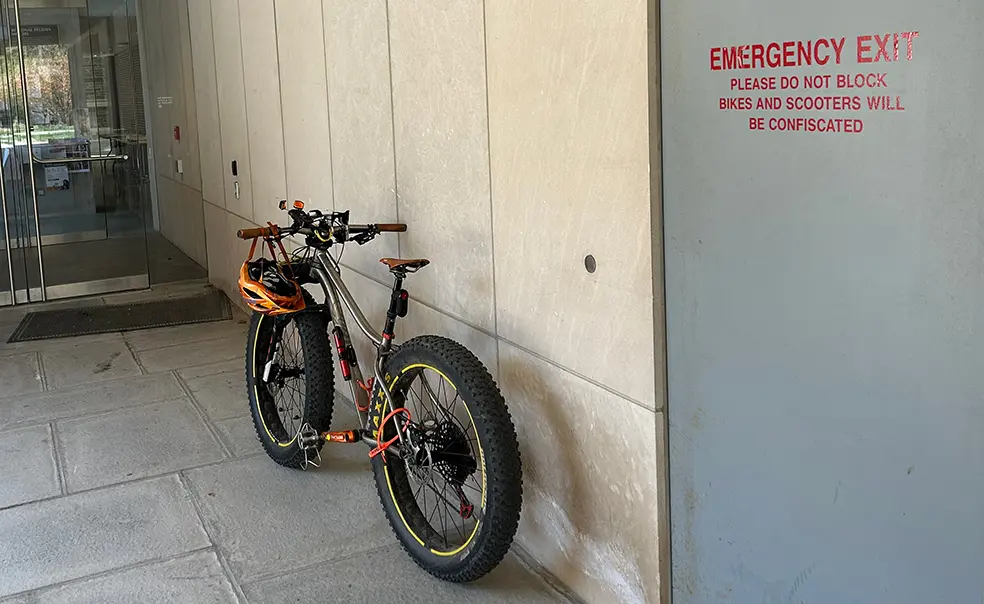

Editor’s note: Shortly after this story was published, the University announced it is banning e-bikes in a zone that includes most of the campus, except for main roadways such as Prospect Avenue and Washington Road. The new policy will take effect June 1.
Walking through Princeton’s campus today requires “360 vision,” said Aaliska Sapkota ’26. Around the blind spot that curves McCosh Walk into University Place or at the usual midday choke points between Frist Campus Center and McCosh Hall, the mismatch of pedestrians and fast-moving e-bikes is hard to miss. “The wheels belong on the road,” Sapkota said, amplifying the view of many students and faculty who walk to class. E-bikes are turning a policy loophole into a campuswide argument over safety, convenience, and common sense.
Princeton’s e-bike problem began with the exile of another “personal electric vehicle.” When the University’s Office of Environmental Health and Safety (EHS) banned e-scooters in 2024, e-bikes remained a conspicuous exception, permitted under one key caveat: They could be ridden on campus roadways in “assist” mode, but on pathways, riders were supposed to switch to manual mode and use them like traditional bicycles.
EHS clarified its guidance on e-bike use when they banned e-scooters, requiring riders to wear helmets, stay to the right on roadways, and use safety lights. A quick walk on campus at almost any time of day makes those guidelines seem almost nonexistent, though. A policy that depends on students deciding to follow the rules has largely been ignored.
At a December Council of the Princeton University Community (CPUC) meeting, Kelly States, director of campus safety and health, discussed potential e-bike restrictions in response to feedback from pedestrians. For her presentation, she attempted to capture an image of the dangerous speed that e-bikes ride on pathways. “I don’t have a picture of that. Why? ’Cause they were going too fast for me to take a picture,” she quipped.
In a group interview with 15 students, nearly everyone had at least one e-bike horror story to share. Alexis Holland ’28 recalled one incident in which an e-bike rider tried to squeeze between two parked cars and “slammed into a professor’s car” while “going, like, super fast.” This resulted in a skinned arm and a payment plan for the resultant damage to the car door. “There’s a lot of the injuries I see on e-bikes,” Holland said. In the CPUC meeting, States echoed Holland’s point, emphasizing that injury numbers are “vastly underreported” and that the available data on accidents “don’t capture the near misses.”
One e-bike rider, a Forbesian with classes up campus who asked not to be identified, admitted to the recklessness of e-bike users but argued that most collisions end in “self-imposed” injuries. To him, e-bikes help manage the long distances between classes and are net positive.
In a Daily Princetonian opinion column, Luqmaan Bamba ’27 proposed several ways to improve pedestrian safety: stricter limits on e-bike size and speed, mandatory registration with visible markers of approval, and a better understanding of bike etiquette.
Professor Aaron Shkuda, an avid cyclist and urban historian, argued that the best solution is to simply use the e-bike as EHS has advised. “If it was fairly straightforward to create dedicated bicycle and pedestrian lanes on campus, the University probably would’ve done so already,” Shkuda said. Princeton, he noted, has a “rather constrained physical footprint,” with too many narrow walkways and choke points to cleanly separate bikes from pedestrians.
What especially struck him was how few students wear helmets. “You all have very impressive and valuable brains,” he said with a laugh, but the “number of students who wear helmets is shockingly low” on a campus full of students who, in theory, know enough physics to understand what happens when a fast-moving body meets an obstacle.
In July, New Jersey’s new statewide e-bike law is set to take effect, requiring riders to be at least 15 years old and to have a valid driver’s license, e-bike license, or permit; the rules also require registration, insurance, and helmets. But as the state cracks down on e-bikes, it looks like Princeton is one step behind.
The Latest
See all


Related News

McCarter Theatre’s First South Asian Musical Took Me Back to Forbes Basement
A Beat of Our Own is about a college dance team not unlike Princeton South Asian Theatrics


1 Response
Joe Weiss
5 Months AgoRegulations Are a Good Start
The new regulations are a good start. I’ve encountered persons riding on handicap ramps, which I sometimes need, and riding up and down outdoor stairs like a gangbanger in a cop film. I wish PU good luck in the effort.