
Princeton’s Graduate School Will Extend Fewer Offers to Applicants

Most graduate programs at Princeton will admit fewer applicants this year due to “uncertainty around Princeton’s budget and research funding,” according to Tracy Meyer, director for communications and external engagement at the Graduate School.
“The modest reduction of target enrollment allows Princeton to continue to prioritize and support graduate education and graduate students,” Meyer told PAW via email. “Princeton is fortunate that our graduate programs … continue to thrive in a challenging time for higher education.”
Princeton joins several peers, including Harvard and the University of Chicago, that have said they intend to admit fewer graduate candidates as institutions negotiate cuts to research funding by the Trump administration.
The only programs at Princeton that are not affected are biophysics, bioengineering, quantum science and engineering, and materials science and engineering — which have all launched in the past three years.
Meyer would not share target enrollment numbers for the coming year; the admissions cycle will wrap up in June. According to the Graduate School website, 3,280 graduate students were enrolled in the 2024-25 academic year, and 23% were new students.
This fall, the National Student Clearinghouse Research Center reported a 0.6% decrease in graduate enrollment nationwide versus the fall of 2024.
Based on estimated admission yield rates, Princeton gives each program a maximum number of offers to extend to prospective students that is usually fairly steady from year to year, according to Meyer, and is determined by a centralized University process. Programs sometimes choose to extend fewer offers than allocated.
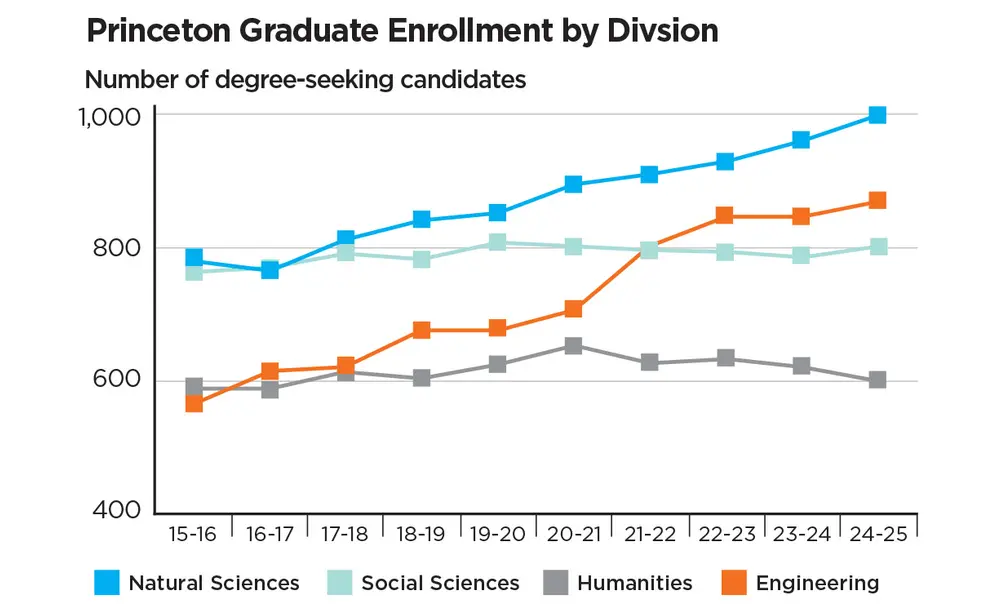
Over the past decade, engineering and natural sciences programs at Princeton have steadily increased their share of graduate students on campus.
Overall, Princeton’s graduate applicant pool has grown significantly, from 10,956 in 2015-16 to 19,931 in 2024-25.
Kurt Ristroph *21, an assistant professor of agricultural and biological engineering at Purdue, said federal funding uncertainty has led faculty at some institutions to “be more hesitant in accepting students” and that he’s aware of some academic units that are “more heavily scrutinizing a faculty member’s funding before allowing a student to be admitted.”
Avery Barnett, a fifth-year graduate student in the School of Public and International Affairs and a GradFUTURES professional development associate, foresees potential advantages and disadvantages to fewer graduate students on campus.
“Smaller could mean more intimate and closer,” she said, inspiring more collaboration.
In addition, as reductions occur across the country, Barnett hopes the job market for those seeking tenure-track positions after graduation may become less competitive.
However, she also worries fewer students could negatively impact “the overall body of research,” and perhaps lead to “a global shift in who is outputting research and the institutions that people look to for new work and information.”
Chris Catalano, a fifth-year graduate student in molecular biology and an officer in the Graduate Student Government, echoed that. “We’re at the forefront of science, and if we want our country and our civilization to be continuing to progress and improve into the future … then we have to continue to have forward thinking and [study] and [learn] about our world as best we can, because that’s going to lead to the innovations that end up changing the world and saving millions of lives.”
Yuzhou Bai *24, who received his Ph.D. in East Asian studies and is now a special collections librarian and archivist at Harvard, believes support staff positions and potentially faculty may be cut if reductions persist. He is also concerned that fewer graduate students at Princeton “would further deteriorate students’ mental health, because as a community, I always felt like the grad students on campus were kind of isolated.”
The Latest
See all


Related News
With Prominent Journalists and Hoagies, the ‘Prince’ Celebrates 150 Years
A gala at the New York Historical raised roughly $400,000 for the independent student newspaper


No responses yet