

Robert McCracken Peck ’74 Explores the World’s Wild Places

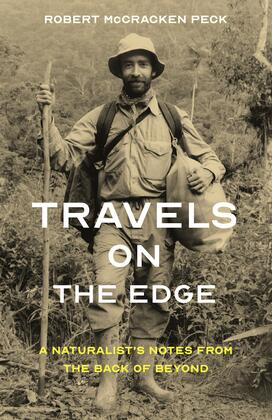
The Book: Blending vivid travel writing with scientific observation and richly detailed illustrations, Travels on the Edge (The American Philosophical Society Press) chronicles five decades of exploration and adventure at the farthest reaches of the natural world. This book brings readers to some of the world’s most remote and remarkable landscapes, from expeditions to Mongolia and a trip to the Andes culminating in the discovery of three previously unknown frog species to a journey across the Gobi Desert by way of camel caravan, and more. Through a series of individual essays, Travels on the Edge captures both the exhilaration and challenges of fieldwork, as well as the unexpected encounters and discoveries that emerge from a lifelong devotion to science, nature, and adventure.
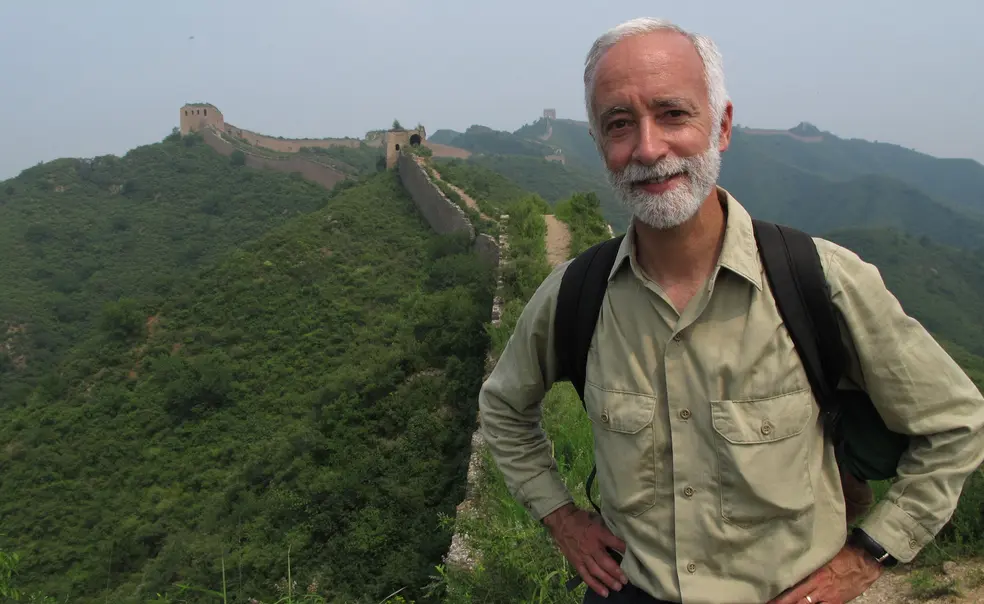
The Author: A historian, naturalist, writer, and explorer, Robert McCracken Peck ’74 has spent his career at the intersection of science, history, and the natural world. As senior fellow at the Academy of Natural Sciences of Drexel University, he has documented his scientific expeditions around the world through his writing and photography. His other work includes Land of the Eagle: A Natural History of North America, which accompanied the BBC/PBS television series of the same name and was recognized by the New York Times Book Review as one of that year’s most notable books on natural history and science. In 1988, a newly identified species of South American frog — one of three he discovered on a trip to Ecuador’s upper Amazon — was named in his honor.
Excerpt:
Preface
In the sleepless hours between midnight and dawn, I sometimes leave my bedroom and settle myself in a well-lite spot with the books that I don’t have time to read by day. The companions I choose for my late-night excursions are either travelers who have written, or writers who have traveled to the far-flung reaches of the world.
By the time I return to bed, I am either sad that I am not wherever I have just read about, or hopeful that I will find some way to get there soon. Sometimes, I am relieved that I can read about the authors’ mishaps without having to endure them myself. The experience of travel evoked by these books is familiar to me, even if their destinations are not, for making such journeys has been a lifelong love of mine, and a central part of my work as a naturalist, photographer, and chronicler of scientific expeditions. Seeing what others have written about so well has inspired me to assemble some writings of my own.
In a large metal cabinet in my office at home lie stacks of expedition journals and notebooks that record almost 50 years of travel to some of the world’s most wild and little-known places, the kinds of places Sir Walter Scott described as “the back of beyond.” These journals stand beside others chronicling times I have spent in some of the world’s most heavily populated and highly civilized areas, witnessing history as it unfolded before me. In Travels on the Edge, I have extracted highlights from both, and arranged them thematically, rather than in geographical or chronological order. Such a structure is intended to spare readers the burden of reading about any one expedition in its entirety. What follows are the highs and lows of almost half a century of expeditionary travel — some of the most memorable moments of my life.
For 50 years I have worked at the Academy of Natural Sciences of Philadelphia (now part of Drexel University), the oldest natural history institution in North America. As the Academy’s Senior Fellow, I have served as the unofficial “humanist” on staff since 1976. I share space in the Academy with over one hundred scientists who do research around the world, in all fields of natural history. I have had the privilege — and fun — of putting their work into a cultural context for our members and a wider audience through lectures, articles, books, and exhibitions.
I have always loved natural science in all its forms, but I have also had academic training in art history, archaeology, social history, and the decorative arts. This makes me something of a polyglot, but I have found that this eclectic background has helped me interpret what my colleagues do, why they do it, and how it is relevant to the lives of people not professionally engaged in the field of natural history.
In the early 19th century, when the natural sciences were just getting their start as fields of professional study, the Academy’s members focused their energies on collecting and describing plants, birds, mammals, fish, insects, and fossils, and announcing their findings in the Academy’s Journal (first published in 1817) and Proceedings (begun in 1841). As pioneering taxonomists, their goal was to inventory the world’s flora and fauna, preserving in the museum specimens that would vouch for their discoveries. Some, like William Bartram, Alexander von Humboldt, and John James Audubon were also gifted travel writers who recorded their experiences and shared them with a public increasingly eager to know more about the natural world. As science evolved, the Academy’s members augmented their discoveries with answers to new questions their predecessors had never thought to ask. Genetic analysis complemented their visual identifications. Relationships between organisms and their environment were reassessed. Behavior was documented and analyzed. Population densities were determined, and threats to biodiversity were exposed.
Collecting the additional data required for these expanded studies left naturalists with less time to keep personal diaries. Their field journals became more technical than literary. And, although they were important for documenting the subjects and habitats studied, most expedition photographs offered little of interest to the public. In 1981, noting this decline in popular coverage of what our scientists were doing in the field, I approached the Academy’s administration to offer my services as a chronicler/photographer/historian of its most far-flung expeditions. I made the case for why having such a person on each trip would be beneficial to the institution and to the research that was being done. To my delight, the Academy accepted my offer, and I began a long string of field experiences that ultimately took me to the ends of the earth. In this book I recount some of the most memorable parts of a traveling career that in some ways harkens back to an earlier era. In so doing, I hope to encourage others to take on this responsibility. Though largely invisible to those not immersed in its intricacy, field research continues in every natural history discipline. It is needed now more than ever, and we owe it to present and future generations to record and share its purpose, its process, and its results with as wide an audience as we can.
Introduction
Although cheap air transport has put almost every part of the globe within reach of travelers with time, money, and an inclination toward adventure, a few regions maintain the cachet of remoteness and inaccessibility that romantics like me find alluring. Parts of the Amazon, Patagonia, the High Arctic, Siberia, and Australia’s outback still conjure up images of isolation that other parts of the world have long since surrendered. Overlooked relics of an earlier time, they comprise the short list of places that require more than a passport and credit card to visit.
There will always be parts of the world where politics, wars, or natural disasters make travel unwise, but vanishingly few that are naturally inaccessible. By sheer good fortune, many of them are places I have had a chance — and a reason — to visit and experience firsthand. As I look back on more than four decades of travel as a photographer and chronicler of research expeditions for the Academy of Natural Sciences, I realize what a rare opportunity I have had to see some of the world’s most remote and beautiful places under conditions that few have ever had, and that even fewer will ever have again. This is the story of some of those places and the people I came to know while traveling in them.
Like many Americans my age, my interest in travel grew from the pages of National Geographic, where what I now realize to be hopelessly romantic (and yes, sometimes racist, sexist, and nationalistic) articles revealed a world of difference I yearned to explore. Reinforcing these visual and written descriptions of distant places and ways of life were my occasional opportunities to meet some of the people who had actually experienced them.
Among my earliest memories of hearing from one of the bigger-than-life figures who had lived a life to which I aspired was when Joy Adamson came to speak at the Academy of Natural Sciences’ museum in Philadelphia. The year was 1962 and I was 9 years old. Whether her husband was with her, or just in the homemade films she showed, I cannot now remember, but the Born Free author and the lions she spoke about that day captured my imagination as no one and no creatures had ever done before. At that moment, I was transformed from a boy who already loved the outdoors, to someone who wanted to explore the world’s wild places and get to know them firsthand.
Since early childhood, the Academy’s dioramas had appealed to my interest in wildlife, but after Joy Adamson’s lecture, I looked to these evocative settings as windows into the distant and intriguingly unspoiled places I wanted to see in person. I could not have known then that just a decade and a half later, I would begin a career at the Academy that would allow me to peer into those same dioramas daily and take me to some of the very places they so magically depicted.
As I look back now on the years of travel that my position as Fellow of the Academy made possible, some of my adventures seem surreal and dreamlike, as though seen through the blurred and wavy lens of an antique window. Others seem as fresh and sharply focused as the photographs I made to record the experiences to share them with a wider world. I hope that the vignettes that follow, complemented by a few of those photographs, will provide both a snapshot of time and place and a window into my privileged life of “running slowly” through parts of this fast-changing world.
The great English explorer Sir Wilfred Thesiger, immortalized in Eric Newby’s book A Short Walk in the Hindu Kush and through his own books on travel in the Middle East, said that he “craved for the past, resented the present, and dreaded the future.” That was the way he felt in 1959 when he wrote it in his classic book, Arabian Sands, and even more so when I came to know him in London in the 1980s.
I understood what he was saying, but it was never a feeling I shared. As a traveler who still has the prospect of roads ahead, and children through whom I hope to travel vicariously, time is as much a friend as enemy, and distance is a buffering agent that can mute a headlong rush to modernity. As I write these pages, I am reminded of what an enormous place the world is, and what a tiny part of it I have seen. As much as I too revere the past, I do not resent the future; I only regret that I will not have more time to explore it.
Excerpted from Travels on the Edge by Robert McCracken Peck. Copyright © 2026 by Robert McCracken Peck. Published by The American Philosophical Society Press.
Review:
“This delightful collection of essays from a much-traveled scientist, who has spent much of his life 'off the beaten track,' is both vivid and philosophical. It is consummate travel writing. ” — Robin Hanbury-Tenison, author of The Oxford Book of Exploration
The Latest
See all


Related News

McCarter Theatre’s First South Asian Musical Took Me Back to Forbes Basement
A Beat of Our Own is about a college dance team not unlike Princeton South Asian Theatrics



No responses yet