

With Screens in the Classroom, What Does ‘Class Time’ Mean?

Last week, a friend said to me, “Now that I’ve memorized your class schedule, I know when to text you to actually get a reply — the only time you respond is when you’re in class.”
True, I thought. Otherwise, I’m busy living life.
Now, this may be counterintuitive, seeing as I am a student and class should, in theory, be the thing with which I mainly busy myself.
While classes themselves vary — the room, the professor, the classmates, the material — class time, on the whole, is consistent in its distinctiveness from the rest of our days. Class time represents a set period during which we are not just doing whatever it is we want — instead, we are in class, following the guidelines set by an instructor. Or so it used to go.
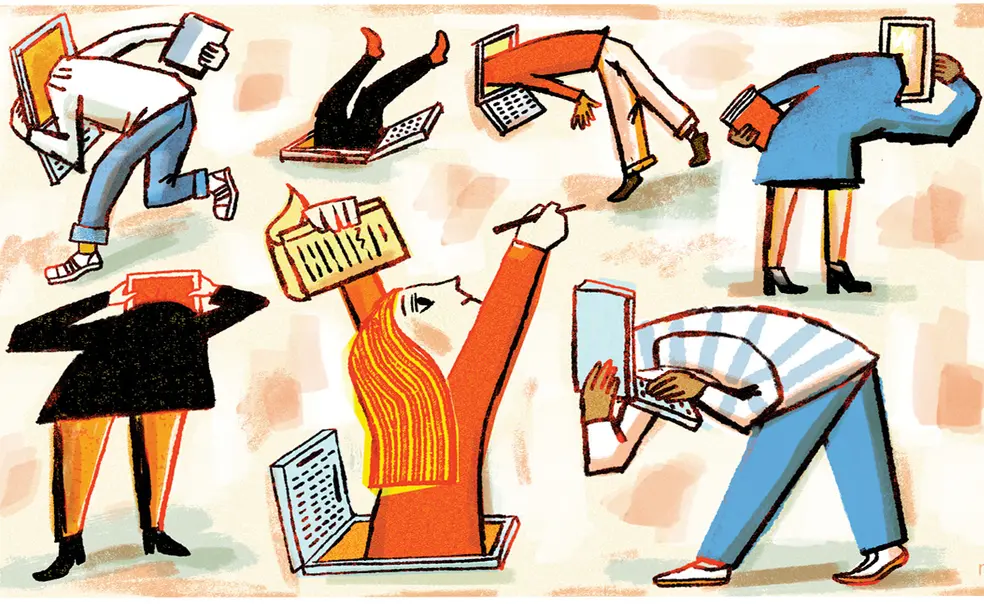
Enter laptops. They’ve waltzed in, permeating that precious bubble, creating a common thread between class and not-class. Being in class is way less different from not being in class now that the two experiences share the core element of screens.
For most college students, laptops exist at the center of academic life. Kamila Isaieva ’27 said that “there has not been a single day this academic year” where she has not opened her laptop at least once. “And it’s not even like I have a specific purpose when I do,” she added. “It’s instinct at this point.”
Gayle Salamon, a professor of English, echoed Isaieva’s sentiment, saying that “our phones [and devices in general] are a habit,” and she believes “using the space of the seminar to break that habit is immensely valuable.”
In a similar vein, sociology professor Matthew Desmond opens his first Poverty, by America lecture with a slide titled “No Screens,” featuring screenshots of articles titled “A Learning Secret: Don’t Take Notes with a Laptop” and “The Pen is Mightier Than the Keyboard.”
Screens, in addition to taking students’ attention away from the course material, “can surface social divisions in the classroom in ways that go unrecognized,” Desmond said. He referenced a New York Times article from his “pre-screen-ban days” in which a student in his class describes watching as a classmate “planned a multicountry spring break trip to Europe” during class. By allowing screens to permeate class time, the differences among students enter an environment that otherwise might temporarily quiet these differences.
Spending less time on our screens is a noble pursuit, most agree. But despite the problems with tech, not everyone is so keen on kicking it out. As one senior who requested anonymity put it, if the class is not very interesting, better to use the time getting things done.
My father, Eldar Shafir, is a professor in the School of Public and International Affairs. At the start of each semester I’ve suggested he implement a tech ban in his class to keep my distraction-prone classmates focused. He is resistant. “I’m hesitant to infantilize my students,” he said. Instead, he tells them, “I know you’re watching videos or buying shoes on Amazon. I assure you, there’s plenty of research showing that either you won’t know what I say, or you’ll buy the wrong shoes.” He’s concluded that “ultimately, it’s their loss if they don’t pay attention.”
Otto Trueman ’27, an anthropology major, is one of these self-disciplined students my father still believes in. He takes his notes on paper. “I don’t trust myself not to get distracted,” he said. “I’m trying not to let myself go down that road. I worry that if I start using screens, I will lose the ability to sit through a lecture fully focused.”
As Princeton students navigate class time with screens — and faculty members struggle alongside them — not everyone agrees on whether a total screen ban is the only, or even the best, solution. But in interviews, there is a consensus that class time, as we once understood it, must be reexamined to keep face-to-face instruction productive and gratifying for all parties — and to ensure that “face-to-face” preserves any meaning at all.
The Latest
See all


Related News

With Prominent Journalists and Hoagies, the ‘Prince’ Celebrates 150 Years
A gala at the New York Historical raised roughly $400,000 for the independent student newspaper



No responses yet