
Standing Strong for Academic Freedom
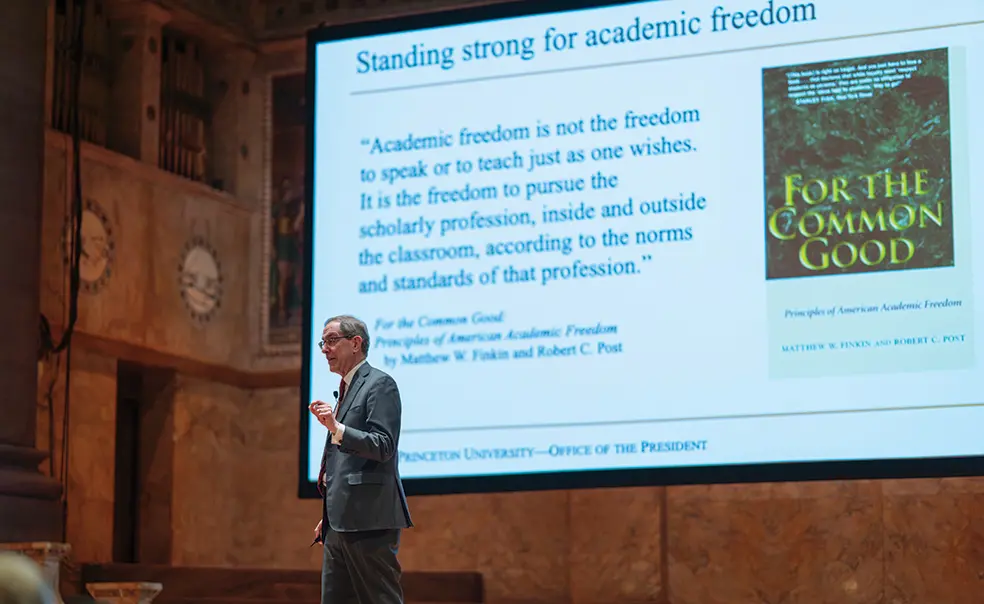

In February, I published my 10th annual State of the University letter to the Princeton community. I included this year a section on academic freedom, and its distinction from free speech, which I excerpt here. — C.L.E.
Princeton and other universities have over the past year faced a variety of threats to research funding, the immigration status of community members, free speech, academic freedom, diversity and inclusion programs, and our endowments.
Addressing these issues has been a major priority for the University and for me personally. I stepped up my work with the Association of American Universities, met more often with Washington policymakers, and sought out opportunities to communicate publicly about the principles that define this University and other great research institutions. We are in a crisis, and universities have an obligation to speak up.
While all of the issues that I have mentioned are important, universities and their leaders have a special responsibility to defend and explain academic freedom, which is crucial to the excellence of research and teaching. The principle is sometimes conflated with free speech, but academic freedom is distinct from free speech and even more directly connected to the core mission of universities.
What is academic freedom?
Academic freedom enables researchers and teachers to pursue truth and advance knowledge in their fields and disciplines. It protects scholarship and teaching from interference by government officials, university administrators, donors, and anyone else who might want to substitute their will, preferences, opinions, or judgments in the place of academic standards.
People sometimes misunderstand academic freedom as allowing professors to say or do whatever they like. That is a mistake. Academic freedom does not insulate scholars from evaluation or accountability. On the contrary, it depends upon and presupposes a rigorous system for evaluating the quality of research.
American universities have become world leaders in no small part because they have insisted on academic freedom and because our governments have, for the most part, respected it.
Scholars’ work is and must be judged all the time: when they submit articles for publication, when they seek appointment or promotion, and when they apply for funding from the government or other sponsors.
The point of academic freedom is not that scholars should be free to say what they like; it is instead that scholarly work should be evaluated through the good-faith application of academic norms and standards, not on the basis of what somebody in power—at the university or outside it—would like to hear.
Academic freedom is not the same as free speech
The connection to academic standards, and to scholarly responsibility, explains why academic freedom is simultaneously distinct from free speech and more fundamental to what universities do.
Free speech rights permit everyone to express opinions, regardless of how those opinions were derived or how qualified the speaker is to pronounce them. They govern controversies like the ones about outside speakers and campus protests at colleges across the nation that have attracted so much attention in recent years.
Academic freedom, by contrast, recognizes the right and the responsibility of scholars to investigate questions and express judgments about matters within the scope of their learning and fields of research.
Free speech and academic freedom are complementary principles; both are essential to the life of a great university. It is academic freedom, however, that ultimately guarantees faculty members here and elsewhere the freedom to seek knowledge even when doing so may anger officials, disrupt industries, upset orthodoxies, or inflame controversies.
Research universities depend upon the capacity to pursue uncomfortable truths and publish controversial ideas. American universities have become world leaders in no small part because they have insisted on academic freedom and because our governments have, for the most part, respected it. If universities cede that right, they compromise not only their own missions but also the vital contributions they make to our country’s health, culture, prosperity, and security.
I have accordingly been heartened by the strong support that Princeton faculty, students, staff, and alumni have given to academic freedom and higher education as part of our Stand Up for Princeton and Higher Education initiative.
Your voices make a difference.
The Latest
See all


Related News

McCarter Theatre’s First South Asian Musical Took Me Back to Forbes Basement
A Beat of Our Own is about a college dance team not unlike Princeton South Asian Theatrics

3 Responses
David Benjamin *73
5 Months AgoUniversities Squander Public Trust
President Eisgruber’s defense of academic freedom passionately affirms the right of faculty to “seek knowledge even when doing so may anger officials.” He goes on to correctly assert that this right assumes a “good-faith application of academic norms” backed by a “rigorous system for evaluating research quality.” Unfortunately, Eisgruber fails to critically address whether these foundational assumptions still hold true.
The modern crisis of academic freedom lies precisely in his unexamined premises. As professors Cornel West and Robert George discussed in their illuminating April 18, 2025, appearance on The Glenn Show, academic freedom has been hollowed out from within for decades. While external political pressures are real, they argue that many disciplines — primarily in the humanities and social sciences — have succumbed to a slow intellectual capture. This decline was fueled first by purging faculties of ideological diversity, and second, by replacing the Socratic pursuit of truth — characterized by critical thinking, evidence, and debate — with performative activism.
Universities, by abandoning their primary mission of truth-seeking, are squandering their most precious resource: public trust. Until Princeton and its peers acknowledge this internal rot, the credibility of their graduates will continue to decline, failing them and ultimately weakening the intellectual foundations of Western civilization.
David L. Evans *66
6 Months AgoAcademic Freedom Anagrams
In Princeton’s 28 decades of storied existence, few — if any — of those 10-year slots experienced the campus changes of the decade I came from; namely, the 1960s. That was a time when liberal/left faculty members like Professor Hugh Wilson, of the politics department, were still reacting to accusations by the late Sen. Joseph McCarthy of Wisconsin of being something like a “Commie Red Façade.”
We, African Americans of those years, represented the largest numbers of Black students ever admitted to Princeton. Moreover, the Civil Rights Movement had shifted into high gear, and the Anti-War Movement was getting started.
It might interest President Eisgruber — and others — that the 15 letters in “Academic Freedom” can be rearranged to generate the following positive and negative reflections: “Decade I came from” and “Commie Red Façade.”
Rabbi Yaakov Menken ’86
6 Months AgoBe Careful Not to Repeat History
Reading the latest President’s Page (“Standing Strong for Academic Freedom,” April 2026), I was struck by President Chris Eisgruber ’83’s tone-deafness to the needs of the moment and the demands of Title VI of the Civil Rights Act. A century ago, many considered Germany the global center of academia. It is thanks to the insistence of German academics that hatred for Jews was meritorious, if couched as “Anti-Semitism,” and that its institutions no longer carry the same cachet.
If America’s elite universities wish to demand “academic freedom” to teach that hatred for Jews is meritorious if couched as “Anti-Zionism,” they will fare no better in the eyes of history. And per both Title VI and basic fairness, they deserve nothing from the federal government or from alumni until they undertake needed reforms.
Rabbi Yaakov (Ken) Menken ’86
Executive vice president, Coalition for Jewish Values