

Those Who Audit Courses Find Joy in Returning to the Classroom
‘I don’t think I understood just how special it would be,’ said Cressey Belden ’91
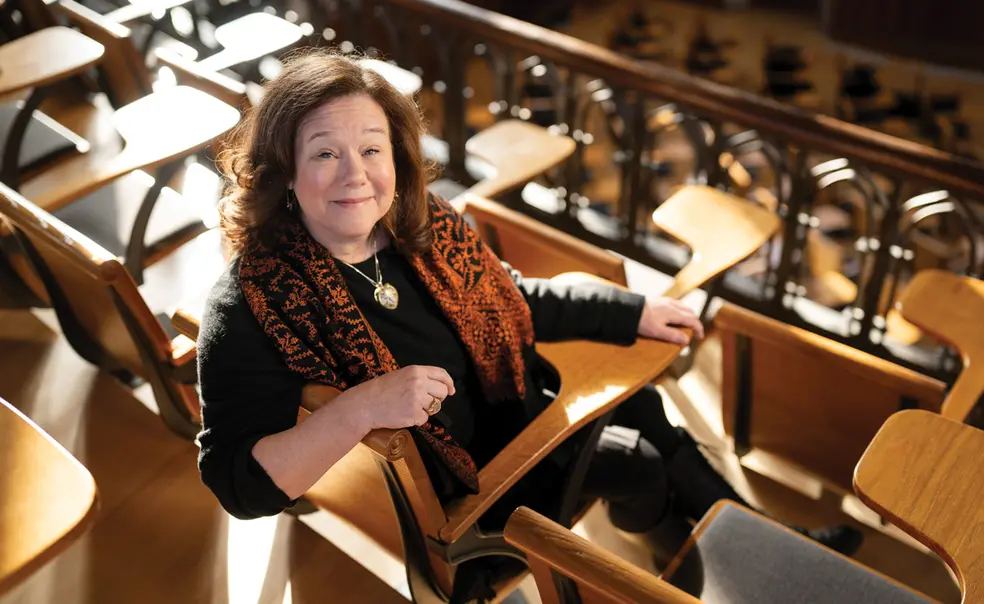

When Cressey Belden ’91 took Introduction to Macroeconomics in the first semester of her freshman year, she recalled noticing “white-haired people” seated at the back of McCosh 50. She didn’t know who they were, only that she wanted to be them someday.
“I was like, that’s the club that I want to be a member of,” she said.
The folks in the back row were likely auditing the course, a practice that has long been an informal part of Princeton and, since 1999, has been managed by the Community Auditing Program (CAP), now run by Gina Mastro, which gives local residents and community members the chance to expand their knowledge by attending Princeton courses. Mastro said that many participants tell her they’ve been looking forward to auditing for years, and some retirees say they moved to the area specifically to enroll. “We are fortunate to have our campus located within a community of lifelong learners,” she said.
Belden majored in sociology at Princeton, but as an auditor she’s wandered widely. She has taken multiple politics and legal courses, along with various religion courses on the religions of China, Jesus, and Buddha, while she was actively writing about faith, which helped her intellectual journey.
Returning to the classroom, Belden said, has been unexpectedly restoring. “I just am myself ... on campus,” she said. “Having this chance to be in the classroom again, I don’t think I understood just how special it would be.”
About 600 people audit each semester, including businesspeople, retirees, au pairs, and University alumni and staff. This fall, auditors chose from 100 classes, along with “auditor only” courses on topics including Claude Monet, the American Revolution, and Mozart’s comic operas. Auditors must live in New Jersey or be within a 50-mile radius of campus and be legal adults with a high school diploma or equivalent. Each course costs $250 unless otherwise noted.
Tony Singleton spent his career in international finance, from global risk management to restructuring banks in Africa, and later worked in microfinance. He worked for years at Chase, and then joined a consulting firm, When he retired, he moved from Westchester to Lawrenceville in search of a more diverse community.
Singleton’s vision for retirement was to engage with “pure learning.” His education has been in political theory, policy, and math, but auditing opened up a new world to him. He was excited to absorb information with a much different perspective than he had at 22 years old, when he first was in college.
Singleton described CAP as “a gift by the University to the community.” He has taken a financial engineering class and several classics courses, which he has experience in, but also has ventured outside of his comfort zone with an astrophysics course and multiple neuroscience courses.
In one of his favorites, they designed what he described as “the platform for a new Uber.” In another, he explored political ethics and the effects of greed on democracy. Auditors are not allowed to complete assignments or exams, join labs or precepts, or participate in class, although a few professors have made exceptions.
“I was absolutely blown away with what was happening in my life — the value, the enrichment that took place,” Singleton said.
Stephen Tarnoff, a retired OB-GYN who remembered paying just $9 a term to attend Brooklyn College, has been auditing for the past six years. He learned about the program from a Princeton alum in Freehold, New Jersey. Each semester, he queues up five or six courses, and like undergraduates during registration, refreshes his screen at
11 a.m. with the hope that he can at least get into one of them.
CAP has a limited capacity for auditors, with three days of course registration. Residents of Princeton and others affiliated with the University can register for one course on Day 1, non-Princeton affiliates, including Tarnoff, can register for one course on Day 2, and all auditors can register for up to one other course (or two total courses) on Day 3. Auditors can make up no more than 10% of a class, unless a professor has made an exception.
Tarnoff especially enjoys classes where teachers encourage auditor participation. In a politics course, students and auditors role-played shareholders as they attempted to pass an immigration bill over three meetings. Tarnoff drew the role of Fox News, which required him to walk around the classroom and gather the most interesting news he could. At one point, he overheard a student, who was playing a Republican congressman, say he planned to stage a filibuster to block the bill. Tarnoff reported the comment. While the student was unhappy, the professor was delighted.
Tarnoff recalled “having that interaction with the student, who looked like he wanted to kill me, and then the teacher saved me, because he said to him, ‘There’s a lesson here.’ The lesson is, if you’re a politician, don’t open your mouth until you know who you’re talking to.’”
He has taken courses on American television, Beethoven, and the history of medicine back to antiquity, along with many others. He described the community of auditors as vibrant and supportive, with friendships formed through shared classes and life experiences. Mastro, the CAP manager, said, “People meet others who they would not have otherwise met, and many friendships, and even a marriage, have been the result.”
The Latest
See all


Related News
With Prominent Journalists and Hoagies, the ‘Prince’ Celebrates 150 Years
A gala at the New York Historical raised roughly $400,000 for the independent student newspaper



1 Response
Richard M. Waugaman ’70
9 Months AgoRevive the Alumni Colleges
What a dream come true! In fact, before the pandemic I literally had a recurrent dream of being back on campus, overjoyed to be taking more courses. That dream also came true when Princeton started offering streaming and hybrid Princeton events since 2020.
My wife Elisabeth and I attended Princeton’s first on-campus alumni college in 1976. It was on the American Revolution. For the past 10 years, we’ve spent a week every summer at Washington and Lee University, participating in their excellent series of alumni colleges.
How about Princeton reviving its own alumni colleges?