

Two Alumni Found Company to Build a Better Electric Boat Motor
Jonathan Lord ’18 and Ben Sorkin ’17’s powerful motor is virtually silent

As a rower on Princeton’s heavyweight crew team, Jonathan Lord ’18 would often be out on Lake Carnegie before dawn rowing in tandem with his teammates, their oars knifing into the glass-like water as the sun rose.

But sometimes that bucolic scene would be interrupted. “As rowers, we were constantly surrounded by gas-powered launch boats with fumes and noise, and it was obvious there had to be a better way,” says Lord, who was named to the Forbes 30 Under 30 list for transportation and aerospace.
Today, two of those boats have Flux Marine propulsion systems. “It’s revolutionary,” says Greg Hughes ’96, head heavyweight men’s rowing coach. “They are so quiet, you don’t even hear them. And the performance is significantly better. You push the throttle, and it just takes off.”

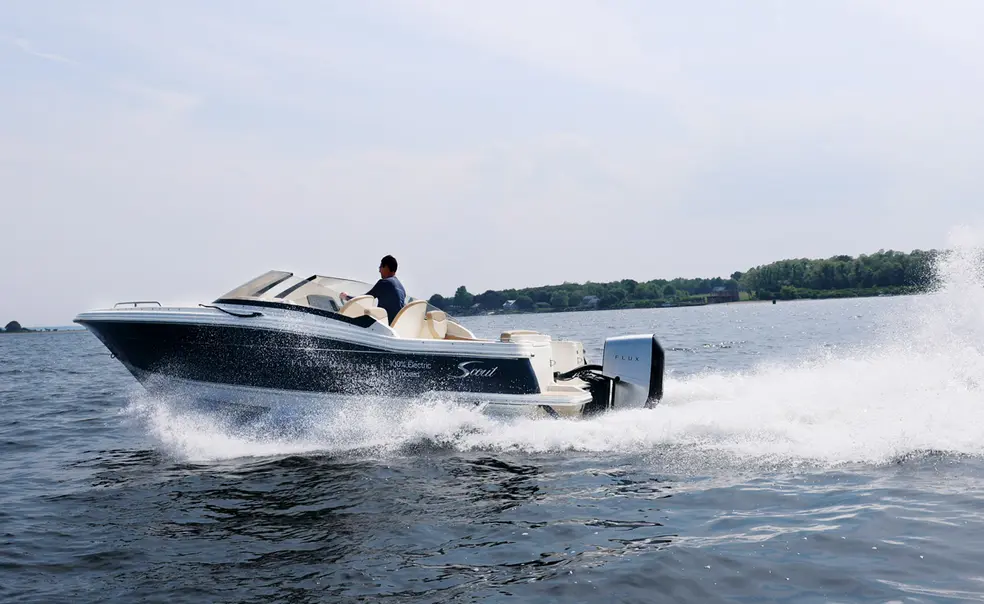
For the past 10 years, Lord, the chief technical officer of Flux Marine, and his partners Ben Sorkin ’17, the chief executive officer, and Daylin Frantin, the chief financial officer, have been working to build a better way to power boats. They have designed and built a powerful motor that is virtually silent. It is powered by a battery and produces zero emissions, and it can go from 0 to nearly 30 mph in four seconds. The motor has a range of 30-50 miles at a cruising speed of 20-24 mph and more than 100 miles at 5 mph.
Sorkin, 30, began exploring the idea for the company as a sophomore studying mechanical and aerospace engineering (MAE) at Princeton in 2015. He and Frantin are childhood friends who grew up in Melville, New York, on Long Island. Sorkin spent summers boating and tinkering with motorboats on Lake George. As he looked for a career that combined that passion with his engineering skills, he hit upon the idea of building electric boats. He brought in Lord, who is from Oxford, England, and was equally passionate about boating, having grown up rowing on the Thames.
The three partners say they have always been inspired by the idea of building boat technology that doesn’t harm the environment. Unlike car engines, which have been required to have pollution-reducing catalytic converters since 1975, there are few federal regulations governing boat engines. Exhaust from boats contains carbon dioxide and other chemicals linked to global warming and air pollution. Boats, especially older boats, also release oil and gasoline into the water. Noise from commercial and recreational boats can affect the habitats of wildlife, like bottle-nosed dolphins and manatees.
But while sustainability is at the heart of their mission, the partners realized the key to success was to focus on building a better product. “If we build a killer company and an incredible product that people actually want to use, the sustainable impact follows naturally,” Lord says.
The electric motor boat was invented in 1839, but by the 1920s, electric motors were overshadowed by powerful internal combustion engines. Today’s high-powered battery technology has produced a growing electric boat market with 100 manufacturers worldwide developing new electric motors, according to Mobility Foresights’ Global Electric Boat Market report.
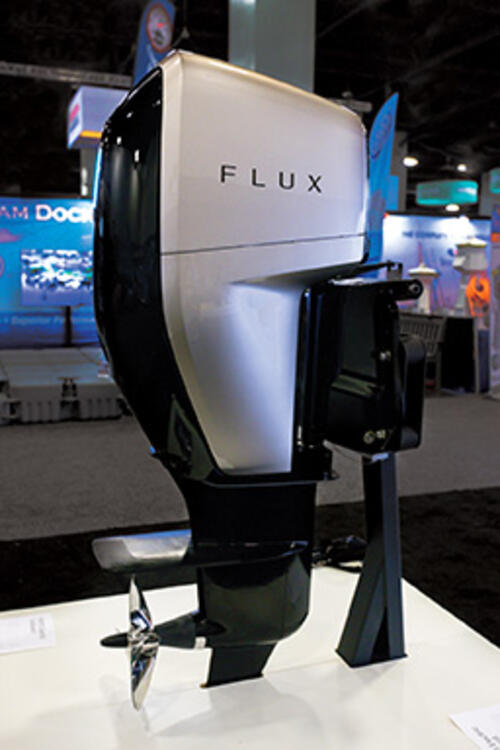
Sorkin and Lord say their company stands out from other electric boat companies because they built the system from the ground up rather than basing it on combustion engine technology. They replaced the driveshaft with a belt drive and designed a motor that has far fewer parts and has a closed cooling loop rather than being cooled with seawater. A computer replaced the digital shifting and throttle. A specially designed battery provides high-voltage power, and the system can be plugged in at virtually any marina, home, or charging station. It takes about eight hours to bring the charge from 20% to 80%.
A boat with a Flux Marine propulsion system costs several thousand dollars more han a boat with a traditional engine. But the Flux Marine partners say the buyer recovers the difference in a few years. Over the lifetime of a boat, they say, an electric boat could save its owner tens of thousands of dollars in gas and maintenance.
Sorkin first developed his idea during MAE’s Summer Practical Research Experience. He built a rudimentary electric motor, which he tried out at Lake Carnegie. “Princeton gave me the freedom, space, and mentorship to explore something unconventional,” he says.
Craig Arnold, vice dean for innovation, University innovation officer, and the Susan Dod Brown Professor of Mechanical and Aerospace Engineering, taught Lord and Sorkin and is one of Sorkin’s mentors. “Ben was not a traditional student,” Arnold recalls. “He was passionate and energetic. Jonathan was more technically focused — very strong on nuts and bolts. Together, they were exceptional at seeing opportunities and connections.”
In his senior year, Sorkin was accepted into the Keller Center for Innovation in Engineering Education’s eLab Summer Accelerator program, which provided housing for his fledgling company, stipends for the three partners and two others, and plenty of advice about how to develop their business.
The three partners have developed a close relationship during their 10-year journey of building the company since then. They have roomed together, Sorkin and Lord got their first jobs out of college at the same company, and they worked out of their homes when the space they were renting shut down during the COVID-19 pandemic. Each partner brings his own skills to their effort to build the company, Frantin says. “Ben is more of the visionary,” he says. “Jon is very good at explaining complex engineering in a way people understand and building relationships. I focus more on risk, numbers, and structure. There’s a lot of overlap, but the differences complement each other.”
The partners raised $1.5 million in seed money from family, friends, and Princeton Alumni Angels. They went on to raise more than $30 million from a host of high-profile investors, including Robert Hugin ’76, retired chairman and CEO of the Celgene Corp. and member of the Princeton Board of Trustees. The partners hope to raise another $35 million in 2026. While they plan to continue developing electric outboards and boat packages, “we also want to do more on the energy side of things — everything from microgrids to mobile DC fast charging,” Sorkin says.
Customers, like the Princeton rowing team and the East Bay Sailing Foundation in Rhode Island, helped test early versions of the electric motor. The company has produced nearly 100 propulsion systems, including for defense contractors working on applications such as underwater drones and unmanned surface vehicles.
In 2025, Sorkin, who lives in East Greenwich, Rhode Island, bought a 22-foot Scout boat equipped with a Flux Marine outboard motor. He uses it for a 10-mile commute to the Bristol Marina, half a mile from the Flux facility. He commutes to work most days during the spring, summer, and fall, and even once or twice a week when it’s possible in the winter.
“What motivates us to keep doing this is a lifelong passion for boating, sustainability, and the challenge of moving a really hard industry forward,” Sorkin says. “Seeing our product out in the world and watching customers use it — that’s what keeps us going.”
The Latest
See all


Related News

McCarter Theatre’s First South Asian Musical Took Me Back to Forbes Basement
A Beat of Our Own is about a college dance team not unlike Princeton South Asian Theatrics


1 Response
Greg Arzoomanian ’79
5 Months AgoAn Efficient Commute
“In 2025, Sorkin, who lives in East Greenwich, Rhode Island, bought a 22-foot Scout boat equipped with a Flux Marine outboard motor. He uses it for a 10-mile commute to the Bristol Marina, half a mile from the Flux facility.” Ten miles across Narragansett Bay, but 30 miles by car through Providence — an hour trip at rush hour. At 20 mph, the time is cut in half.