

Young Alumni Shake Up the Business World With AI
Two teams of recent Princeton alumni are behind companies at the heart of a disruptive shift towards generative AI


Generative AI tools have changed what’s possible for young startup founders looking to build disruptive businesses. Tasks that previously would have taken significant time and resources can now be largely automated using large language models trained on massive datasets. Recent Princeton alumni are behind two companies at the center of this shift.
For their senior thesis, Gabe Stengel ’20 and John Willett ’20 built a chatbot for econometrics, a field which uses statistical models to quantify economic theories and forecast economic trends. Users could ask it questions such as how a country’s GDP correlated with the likelihood it would host an Olympics. After graduating, they started jobs in finance at J.P. Morgan and Lazard. Later that summer, OpenAI released GPT-3 for developers. “I was playing around with it and I pinged John and said, ‘This could make that crummy, slow thing we built before kind of great,’” says Stengel. In January 2022, they quit their jobs to start Rogo, a generative AI platform for finance.
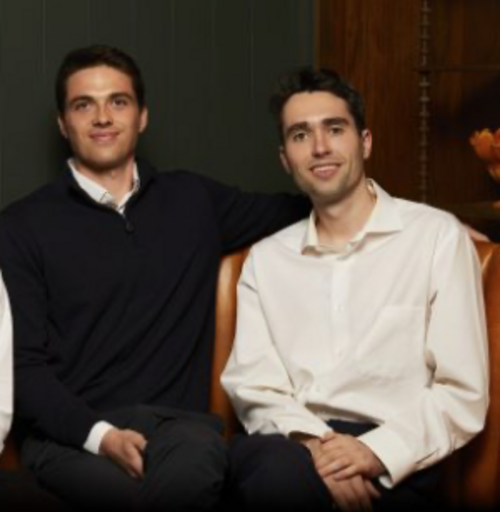
Rogo is like a specialized version of ChatGPT for investment professionals, designed to help them analyze vast amounts of data with speed and precision. At first, finding traction with customers was difficult. “For the first 24 months nobody wanted to talk to us,” says Stengel. “They were like, ‘What do you mean you have AI for my data? You’re two 23-year-old kids.’” In late 2023, they signed their first paying customer and today Rogo is used at many of the top firms on Wall Street. They’ve raised $150 million in funding and are valued at $750 million. The Rogo founders were selected for Forbes’ 2026 30 Under 30 class for finance, which was announced in December.
Around the same time, a parallel journey was emerging in the world of software engineering. Matan Grinberg ’20 graduated with Stengel and Willett and was pursuing a Ph.D. in physics at the University of California, Berkeley when he realized his heart was no longer in string theory. He cold emailed Shaun Maguire, a partner at Sequoia Capital who also earned a Ph.D. in physics, asking for advice. Their meeting turned into a three-hour walk, during which Maguire recommended that Grinberg join Twitter, join one of his portfolio companies, or found a startup. Grinberg had recently attended a hackathon in San Francisco where he spotted Eno Reyes ’21, a machine learning engineer. Despite having many mutual friends at Princeton, the pair had never actually spoken, but Grinberg describes the meeting as “intellectual love at first sight.” The day after his walk with Maguire, Grinberg met Reyes for a coffee and decided to start a company.
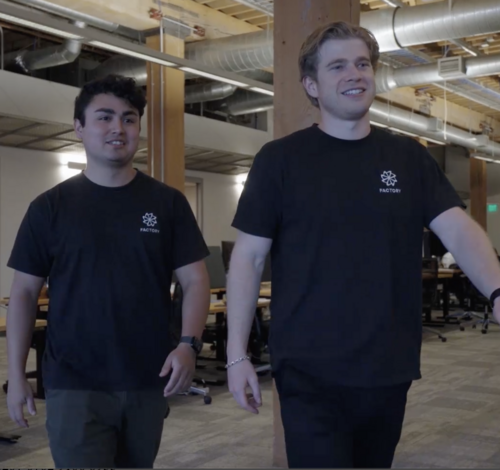
Over the next 72 hours they built a demo of Factory, a software development platform which uses AI agents called “droids” to automate parts of the coding process. Grinberg emailed the demo to Maguire, who asked him if he was serious about pursuing the project. When Grinberg said yes, Maguire told him to drop out of his Ph.D. program and then send a screenshot as confirmation, which he did. Maguire set up a meeting for the next day where Grinberg and Reyes pitched their idea to Sequoia, which invested.
Much like what Rogo is for finance, Factory enables software engineers to use AI to handle parts of their work — from writing and debugging code to automating the repetitive tasks which slow projects down. Grinberg says this “raises the leverage” that each individual software engineer has, allowing them to tackle increasingly complex problems. Grinberg remembers being on the verge of tears on the call when Factory closed its first paying customer. Today, it is used by large enterprise customers and has raised $50 million at a $300 million valuation. Grinberg and Reyes were named to the Forbes’ 2025 30 Under 30 class for AI.
This early success is an indicator of the way the day-to-day work of investors and engineers may change in the years ahead. Stengel says that in the near future Rogo will be akin to a “fully autonomous analyst” that understands how its users think, what kind of questions they ask, what investments they like, and can independently surface insights and prepare materials in their style. Grinberg says that AI tools like Factory will raise the bar for the kind of tasks it’s possible to solve with software. “Things which we previously thought were too complicated to be solved with software are now going to be in play,” he says.
The rapid growth of both startups is a testament to the speed at which the current landscape is changing. Stengel says the rate is so fast that every few weeks the notion of what will be possible with these technologies evolves. “The best way to stay apprised is just being very open-minded and non-dogmatic about what it can do,” he says.
For many, the societal impacts this rapid change may bring are threatening. But Grinberg says that while certain jobs will likely be automated away, software engineering isn’t one of them. He believes that tools like Factory, by bringing new problems into play, will increase the demand for developers to solve them. “The number of developers working is going to be strictly increasing,” he says.
In addition to Rogo founders Gabe Stengel ’20 and John Willett ’20, several other young alumni were named to one of Forbes’ 30 Under 30 lists for 2026, which recognizes 600 honorees across 20 industries (30 for each list) who are making an impact on the world. They include:

James Tralie ’19
Creative director at NASA
Since joining the team in 2019, the geosciences major has produced TV shows, films, and other digital content. Tralie is known for “making the science of space palatable to more than 10 million who watch his ccoverage,” according to the Forbes announcement. “It’s so much fun, communicating this stuff,” Tralie told PAW in a 2023 profile. “You start to feel a deep connection with the far reaches of the cosmos.”

Jonathan Lord ’18
CTO and co-founder of Flux Marine
The idea to develop an electric boat first took shape at Princeton, and eventually co-founders Lord, Ben Sorkin ’17, and Daylin Frantin made it a reality when they launched Flux Marine in 2018. The Bristol, Rhode Island-based company builds high-performance electric outboard motors and battery systems. Lord’s disdain for gas engines in boats turned out to be a shared pet peeve as Flux Marine has raised more than $30 million in funding.

Nick Callegari ’20
Founder & CEO of Verustruct
Housing insecurity was the issue Callegari wanted to address when he left SpaceX and moved into the social entrepreneurship space. His startup, Verustruct, is developing 3D printers to create more affordable and sustainable housing materials. Among Verustruct’s innovations is that the walls its printers produce are smooth — unlike other 3D printed homes that have a layered look. “Housing is a human right,” Callegari wrote in a LinkedIn post announcing the Forbes recognition. “The real milestone will be when families everywhere have access to safe, affordable, sustainable places to live.”

Roman Papademetriou ’18
COO of Mutuals Media
In collaboration with co-founders Amelia Montooth and Emmet Sandberg, Papademetriou launched Mutuals Media, a digital media network and production studio that produces video series for social media. Since its launch in February 2024, Mutuals Media’s flagship show Gaydar, hosted by content creator Anania Williams, has dropped more than 140 episodes, reaching more than 1.7 million viewers per show, and has had partnerships with many major brands including Hinge and Apple TV.

Hassan Chaudhry ’18
Vice president at BlackRock
After graduating from Princeton with a degree in operations research and financial engineering, Chaudhry jumped straight into the world of finance by joining the investment firm BlackRock. He spent two years at Morgan Stanley before returning to BlackRock’s Private Equity Partners team in 2023. Chaudhry was recognized in Forbes’ Venture Capital category for his role in helping to launch the firm’s Growth Equity platform. Under his direction, BlackRock has invested more than $800 million in various projects including AI companies Gorq and Applied Intuition.
The Latest
See all


Related News
With Prominent Journalists and Hoagies, the ‘Prince’ Celebrates 150 Years
A gala at the New York Historical raised roughly $400,000 for the independent student newspaper


No responses yet