

Overhaul Will Shorten Orientation by Four Days, Move Outdoor Action to Fall Break
Starting next year, freshman orientation will be eight days instead of 12 and no longer include Outdoor Action and other small-group experiences
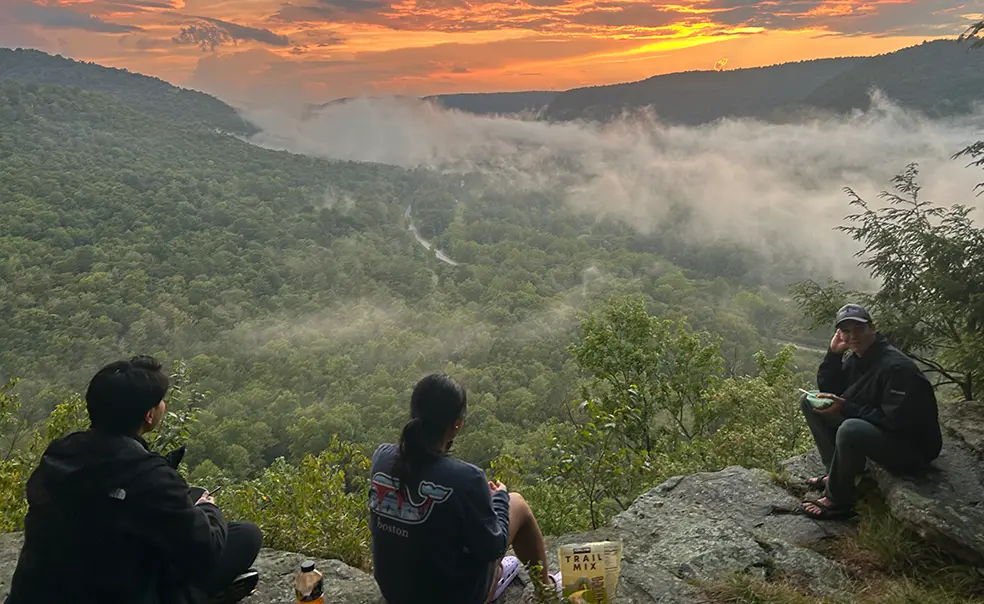

The Class of 2030 was the last to experience a 12-day freshman orientation with mandatory small-group experiences, Princeton University announced in an email to all students on Oct. 27. Outdoor Action, Community Action, and Dialogue and Difference in Action for first-year and transfer students will be moved to fall break and will no longer be required, among other changes.
Orientation will also be shortened by four days, to a total of eight, beginning next fall.
Vice President for Campus Life W. Rochelle Calhoun cited “an expanded approach … that recognizes that meaningful connections and belonging develop over time” in her note to students, which encouraged them to participate in a survey that will help guide future programming. Former student leaders can sign up to participate in one of 10 feedback sessions between Oct. 29 and Nov. 18. It is unclear what role student leaders may play going forward, though a New Student Orientation FAQ page said they are “an essential part of these programs.”
Calhoun’s email said the changes were “prompted by budgetary considerations” as well as feedback from students, staff, and faculty. “While the small group experiences have been positively received and valued, comments on the length of orientation and concerns about providing adequate time for students to settle into college life were also considered,” Calhoun wrote.
Princeton announced budget cuts of 5% to 10% beginning in 2025, in part due to cuts to federal research funding. In February, President Christopher Eisgruber ’83 warned of additional cuts in anticipation of a decline in long-term endowment returns. However, in October, the University announced a 23.7% return for fiscal 2026, raising the endowment’s value to $42.3 billion.
“The strong endowment return for the 2026 fiscal year should allow us to reach a lower payout rate more quickly than expected,” the FAQ stated. “However, we have not changed our long-term expectations for the endowment and will therefore continue to operate in a more financially constrained environment for the next couple of years as we transition to a new budget model to match the expected lower long-term returns.”
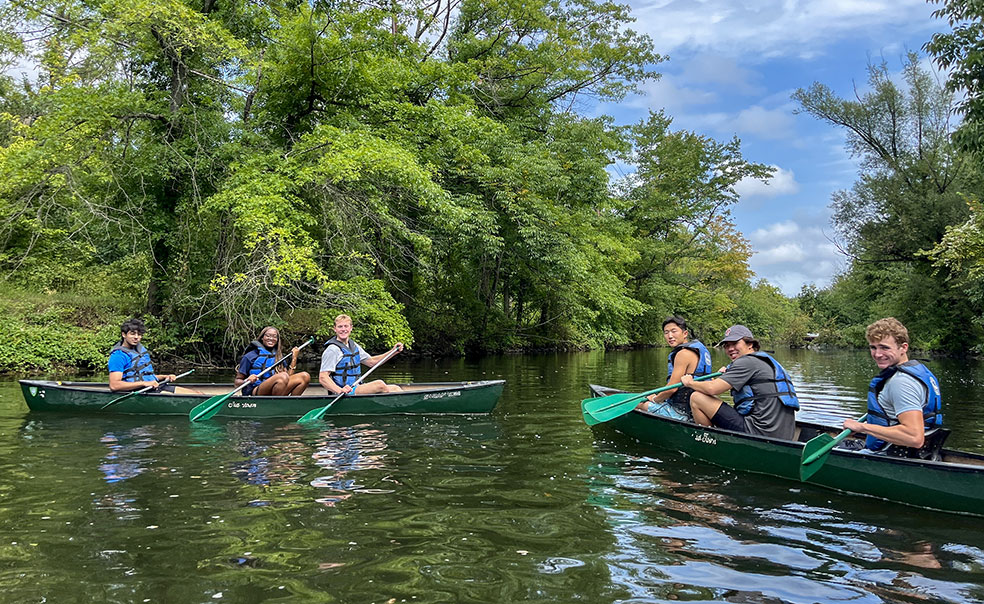
The survey asks first-years which topics and themes were most helpful during orientation, such as adjusting to life as a Princeton student, understanding values, supporting health and well-being, and getting to know people and making friends. Older students were asked how they felt around fall break of their first year at Princeton. Students were also asked how many nights they’d prefer for small-group experiences, how important it is to be off campus, and which elements of the programs were most important.
The Orientation Advisory Board is composed of 14 administrators across the University and is charged with providing “direction for the future of the Orientation program,” according to the New Student Orientation website.
The Pace Center for Civic Engagement runs Community Action, founded in 1987, in which students “learn what it means to be part of a community, how to grapple with complex societal questions, and begin to develop an awareness of their personal values,” according to the Pace Center website. The Pace Center Instagram account reported that 765 students participated this year.
The Office of Diversity and Inclusion runs Dialogue and Difference in Action, a social justice program in which students “engage in critical dialogues focused on identity, power, privilege, and difference” both in the University community and beyond, according to its website. It launched in 2017.
The Office of the Dean of Undergraduate Students runs Outdoor Action. This year, OA had 665 participants, according to Rick Curtis ’79, who has directed the program since 1981.
When OA celebrated its 50th anniversary in 2024, more than 130 former trip leaders came to campus to reflect on the program, which has had more than 25,000 participants. Holly Zindulis ’05, a former OA leader, told PAW at that time that the freshman trip “is so much more than a backpacking trip or a camping trip.”
Registration for the free small-group programs will open in early fall 2027, though spots will be limited.
The Latest
See all


Related News



Kate Kaneko ’16 Turns Unused Restaurant Spaces Into Daytime Cafés
Asano is currently in two New York City restaurants, Sandro’s and The Noortwyck

22 Responses
Denali Barron ’09
1 Week AgoSustain Opportunities for Leadership and Community Building
I feel compelled to share my thoughts on administration’s recent announcement of sweeping changes to first-year student orientation.
The decision to take OA, CA, and DDA out of first-year orientation critically overlooks the community of student leadership that these programs sustain. Princeton has hundreds of passionate upperclassmen working closely together to facilitate a welcoming, memorable, outside-the-box experience for incoming students each year — what an extraordinary source of organic community building. You have something here that really works and cannot be replaced.
Twenty years after leading my first trip, I feel pretty distant from anything I learned in a classroom or lecture hall at Princeton. But my formative experiences as an OA leader and leader trainer remain relevant. Community building is difficult, rewarding work and absolutely not something to undervalue. Princeton can afford to support and celebrate freshman orientation trips and the community of leaders that make them happen. In fact, we can’t afford to lose them.
I very much hope the administration will reconsider the changes to first-year orientation.
Robert (Bob) Wolf ’73
2 Weeks AgoOrientation Programs Make Princeton Better
I am a proud member of the Class of 1973, Princeton’s first four-year coed class (and by the way, I truly believe that the decision to admit women to the University was the smartest one Princeton ever made!). As I was heading into the stadium this past Saturday for the Homecoming game vs. Cornell, I was approached by an undergraduate student who handed me a flyer and informed me that the University intends to do away with freshman orientation in its present form and offer Outdoor Action, Community Action, and other traditional pre-start-of-fall-class orientation programs as mere “optional” ones during fall break.
These freshman orientation programs which Princeton has offered for many years now before fall classes commence were not in existence when my class arrived on campus in the fall of 1969. I wish they had, as I believe that such programs, particularly with women undergraduates arriving on the campus for the first time, would have helped ease the natural awkwardness that accompanied the scene that fall with 3,200 males and a mere 150 females present among the student body. It seems to me that the camaraderie that naturally develops among the freshman class each year, before the fall semester begins, by having these orientation programs, is such a positive one for the University administration to desire and promote. They can only help to ease the natural tension and uneasiness that I suspect the overwhelming majority of the freshman body feel in being away from home for the first time in their lives, and on a campus far removed from the settings and environments to which they have been accustomed.
If it is the cost of maintaining these programs that is at issue, then the administration should make an appeal to alumni to donate funds to meet those costs. As I said above, I wish my classmates and I had had such orientation programs when we arrived at Old Nassau. Don’t take them away from the future freshman classes. They and the University community will be that much better for maintaining them.
Katie Prager ’96
2 Weeks AgoOA Friendships Enrich Students
Outdoor Action and the Frosh Trip were core parts of my Princeton experience and their impact on me and my life continue to be felt. Being in the wilderness with a small group of people creates a bond and a foundation for friendship that otherwise can take months. Unlike the friendships that are made during the first weeks of school and develop with other members of your college or a sports team, these friendships reach across campus and interests. They provide opportunities to meet groups beyond the initial circle of friends that you make, something that can be quite difficult otherwise. Friendships that I made through OA have lasted with me to this day and my life has been so much richer because of it. Moving Frosh Trips to fall break would fundamentally change the experience. Students will have already started to form their friend groups and will be less open to the experience, and fewer students will be interested in participating. Given the size of Princeton’s endowment and the interest of so many OA alum, I am saddened and baffled by this decision. Please do not cancel the Frosh Trip.
Doug Brown ’91
2 Weeks AgoAn Essential Princeton Experience
Of the 14 current members of the Orientation Advisory Board, only two members were undergraduates at Princeton. (One other received a doctorate from Old Nassau.) The remaining 11 members attended other schools. Is it any surprise, then, that this group, having never experienced an OA Frosh Trip for themselves, would fail to appreciate the value to the tens of thousands of us who did? Bring back the Frosh Trip. It is a unique and essential component of the Princeton experience.
Abigail Brown ’24
2 Weeks AgoWhat the COVID Classes Missed
I can speak as a member of the COVID class, where I signed up for Outdoor Action in 2020 as a pre-frosh before everything was officially cancelled. My OA leaders did their absolute best to create an experience for us with the cards they were dealt (enter the infamous Mount Everest Harvard simulation), but I knew I had missed out on an invaluable experience which I see echoed in the comments of everyone here.
My freshman orientation experience was a Canvas page. And Zoom meetings. So many Zoom meetings. I learned all about Princeton’s many valuable resources and programs during orientation, but that information did not help me feel connected to Princeton. In fact, it mainly overwhelmed me. Meeting other students from all over the world and from so many different perspectives is what connected me and challenged me.
Yes, connection takes time. Experiences like OA, where students can get away from campus and dedicate focused energy to personal development unrelated to schoolwork, give us that time. From my experience through COVID and on campus afterward, the connections I could have made in a few days on an OA trip took two years to make at virtual Princeton. I can’t speak to exactly what Princeton may be losing by removing small group experiences, because I did not fully experience these, but hearing the experiences of classes that came before and after me, I know that my class missed out on something valuable.
Edward Reynolds ’06
2 Weeks AgoSmall Groups Make Newcomers Feel Welcome
I am incredulous that this decision was made. OA was one of the most impactful parts of my entire four years at Princeton and made me infinitely more comfortable with easing into the (large) greater University community having shared such an experience with a small group of fellow newcomers. I urge all Princeton administrators to reinstate OA as an optional pre-orientation activity and not move it to fall break. It is absolutely instrumental for new students! Especially if the other orientation events remain sparsely-attended, they can consolidate those and avoid lengthening the orientation period. As for budget cuts, I can promise that the OA experience has an incredibly high return on investment for the University in terms of student well-being and overall experience. Find something else to cut that thousands of alums don’t consider to be pivotal.
Benjamin Getraer ’19
2 Weeks AgoSelf Inflicted Loss of Massive Proportions
The place of OA and other orientation trips as a pre-semester small group experience has created the only Princeton community in which students without prior experience, students with athletic commitments, students with research jobs, on-campus jobs, and social anxiety, join an in-person, connective, healthy, and respectful environment together. An authentic, student-led and driven community linking classmates for over half a century in traditions, memories, skills, and dedication to the University and to each other. A community that fosters positive, lasting community norms. A community in which students receive and give back in equal measures, in which their college experience includes participating in and building an institution that aims to serve every Princeton undergraduate.
The type of authentic, inclusive, and positive community built by OA and its sister programs is one which administrators fantasize about having, but which in reality are incredibly difficult to build and sustain from scratch from the top down. The elimination of Frosh Trip as a pre-semester event destroys the central event of purpose, renewal, and recruitment for this community. Why Princeton would do this to itself, its students, and its alumni, can really only be explained by one reason: The administrators and consultants steering the ship simply don’t get it. Please, please, listen to the people who do, before it is too late.
Maggie Pecsok ’18
2 Weeks AgoOA’s Learning Opportunities Are Irreplaceable
I am deeply concerned that cutting OA indicates Princeton is prioritizing visible prestige over the vital, humbler, less tangible institutions that foster community and personal growth. Although I have camped just twice since graduating in 2018, OA remains central to my identity. The empowerment, independence, and experiential learning it afforded were transformative. “Challenge by choice; choose to be challenged” became my guiding principle. I still use OA skills daily, from acronym-based daily debriefs with my husband, to conflict resolution in the workplace and interviewing patients on my clinical rotations.
OA taught me to trust myself. I am not sure I would have had the confidence to take on everything I have since graduation without repeatedly discovering through OA that I can do difficult things. That confidence empowered me to choose an MD/Ph.D. after Princeton. Being entrusted with others’ safety is a huge responsibility for Frosh Trip leaders, and a vital opportunity for growth. Seven years into my medical training, I may not again be entrusted with that degree of responsibility until I either start residency or become a parent.
Removing the orientation component from OA would strip away much of what makes the program so powerful. One of Princeton’s greatest strengths is bringing people together from remarkably different backgrounds and interests and fostering curiosity about one another. Before students have self-sorted into other campus affiliations, OA provides an important neutral ground for that curiosity by stripping away the social cues and hierarchies of campus life and replacing those with shared vulnerability and common challenges that lead to instant camaraderie. Frosh Trip is OA’s flagship, but OA’s full impact extends through leader training, mentorship, first-aid education, community, and relationships that persist long after trips end. These satellite programs draw their energy from a shared understanding of how formative those first days at Princeton can be. My OA friends came from different corners of Princeton but shared an openness and deep appreciation for one another. The recent outpouring from alumni is not just nostalgia; we recognize that OA’s community and learning opportunities are irreplaceable.
If cost is the concern, why not make OA opt-in again? Preserve financial aid so any student who wants to can participate, while reducing costs through lower enrollment. Better yet, continue supporting this beloved program whose costs are modest compared to the University’s budget. OA’s benefits are harder to quantify than those of a new museum or residential college, yet investing in Princeton’s intangible infrastructure is just as important as investing in its physical campus. OA provides identity, community, growth, and the freedom to discover you are capable of more than you realized. It prepares students to excel, lead, and serve humanity. Dismantling such an institution would undermine the values and the very measures of excellence Princeton seeks to prioritize. Preserving OA would affirm that Princeton’s commitment to the service of humanity extends beyond what students learn to what kind of people they become.
Jay Granzow ’93
2 Weeks AgoOA Trip Was a Foundational Experience
Absolutely well said! I couldn’t agree more.
I’m over 33 years out from Princeton. Life has included many challenges, such as medical school and working and living on every continent other than Antarctica.
Through all this, I can unequivocally say that the Outdoor Action freshman trip experience was a key foundation in moving forward with life‘s challenges and experiences. It is absolutely inconceivable that this would be removed as an option. It is exactly this type of experience that is so desperately needed especially in the phone and tablet centered era that we now face.
I can’t think of a single program or experience during my entire time of Princeton that brought together different students of diverse backgrounds better and challenged each one of us more than this freshman experience.
Outdoor Action absolutely must be reinstated!
Kathleen Wray Baughman ’90
2 Weeks AgoReinstate OA as an Optional Pre-Orientation Program
For the sake of what should be our proud University’s actual, not just rhetorical, commitments to student health and well-being, to sustainability and care for our shared earth, and to the liberal arts goal of fostering humane values, the decision to eliminate the orientation Outdoor Action trips should be reconsidered.
OA starts the Princeton experience by getting people off their phones and having real sustained conversations. The proposed change would directly impact student development of some of the most crucial skills and values in human — and humane — societies: the ability to communicate meaningfully, in person and in real life, with other people outside usual circles of interest and affiliation. Endless studies and observations by educators, health professionals, civic leaders, and employers have lamented that this need is even more acute for the post-COVID generation, and crucial in the face of AI.
OA also immerses students in the natural world and builds students’ comfort in and appreciation of the environment. Isn’t teaching “Leave No Trace” skills to hundreds of incoming students each year an embodiment of teaching “in the service of humanity”?
Finally, OA has for decades been a key step in building community for many students. It fosters a cooperative starting point, rather than a competitive one. In my personal experience, OA gave me:
- increased resilience (Remember how much we’ve all been touting that essential quality these days?) and confidence;
- a diverse cluster of people I could turn to when I felt lonely in the first semester, including friends from across residential colleges;
- several upper class mentors who could give advice on everything from course selection to budgeting to resident squirrels);
- an endeavor that took my mind off the inevitable worries: “What if everyone here is smarter than I am? Who will I sit with in the dining hall? I’m underage — will I be ‘uncool’ if I don’t try to sneak into parties?”
The announced plan reflects that the University is no longer prioritizing educating the whole human. A commitment to the OA program was a factor that led me — and later my daughter, Class of 2021 — to choose Princeton over its peer schools.
This decision is short-sighted and not in keeping with the University’s ostensible values. I urge the school to reinstate the Outdoor Action as a well-supported, optional, pre-orientation program open at no cost to all incoming students.
Jon Benner ’03
2 Weeks AgoBaffling Choice of Priorities
This is a baffling decision. It seems that those who made it do not understand the sheer value of the Outdoor Action program to the University. OA is woven into the fabric of the University because of the orientation week frosh trip — so many participants, so many leaders — and if you move it to fall break, participation will drop and the program will wither. It’s a refuge for students who otherwise don’t find a home in the alcohol-fueled social life of the University, and it gets students offline and forges real connections. At this confusing time to be alive, a program like OA should be considered a crown jewel and a high-priority budget item, not something to be cut.
John Vine ’86
2 Weeks AgoOA’s Vivid and Beneficial Experiences
I have numerous vivid memories of my Princeton experience. OA is one of them. I wasn’t particularly into nature back then, at least not as much as presently. I think we all might be better off with OA-type experiences, in and out of the college domain.
Reed Dyer ’94
2 Weeks AgoAs Trips Have Evolved, Positive Role Remains
Outdoor Action was absolutely the best thing that happened to me at Princeton.
Other aspects of my undergrad life had profound impacts, but nothing was more positive and profound than four years of engagement in Outdoor Action, and that all started with the orientation trip. More than 35 years later, I can still tell you the name of every classmate on that first adventure.
I attended the 50th OA reunion in 2024 and understand that the “Frosh Trip” has evolved over time as part of a broader effort to ensure all students have access to meaningful orientation activities as they begin their first year. As someone who has worked in public education since I graduated, I appreciate the need to think (and rethink) how we help young people transition to new learning environments.
However, eliminating the OA trip as an option during orientation eliminates one of the most powerful learning and bonding experiences the University provides. This decision is a mistake and should be reversed.
Michael K. Schneider ’94
2 Weeks AgoSmall Group Programs Align With Princeton’s Mission
I am disappointed to hear that the administration has decided to eliminate the small group experiences including Outdoor Action from fall orientation, and I would encourage the administration to revisit this decision. My freshman Outdoor Action hiking trip provided me with a valuable opportunity to get to know a small group of my fellow freshmen in a way that gave me confidence as I started my college career. Moreover, the trips provide valuable leadership opportunities for upperclassmen. The University should continue to embrace the programming as a way to achieve its mission of providing an educational environment at “a human scale that nurtures a strong sense of community, invites high levels of engagement, and fosters personal communication.”
Bill Van Cleve ’17
2 Weeks AgoDecision Neglects the Needs of Incoming Students
When you read the news about student life at top universities today, what are the most concerning things you see? Mental health challenges due to pressure and stress. Terrible things happening at parties where students are under the influence of alcohol and drugs. And a loneliness epidemic amid a desire for more genuine in-person connection.
Imagine starting an orientation program that gets students away from their phones, outside the party scene, and fosters connections between people who might not otherwise meet. Now imagine that a hugely successful, 50-year-old program already does all that — and you decide to cancel it. That is the action of an administration disconnected from the needs of today’s students.
Leslie Kernisan ’97
2 Weeks AgoTrips Provide IRL Connection
I completely agree with this (and the other comments!). Especially at this time when so many young people are in dire need of IRL human connection, what could be better at the start of college than spending several days in nature with fellow students? It is really misguided of the University to cancel the frosh trips and I really hope they reconsider. I had never been backpacking before I came to Princeton and treasure the memories I have of my OA trips.
Rob Hill ’00
2 Weeks AgoFrosh Trip’s Enduring Value
I encourage my fellow OA alumni to sign the petition mentioned by Daniel Wang ’26:
https://saveprincetonorientation.org.
Beyond the personal benefits, which for me, as for so many others, were invaluable, Princeton leaderships needs to think about the larger institutional benefits and the political climate. The Frosh Trip experience serves to bind together those who would otherwise be split by ethnic, racial, gender, religious, socioeconomic, etc. identity as well as political ideology. It is a low-cost, high-impact way of forcing students to break out of whatever bubble they have been in and, if left to their own devices, may well continue in. Rather, the Frosh Trip helps them enter the “Orange Bubble,” where the personal is not always political, and we can be friends with those we might disagree with.
Princeton orientation this year came under national scrutiny by conservative media this year due to a speaker’s unwillingness even to speak the name of our nation’s duly elected leader, as discussed in an insightful Prince op-ed by freshman Simon Riley ’30, who also catalogues what he believes to be ideologically left-wing elements of the Orientation program. Princeton leadership needs to remember that while it was able to save a staggering $180 million annually due to an endowment tax loophole, according to The Daily Princetonian, loopholes can always be filled by a sufficiently determined administration. Purely on economic terms, the meager cost savings from this move to radically downsize orientation are dwarfed by the downside potential of a more radicalized, polarized, fractured campus.
Finally, a reasonable albeit impolite question: Did any of the Orientation Advisory Board members actually go on the Frosh Trip? Varsity athletes and graduate students, for instance, rarely go on the Frosh Trip, so not all Princeton alumni have that personal experience. Lacking such perspective seems like an error in process and perhaps cause for revisiting the decision. More generally, anything that pushes young people out of their comfort zone, as the Frosh Trip so importantly does, is not necessarily going to fare well in polls and surveys — but is Princeton catering to the students of the present, or to the long-term interests of all its stakeholders?
Kiptoo Magutt ’12
2 Weeks AgoTiming Matters for OA Experience
As a new (and mostly struggling!) international student, Outdoor Action during orientation helped me to understand and adjust to America from many angles, and it made a big difference that the experience occurred before classes started. I met lifelong friends through OA.
Cara Pellegrini ’97
2 Weeks AgoBuilding Confidence and a Sense of Belonging
I was a little scared and very excited before heading out on my OA trip. My mom bought me a book (How to S--- in the Woods). The trip, which was about a week back then, really built my confidence and helped me start at Princeton already with a sense of belonging. I can’t imagine that mandatory lectures on campus comes close to providing the same sort of orientation experience. This decision saddens me so much for all that will be lost for future students. My daughter, on campus now, has grown so much through the opportunity to lead OA trips. I really hope the University reconsiders and would be eager to join voices and action with other alumni.
Daniel Wang ’26
3 Weeks AgoInvest in Belonging, Cut Low-Engagement Events
This is a universally unpopular decision among students I’ve heard from. OA is a cheap investment for freshman belonging, mental health, and for lifelong friendships, memories, and character development.
As a three-time OA Leader, I have seen three classes of freshmen arrive to OA seven days into orientation (nearly the length of next year’s orientation if OA is cut). They are not oriented. Orientation can’t happen when it’s not student led, small-group, and unstructured.
If cost is an issue, why don’t we cancel the other parts of orientation that are admin led and infamously low engagement and attendance?
A petition is available here: saveprincetonorientation.org.
Katherine Zaeh ’10
3 Weeks AgoHeartbroken by Failure to See OA’s Significance
Outdoor Action was the most significant experience of my Princeton education. I’m heartbroken that the University fails to see how essential the program is to helping freshmen find a supportive community in their first week of college. An optional trip later in the semester will not have the same power to set a campus culture that is built by full-value contracts, challenge-by-choice, and open and supportive dialogue. Without OA in orientation week, freshmen seeking belonging will turn to more exclusive communities that are immersed in drinking culture. I can’t see how the University views this as progress. Please let us know what alumni can do to fight this decision.
Alexander Getraer ’19
3 Weeks AgoChange Discards OA’s Valued Role as an Introduction to Princeton
I am so disappointed and discouraged to read this news. Outdoor Action was by far the most worthwhile part of my Princeton orientation. It served as an opportunity for me to build close relationships with peers from a wide range of backgrounds, many of whom I might not otherwise have crossed paths with on campus. Thanks to OA, my first Princeton experience was of an environment that encouraged camaraderie, problem solving, mutual respect and responsibility, kindness, humor, and not taking oneself too seriously. I entered campus with a cohort of friends some of whom became close lifelong friends. Becoming an OA leader not only provided me with new leadership skills and even more dear friends, but also provided a meaningful service opportunity to give back to the campus community and connect with future classes. I question whether those who made this decision truly understand the value of the OA student experience, the decades of traditions they are discarding, or the positive impact that OA has had on campus culture. They will be depriving future classes of a wonderful thing.