

Facing a Job Market Shaped by AI, Seniors Reevaluate Their Paths
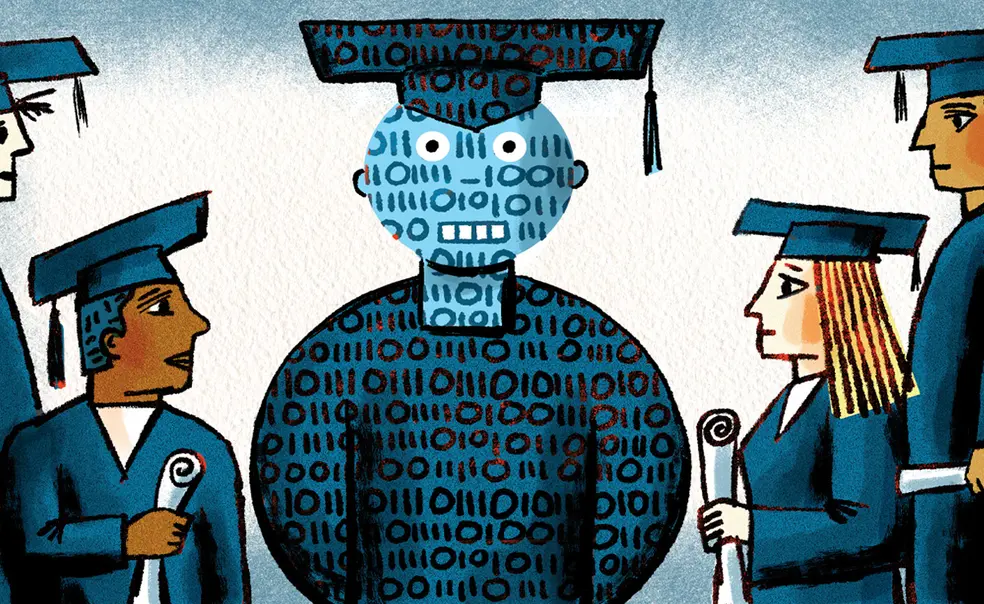


Four years ago, when the Class of 2026 attended freshman orientation, every talk seemed to circle the same question: “What does a Princeton student do?” The answers would take the form of thousands of divergent paths, shaped by choices like what we would study, which communities we would join, and how we might create a Princeton experience uniquely our own. No one mentioned — at least not yet — artificial intelligence, except obliquely, in reminders about academic integrity policies and professors’ quiet uncertainty about how it would reshape the classroom.
Now, as seniors ponder a new question — “What does a Princeton student go on to do?” — the influence of AI on the job market and long-term career plans has become impossible to ignore, even in popular fields that regularly send recruiters to campus.
Of the roughly 1,200 Class of 2024 graduates who responded to the Center for Career Development’s survey of first destinations after graduation, 16% chose jobs in finance. For many, however, this choice reflects precaution rather than aspiration. Four of the 15 students who spoke with PAW for this story described entering the finance recruiting pipeline despite having little interest in the work itself. As one student put it, the decision felt less like a commitment than a contingency plan: With recruiting timelines beginning as early as freshman year, opting out early can feel like forfeiting the option entirely.
The sense of stability once underpinning these early decisions has begun to erode, as some companies have opted for AI-driven productivity gains, rather than hiring. Students said that entry-level roles in finance, consulting, and computer science feel increasingly uncertain. Several pointed to shrinking analyst classes, tighter return offers, and the replacement of routine tasks with automated tools as evidence that junior roles are becoming more precarious.
Students are responding to this uncertainty in markedly different ways. Some are applying to more of these increasingly scarce entry-level roles. One student, a School of Public and International Affairs major who requested anonymity because they are still searching for a job, explained that they “bulk applied” to about 40 finance and venture capital jobs, “just submitting one after another, changing the cover letter slightly for each.” The motivating force, they noted, was not interest but panic.
Even those who have already secured offers feel the instability. Another senior, who asked to remain anonymous, accepted a full-time position at JPMorgan but said that “AI could still take over my job as a junior banker,” noting that the work he does could be used to train AI.
At the same time, others are energized by the so-called “AI revolution,” viewing it as an opportunity to lean into what they believe is irreplaceable about their own ways of thinking and being. Devan Morey ’26, a SPIA major planning to pursue a career in law, explained that her response to AI has been to increasingly “exercise personal ways of thinking that can’t be outsourced to an algorithm — creative muscles, interpersonal nuance, and empathetic problem solving.”
Daniel Pries ’26 echoed this sentiment, emphasizing that human lived experience is “something that AI can never really replicate.” Though he majors in operations research and financial engineering and plans to pursue a career in technology, Pries said his passions lie in music and in forging meaningful human connection.
“As AI becomes more prominent, humans will start to see human things — crafted, written, molded, discussed — as more genuine and have a greater appreciation for what’s human,” Pries said. “There’s a certain level of raw expression that can’t really be replaced by AI.”
Perhaps the more hopeful response to AI, then, is not resistance but recalibration. AI may replace redundancy, automate patterns, and optimize workflows, but it cannot replace thoughtful writing, artistic risk, or the authenticity of lived experience. And the four years spent answering “What does a Princeton student do?” — through experimentation, failure, and formation — help students discover what cannot be automated. That discovery, more than any job pipeline or technical skill, ultimately shapes not just what a Princeton student does, but what they can go on to become.
The Latest
See all


Related News

Janice Lee ’09 Worked to Renovate One of Hollywood’s Best-Kept Secrets
An engineer by training, Lee has been deputy project manager on the renovation of Hollywood Burbank Airport


No responses yet