
Princeton Teams Just Keep Winning. What’s Going On?
Tiger teams won 17 Ivy League championships in 2025-26, tying their own record set the year before
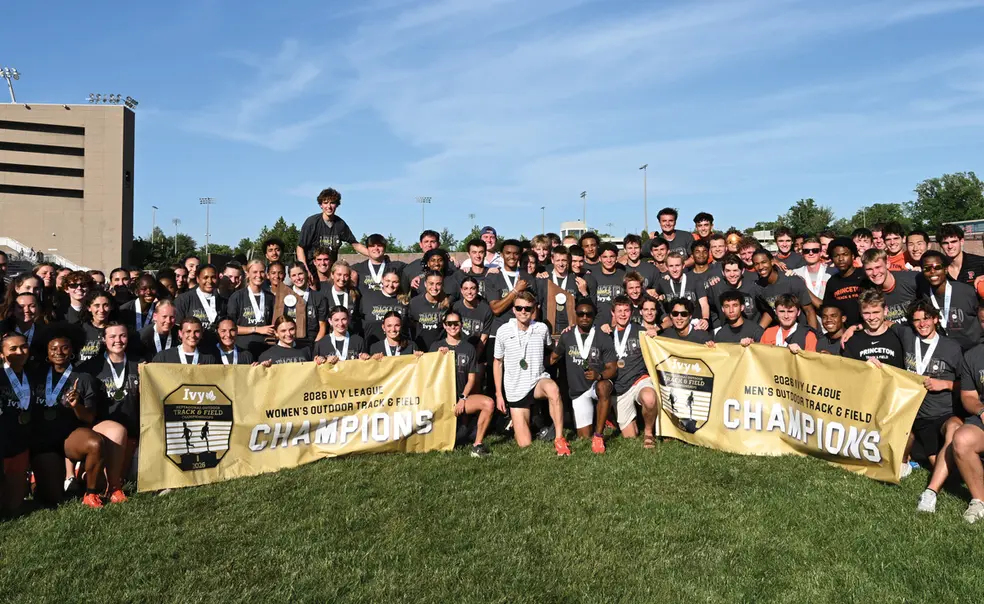

For the last two years, Princeton athletics has been on a roll, a winning streak, a generational heater. Tiger teams won 17 Ivy League championships in 2025-26, tying their own record set the year before, and 28 programs either qualified for the NCAA postseason or sent athletes to national championships. Men’s lacrosse won the NCAA title and field hockey was the national runner-up. Women’s lightweight rowing and women’s squash star Zeina Zein ’27 won national titles in both years.
On the strength of its postseason results, Princeton finished 20th in the Division I Learfield Directors’ Cup standings, a measure of overall athletic success, one notch below Notre Dame. The top 19 schools spent, on average, nearly $220 million on athletics, more than four times Princeton’s budget for varsity teams.
In an era of college sports often defined by billion-dollar media rights contracts and million-dollar name, image, and likeness (NIL) deals for individual athletes, an Ivy League school would seem to be overmatched. And yet, Princeton keeps winning. How?
“If I had an answer, I’d probably bottle it and sell it,” joked John Mack ’00, Princeton’s athletics director since 2021. He points to several factors: Princeton’s world-class academic reputation, the administration’s support for athletics, stellar facilities, alumni donors, and a roster of experienced coaches who are dedicated to attracting athletes who’ll be a good fit at the University. “I think it’s the combination of all of those things, plus a culture that values success,” Mack said. “We talk about winning a lot, but we don’t talk about winning for winning’s sake.”
“Culture” may be an overused term, but Mack can point to examples of what he means. For instance, each summer his department hosts a coaching summit for the staffs of all 38 varsity teams, allowing coaches to share ideas and discuss what’s working (or isn’t) in their own programs.
“It’s really cool,” said Abby Brethauer, who has led her team to championships in each of her three years as head coach of Princeton women’s swimming and diving. “It’s all coaches — so from the third assistant to, you know, Matt Madalon, who just won a national title — and we’re all in the room together.”
High on the list of topics is recruiting, a challenge for all Princeton coaches and the first step to a successful team. “If you want to win an Ivy League title, in any sport, you have to recruit athletes who aspire to compete at the national level,” said Jason Vigilante, head coach of men’s track and field and cross country, whose teams have swept the Ivies for three straight years.
For Carla Tagliente, who has led field hockey to four NCAA Final Four appearances, that often means recruiting athletes who are being wooed by other prestigious schools (Duke, Northwestern) that offer athletic scholarships. But for every perceived recruiting disadvantage Princeton might have, Tagliente has a counterpoint. While the Ivies have never had athletic scholarships, Princeton has arguably the best financial aid in the country. Princeton doesn’t bring in transfers, but that gives the athletes who come here a chance to develop over four years — and not worry about a star transfer taking away their playing time.
Yes, academics are difficult at Princeton, Tagliente said, but coaches recognize that and create more balance for players, who learn to handle their coursework amid busy in-season schedules. “I tell kids in recruiting, ‘When you leave here, no one’s going to hand-hold you through your job just because you played a sport,’” she said. “They’re learning critical skills that will then also be transferable into the real world for them. I think it’s an advantage.”
Brethauer said she looks for recruits who appreciate Princeton’s swimming tradition and want to build on it. It’s a common theme in an athletics department that has real history, winning more Ivy team championships than any other school and more than double the titles of every league rival except Harvard. Since 1974-75, the first full year of women’s championships in the league, Princeton has averaged 10 Ivy titles per year.
Tradition also plays a role in fundraising. “Athletics philanthropy is huge,” said Allison Rich ’91, who recently served as athletics director at the University of New Hampshire following nine years as a senior administrator at Princeton. “When you don’t have the giant budgets of some of the schools you’re competing against, to be able to take a foreign trip for development purposes or to add equipment that helps monitor heart rate or workload, for example … that makes a big difference.”
Tiger Athletics Give Day, the department’s annual fundraising push, raised nearly $6.7 million in December, with donations from more than 6,000 alumni and friends. The University has also received major gifts from alumni for recent facility additions including Cynthia Lynn Paul ’94 Field (softball), Haaga House (rugby), Wilkinson Fitness Center, and the Class of 1986 Fitness and Wellness Center.
Even with that backing, Princeton’s athletics budget is not an outlier. Princeton spent $50.3 million on varsity sports, the third highest total among Ivy schools, in 2024-25, the most recent year recorded in the U.S. Department of Education’s Equity in Athletics Data Analysis. Yale topped the list at nearly $78 million, while Dartmouth landed at the bottom with $42 million.
Reputation, like tradition, might be part of Princeton’s lasting success. Some Ivy schools are perceived as sporty, others less so. Jonathan Tannenwald, a Philadelphia Inquirer sportswriter and 2006 Penn grad, recalled that when he toured Columbia as a prospective student in the early 2000s, the guide said the campus didn’t care about sports and was proud of that. A quarter century later, students in Morningside Heights may feel differently: Lions teams have won Ivy titles in football, baseball, women’s basketball, men’s tennis, and men’s and women’s fencing in recent years. “Whatever hierarchy there is,” Tannenwald said, “it could change at any time.”
Indeed, while Princeton’s top-20 ranking in the Learfield Directors’ Cup was impressive, Yale (45th) and Harvard (48th) were not far down the list. Penn, Yale, and Columbia also finished in the top 80 among the 301 Division I schools ranked. The Ivy League placed fifth among conferences, behind the SEC, Big Ten, ACC, and Big 12.
Princeton’s success may be part of a larger story about the Ivy League’s enduring place in college sports in spite of — or maybe because of — changes like NIL, revenue sharing, and the transfer portal that have blurred the distinction between collegians and pros. Men’s basketball has seen some star players depart as transfers, but in most sports, Ivy athletes still stay and play four years. “There will always be a pool of really exceptional students who just happen to be phenomenal athletes who want the kind of experience that we provide, where you don’t have to sacrifice your academic pursuits and ideals for your athletic pursuits and ideals,” Mack said.
So even when the ball doesn’t bounce the Tigers’ way, in the years when teams win, say, 11 Ivy trophies instead of 17, Mack can measure success in the conversations he has with team captains who tell him about the classes they’re taking, the internships they’ve completed, and the career goals they’re chasing. “For me, it’s one of the barometers that we’re still doing it right,” he said. “Princeton’s still changing lives, and athletics is still a fantastic vehicle to do that.”
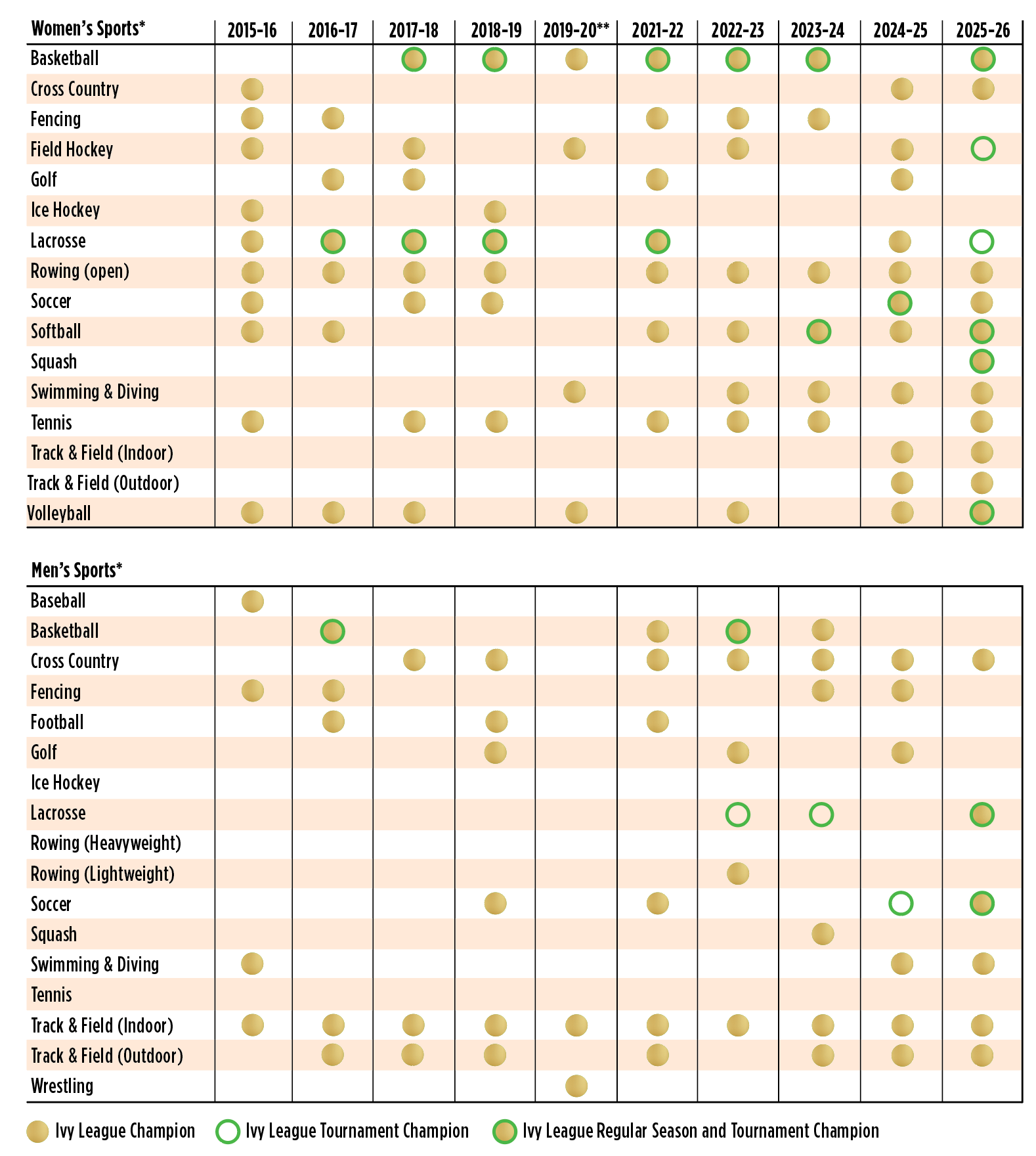
Princeton’s Ivy League Titles Since 2015-16






2 Responses
Reed M. Benet ’84
1 Week AgoPrinceton’s Improbable Ivy Dominance
After seeing PAW’s chart of Princeton’s Ivy League titles since 2015–16, I asked ChatGPT to help put the record in perspective. And, as per the “ChatGPT can make mistakes. Check important info” disclaimer, thankfully PAW managing editor Brett Tomlinson provided a backstop to our first draft.
The chart shows 126 regular-season Ivy titles: 77 in women’s sports and 49 in men’s. Across 16 women’s sports and 17 men’s sports over the 10 seasons shown, that’s 330 sport-season opportunities. If each of the eight Ivy schools had an equal, independent chance to win each title, Princeton would expect about 41.
Instead, Princeton won 126 — more than three times that number. Under this deliberately simple model, the odds of winning at least that many are roughly 1 in 3.58 × 10^31, or “effectively zero.”
Of course, college teams aren’t randomly assigned their strengths — and, of course, Yale sucks. But the comparison captures the breadth and consistency of Princeton’s success.
From a former lightweight crewbie and rugby player: Go Tigers!
Jerry Peacock ’79
2 Weeks AgoTiger Athletes Lead the Way
Love seeing Princeton Athletics continue lead the way in a world turned upside down due to NIL’s impact on Division I “money sports”!