

The Race To Save the Night
Princeton astrophysicist Gáspár Bakos joins the fight against a startup offering ‘sunlight on demand’
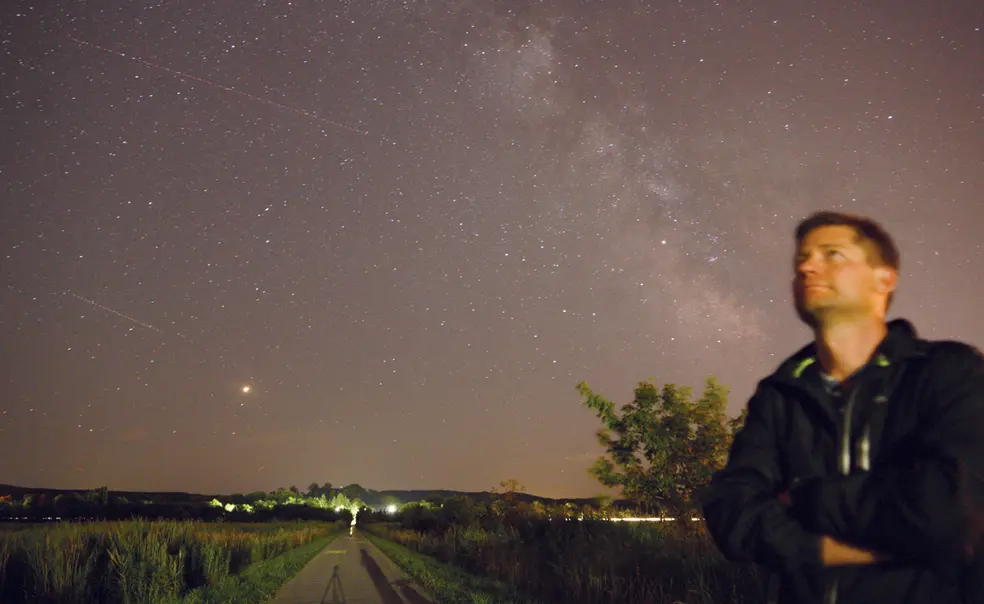

Gáspár Bakos explores the universe for a living. As a professor in Princeton’s Department of Astrophysical Sciences, he studies planets outside the solar system. He also looks for exploding stars, near-Earth asteroids, and anything changing in the sky.
This work keeps Bakos up at night, but it’s not the only thing. He is also an advocate for night sky conservation in the United States, Chile, and Namibia. Bakos has tracked Princeton’s growing light pollution problem for years. In his spare time, he works with both the University and the Municipality of Princeton to limit excess artificial light at night.
But a new development threatens to obliterate his dark-sky advocacy work. A California-based startup, Reflect Orbital, plans to launch more than 50,000 satellites into orbit by 2035. Using space mirrors, the company offers “sunlight on demand” by reflecting sunshine back to the Earth at night. Reflect Orbital says it will provide beams of light at least 5 kilometers wide to replace streetlights, boost crop yields, and extend solar panel use. The company submitted an application in January to the Federal Communications Commission, which licenses communications satellites in the U.S., to launch one test satellite.
Bakos is alarmed. He points to established research showing that artificial light at night interrupts the sleep-wake cycles of all living things. In humans, this disruption is associated with an increased risk of breast cancer. Light pollution also affects wildlife by interfering with nighttime activities such as foraging and migration. A 5-kilometer-wide beam would be even more polluting than a similar-sized town lit by streetlights, he warns. While streetlights focus on only roads and walkways, an orbital shaft would be indiscriminate.
“They will light up things we don’t need to light up,” he says. “It will light up the nest of an owl, it will light up my roof, it will light up the meadow where the fox is hunting. It’s a terrible thing.”
Environmental impacts are not the only concern. Bakos also questions the science. Reflect Orbital claims to offer precise sunbeams, yet this is impossible, he notes. Light particles scatter in the atmosphere and are also reflected upward from the ground and clouds, creating skyglow. The consequences are profound. The more light diffused across the sky, the greater the ecological harms and the fainter our view of the stars.
Bakos was born in Hungary but spent his childhood in Nigeria. It was on a remote farm on the Cameroonian border that he developed his love for the night skies. Now, he relies on darkness to conduct astrophysical research. Using ground-based telescopes located in four countries, his research group has found 144 exoplanets so far. He also introduces astronomy students to the marvels of the constellations, yet light pollution is already degrading their experience. He worries their celestial view could soon vanish.
Reflect Orbital says that won’t happen.
“Conventional skyglow analysis assumes light sources that emit in all directions, including sideways and upwards,” said in an email statement to PAW. “That analysis does not take into account a directed downward light source from orbit, which several pre-eminent academics have found to significantly reduce light scatter.”
Bakos disagrees. Photons are redirected by atmospheric particles before they even reach the ground, he explains, as established by the Rayleigh and Mie scattering processes.
“There is no peer-reviewed scientific paper proving the claim that downward-scattered light will be scattered less,” Bakos says.
Reflect Orbital also points to the overall vision. “We are striving to harness space technology for the benefit of humanity,” the company says by email. “Energy poverty affects billions of people, and humans are struggling to meet our energy demands without harming the planet. Asking how space-based technology can help solve that dilemma is, in our view, a worthwhile endeavor.”
Yet this position has attracted widespread skepticism. A global community of scientists raised concerns with the FCC, among them the American Institute of Biological Sciences (AIBS), which represents 28 scientific bodies across disciplines including astronomy, biology, and meteorology. In its FCC comments, the organization registered grave concerns about the plan. It notes that redirecting sunlight could affect human health and ecosystems and have significant impacts on the atmosphere and on astronomical observations.
“For these reasons, we believe that the proposal does not serve the public interest, and urge the Commission to deny the application, or at least require a thorough environmental impact assessment before any license is granted,” AIBS wrote.
Reflect Orbital says it welcomes regulation and will conduct environmental impact assessments, including with independent third parties.
Yet for Bakos, the concept raises an even larger question: Who has access to the cosmos, and who has the right to commercialize it? Space is inseparable from our environment, he notes. To treat it as distinct is shortsighted. In addition, natural darkness is part of the global public commons, while our view of the constellations belongs to culture and heritage, not to private corporations.
For this reason, even while scanning the galaxy for his own research, Bakos feels compelled toward advocacy closer to home. “The view of the night sky is our treasure,” he wrote in his comments to the FCC. “It does not belong to Reflect Orbital.”
The Latest
See all


Related News

Jeremy Chen ’11 Is Cleaning up a Community While Offering Hope to Kids
Chen started Klean Kensington in his corner of Philadelphia by paying teenagers to pick up trash


David Trefgarne ’63’s Run in Britain’s House of Lords Is At an End
Parliament passed legislation this spring ending the tradition of hereditary peers

No responses yet