

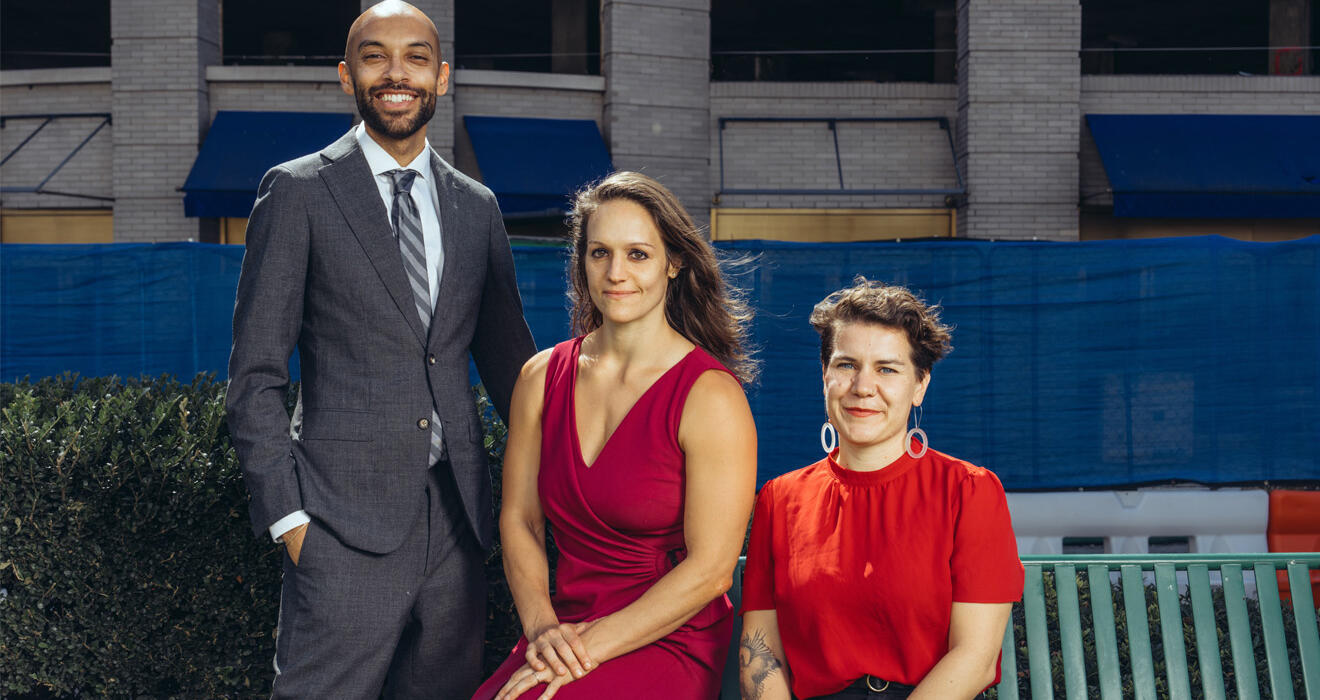

When Gillian Pressman ’08 was working at a nonprofit in the late 2010s, she lived in a 400-square-foot studio apartment. “By San Francisco standards, I had it good,” she says.
On Pressman’s four-block walk to the subway, she would pass at least five homeless groups in tents as well as people sleeping in the train station. “You couldn’t escape it,” she recalls.
The problem got personal when she asked a date where he lived. “He was dodgy,” she remembers. He then acknowledged he had a job but was living in his car. He’d shower at his gym.
“You wouldn’t have known he was homeless,” she says.
Pressman, then in a job providing mental health and sex education in schools, wanted to learn more. She attended a one-day introduction to YIMBY (Yes In My Back Yard), a movement that advocates for a mix of regulatory relaxations across the nation to encourage more housing construction. The event was sponsored by YIMBY Action, the major umbrella organization, and showed her “San Francisco was one of the hardest places to build housing.”
In 2019, Pressman began volunteering for YIMBY Action and later that year joined full time as director of development. In 2022, she became managing director, coordinating operations, fundraising, and strategy. Pressman left her position in December but remains involved as a YIMBY Action board member.
“We need to shift our mindset,” says Pressman, who moved last year from Norfolk, Virginia, to Washington, D.C. “Allowing housing in your neighborhood is what we do for a good society.”
Recent studies point to an ever-tightening housing market. Zillow last year estimated that the U.S. housing shortage grew to a record 4.7 million units. In a report titled “Priced Out: When a good job isn’t enough,” the National Housing Conference said even dentists and civil engineers could not afford typically priced houses in some cities.
By most accounts, the YIMBY acronym — aiming to counter the NIMBY (Not In My Back Yard) mindset — dates to the 1980s. But the movement began gathering strength in the 2010s, particularly in California, which ranks among the states with the largest housing shortages. There, “the grassroots movement is really pushing it,” Pressman says. Of YIMBY Action’s 83 local chapters, 20 are in California.
Activists scored a major victory last year when the state revised the California Environmental Quality Act to provide exemptions to high-density housing projects not lying in environmentally sensitive areas, streamline the approval process, and reduce the litigation timeline.
Affordable-housing advocates also won in November with the elections of governors Mikie Sherrill in New Jersey and Abigail Spanberger in Virginia and New York City Mayor Zohran Mamdani. Both governors said they would expedite the review and permitting processes for new housing, and Mamdani vowed to freeze rents for tenants in rent-stabilized apartments.
Some municipalities have made dramatic gains. In Falls Church, Virginia, outside Washington, the number of housing units has jumped 46% since 2020. Residents are happy, Mayor Letty Hardi says: 94% described life in Falls Church as “good or great” in a survey last year.
“We always end up having people vote for good things to happen because they have seen the results,” she says.
But construction projects in two nearby suburbs, Arlington and Alexandria, have been tangled in lawsuits. And in Connecticut, Gov. Ned Lamont last year vetoed a bill seeking to expand housing, saying it hamstrung municipalities.
Carl Gershenson is the managing director of Princeton’s Eviction Lab, which studies the nation’s housing crisis. He says YIMBY advocates “have been successful in getting political bodies to embrace policies that should increase the housing stock.” However, the increase hasn’t been substantial. “You would never expect policy reforms to create sufficient housing in a matter of a few years,” he says.

Princetonians are lobbying for YIMBY goals in a variety of locations and positions.
Jessica Sarriot *18 is co-executive director of VOICE — Virginians Organized for Interfaith Community Engagement. She sees “status quo bias” as a major challenge: Local politicians who become state legislators often give deference to municipalities, particularly on land-use issues.
Sarriot supports a YIMBY offshoot called YIGBY, or Yes In God’s Back Yard, which permits faith organizations to build housing on their properties. YIGBY bills were introduced in the U.S. Senate and House in September. Virginia legislators tabled a similar bill, but Sarriot is working to revive it this year.
“If I didn’t think we could win,” she says, “I wouldn’t be doing this.”
Joshua Seawell *22 serves as head of policy at Inclusive Abundance, engaging federal lawmakers on issues such as housing and energy. The organization follows the abundance philosophy, championed by political commentator Ezra Klein, which believes society has adequate resources to solve its toughest problems.
“With all the focus on deportations or Palestine or Trump’s appointments, it’s hard to get floor time for other things of importance,” says Seawell, who is based in Los Angeles.
In a big win for YIMBY, the Senate last year tucked the provisions of the ROAD to Housing Act, including initiatives to increase housing supply and affordability, into its version of the National Defense Authorization Act. The House, however, deleted the housing language in December. Seawell hopes Congress can reach a compromise this year.

YIMBY leaders say the movement draws bipartisan support. “We have socialist members and libertarian members,” Pressman says.
The recent election winners are Democrats, but Montana’s Republican Gov. Greg Gianforte has won passage of a series of housing reforms, known as “the Montana Miracle.” Sarah Rogers ’94 also sees a range of philosophies among the members of D9 Neighbors for Housing, an organization she helped revive to lobby for new housing in San Francisco’s District 9.
“We want more neighbors,” says Rogers, who works as a chief operating officer for an investment fund. “More neighbors makes for a better and more resilient community.”
The YIMBY playbook goes beyond new buildings. Smaller strategies include:
• Less parking. Montana substantially reduced parking requirements for housing. “They add a ton of expense and take up a lot of space,” Pressman says.
• More accessory dwelling units (ADUs), once known as in-law suites. These account for one in five new units in California. Norfolk recently joined the list of cities easing restrictions on ADUs.
• Fewer stairways. Cities such as New York and Seattle now require only one stairway in six-story buildings, freeing space for more units. A Pew Charitable Trusts study last year found no increased safety risk, but the International Association of Fire Fighters and the Metropolitan Fire Chiefs Association say “lives will be endangered” in single-stairway buildings.
YIMBY groups also support major construction projects, and not just subsidized housing. “We have to build housing at all levels,” including luxury condos, says Pressman, now head of development for Inclusive Abundance.
That creates a domino effect in moves, and “it only takes a few chains in the sequence to open new housing options for lower-income people,” says Zack Subin, associate research director for Berkeley’s Terner Center for Housing Innovation.
“By making housing more affordable,” he says, “you stop the flow into homelessness.”
In 2023, the Urban Institute saw “no statistically significant evidence that additional lower-cost units became available or less expensive in the years following reforms.” But a
2023 article in the Journal of Urban Economics and a Pew study last year found an increase in availability of affordable housing.
Low-income residents don’t always side with YIMBY. Norfolk’s City Council in March overwhelmingly approved a 154-unit apartment complex over the objections of the neighborhood’s civic league president, Jamie Pickens, who complained it would deepen pockets of poverty.
The revisions to California’s law also drew opposition from environmental groups. But Subin, who did postdoctoral work at what is now known as Princeton’s High Meadows Environmental Institute, says YIMBY’s objectives help reduce car use and carbon emissions.
“Our job,” Pressman says, “is not convincing NIMBYs; our job is convincing people who are ‘yes’ to get more active. You can be one person who decides to show up and totally shift the atmosphere in the room.”
Philip Walzer ’81 is a retired journalist and magazine editor in Norfolk, Virginia.
Related News
With Prominent Journalists and Hoagies, the ‘Prince’ Celebrates 150 Years
A gala at the New York Historical raised roughly $400,000 for the independent student newspaper


9 Responses
Ender Berberian ’96
6 Months AgoCommon Sense Rules for Subsidized Housing
I am concerned that because of the way subsidized housing restrictions are written, residents are reluctant to accept help from churches and charitable organizations for needs such as healthcare bills, lest this aid be considered “additional income,” which would disqualify them from housing. I hope future subsidized housing rules can explicitly allow residents to accept charitable donations to cover immediate needs without jeopardizing their eligibility.
Rocky Semmes ’79
8 Months AgoStarting at the Very Beginning
Philip Walzer’s comprehensive coverage of the nationwide YIMBY movement quotes Zack Subin, associate research director for Berkeley’s Turner Center for Housing innovation, who says that “by making housing more affordable, you stop the flow into homelessness.” But with the United Nations Population Fund (UNFPA) reporting that nearly half of all pregnancies worldwide are unintended, isn’t global funding-to-scale of Planned Parenthood the optimal solution to the housing problem? Stopping the “flow” of the homeless (i.e., people) would seem the first and foremost forthright step toward solving the homeless problem.
Simultaneously, this solution also addresses globally complex conundrums like hunger, immigration, environmental degradation, and a hearty host of other human problems. The popular song from the film Sound of Music succinctly says it all, “Let’s start at the very beginning / A very good place to start.” Overlooking the overwhelmingly obvious connection here seems utterly unimaginative, improvident, and frankly stupid.
Bill Richardson ’73, Charles Henkin ’64
8 Months AgoConsidering the Impacts of Housing and Zoning Policies
In the February PAW, a fellow Virginian described the commendable efforts of alumni to address the demand for housing. As president and board member of our neighborhood civic association in Arlington, we have been following this issue. So has Princeton. A prior notice in the PAW led us to Professor Aaron Shkuda, who is teaching a course on Affordable Housing in the United States.
We take no issue with the general concern that many would benefit from cheaper homes. This does not, however, mean that one size fits all.
At one end of the income scale, many recognize we do not have sufficient “affordable” housing (i.e., for those making less than area median income). However, low-income housing is extremely difficult to build in areas like Arlington, where land is expensive. At such lower income levels, we need more public funding. As Rep. Alexandria Ocasio-Cortez has put it, “[o]utsourcing development to the private market” is not a solution to the affordable housing problem.
For middle- and upper-income residents, the issue is different. It is simply not clear that more housing lowers prices for everyone. As the article recognizes, some studies show that if we dispense with zoning protections, developers will simply build more luxury homes. The homes built following such a change in Arlington reflect this marketplace behavior. The litigation referred to in the article challenges this zoning change as increasing density without adequately considering impacts on transportation, traffic, schools, and other crucial services.
Jim Edmondson ’67
8 Months AgoSubsidies Matter for Affordable Housing Developers
Kudos to PAW for bringing this important issue to the attention of alumni. It misses some key elements that are required actually to accomplish the goals of the YIMBYs. As an affordable housing developer for 45 years I know the terrain.
Housing production is a local issue driven by local market forces, not determined by national models. Every locality has its own parameters. The focus of YIMBY advocates on zoning densities, parking requirements, environmental restrictions, and other measures to ease construction and development costs is important but not adequate to the solutions. Capital subsidies for covering costs and/or rent subsidies for the lowest income households to be served are essential.
The fundamental cause of the lack of affordable housing: an owner (even a public owner) cannot rent an apartment for $1,000/month if the cost of the building is $350,000 per unit, as it is in my market, unless the capital structure for building the unit has very substantial “free money,” i.e. capital subsidies from government at every level. My company competes for awards of local, state and federal resources. Yes, take the steps in the article: higher density, taller buildings, reduced parking, less open space, faster by-right processing. If I had the benefit of all of them, maybe the cost would go down 10%, but affordable rents still won’t carry the debt without subsides.
The “free money” in the capital structure — tax-credit equity, state reduced-price loans and local subordinate debt — will need to be $200,000 or more. That’s daunting, especially for local government officials, but many municipalities have stepped up.
The “free money” can come in other forms. In our area local churches and their governing bodies (YIGBYs, as noted in the article) have offered reduced-price land. Local governments have surplus land that they have designated for our use.
I applaud the YIMBYs for their advocacy. Here is the most important tool for use locally either by local choice or mandated by the state: require that a certain portion of new units produced on a parcel of five or more acres include a percentage of units that is priced for households with incomes well below the area median, whether for sale or rental. Many jurisdictions in our area have used this tool. This tool puts local governments in the “compliance” business to hold the property owners and tenants to account for the subsidies for the life of the project’s financing. A necessary burden.
Of course, localities have also done foolish, counterproductive things. Please, please YIMBYs, no rent freezes. They stop new construction and cause deterioration of the stock. The new mayor’s plan in New York City will prove disastrous. The city council in D.C. froze evictions during and after COVID, which also proved disastrous.
The tools in the article as a full solution at the national level won’t work. Knowledgeable local government officials know that truth, and I hope the advocates will see it as well.
Christopher C. Binns ’69
8 Months AgoSubsidies Needed to Build Affordable Housing
I bought my house in Dorchester (Boston) in 1979 when they were being given away. Today, Boston is unaffordable for anyone without a foothold or household income of $120,000 to rent or $190,000 to buy, with the exception of income-restricted housing. Reforms described in “Saying ‘Yes’ to Housing” (February issue) are helpful but have marginal effects on the cost to build housing. A modest two-bedroom apartment in Boston costs at least $700,000 to build, primarily because of the cost of land, materials, and labor. Major subsidies are required for affordability to the middle and working class. Boston cobbles together federal, state, and city subsidy sources, but the main subsidy is the federal Low Income Housing Tax Credits. Most subsidies are only for rental housing. Income-restricted owner-occupied housing, critical for generational wealth building, has fewer avenues for success.
Moreover, in a prosperous city with a tiny footprint, like Boston or San Francisco (roughly 45 square miles each), most of the surrounding cities and towns vigorously oppose most attempts at multifamily housing at all, let alone income-restricted housing. Many of the wealthy suburbs of Boston see themselves as the country villages they were in the 18th and early 19th century, rather than the bedrooms for the wealthy who depend upon the Boston economy for the generation of that wealth. The answer is money, lots of it. Without subsidies to build, the middle class and working class in economically successful major cities will be priced out. It’s already happening here.
Jacob Oppenheim ’09
8 Months AgoPrincetonian Housing Advocates Include Polis ’96, Campbell ’04
I was glad to see PAW cover the role of Princetonians in the burgeoning YIMBY movement, working to ensure abundant housing for all Americans. I was surprised, though, at who the article chose to mention. Many of the strongest pro-housing reforms in the country were passed by Gov. Jared Polis ’96 in Colorado, which has been the rare blue state to rapidly increase its supply of housing, supporting robust population growth, including in city centers. Massachusetts Attorney General Andrea Campbell ’04 has been aggressively pursuing legal action against cities and towns that fail to meet their obligation to build more housing and leads one of the most avowedly pro-housing AG offices in the country. She is a close ally of Massachusetts’ YIMBY groups, some of which are among the oldest in the country. I am sure there are many more Princetonians active in our movement who should have been mentioned, too.
Editor’s note: The writer is co-founder and board vice president for Abundant Housing Massachusetts.
Rachel May ’78
8 Months AgoLegislative Work for More Housing in New York State
Thank you for lifting up Princetonians who are on the front lines of the YIMBY movement. The fight for more homes is about affordability, access, and building great, walkable neighborhoods for young families and older Americans alike. Here in New York the legislative push for more housing is being led by my colleague Brian Kavanagh ’89 as chair of the New York State Senate Housing Committee. He has had some huge successes with programs to help renters and homeowners stay in their homes and to secure funding in the budget for more housing construction and renovation. I’m also proud to have championed a host of housing legislation tailored to upstate communities like Syracuse. My single stair bill made it into the budget omnibus two years ago (though it is still stalled in the fire code process); last year we got a revolving loan fund for housing development into the budget; and this year the governor is pushing some of my proposed reforms of our State Environmental Quality Review Act to boost infill development and reduce the pressure for more sprawl. I’m also spearheading an effort to allow cities to test a land value tax that would allow them to identify areas where differential taxation could spur owners of vacant land and surface parking to develop more housing instead. And Sen. Kavanagh and I have also been supporting the “YIGBY” (Yes in God’s Backyard) movement, to relax zoning restrictions in order to allow houses of faith that have extra land to develop that land for creating affordable and potentially supportive housing.
Editor’s note: The writer is state senator for New York’s 48th district.
Dean Wanderer ’67
8 Months AgoMaking Connections
I’m advocating for affordable housing in Virginia.
I would like to connect with any of these groups to discuss issues and ideas.
Doug Brown ’91
8 Months AgoCounterproductive Labels in Housing Discussion
Though many of the ideas espoused in the article may be good in principle, the author’s embracing of the YIMBY and NIMBY labels is not constructive. It’s important to keep in mind that the NIMBY name is a pejorative first created to attack those who oppose the so-called “pro-housing” movement. My personal experience trying to engage with these activists (who might be better categorized as YIYBY, or “Yes In Your Back Yard”) is that it’s much easier for them to label their opponents as obstructive than it is for them to understand the valid concerns many of us have about the negative aspects of neoliberal, market-based solutions to the housing problem.