

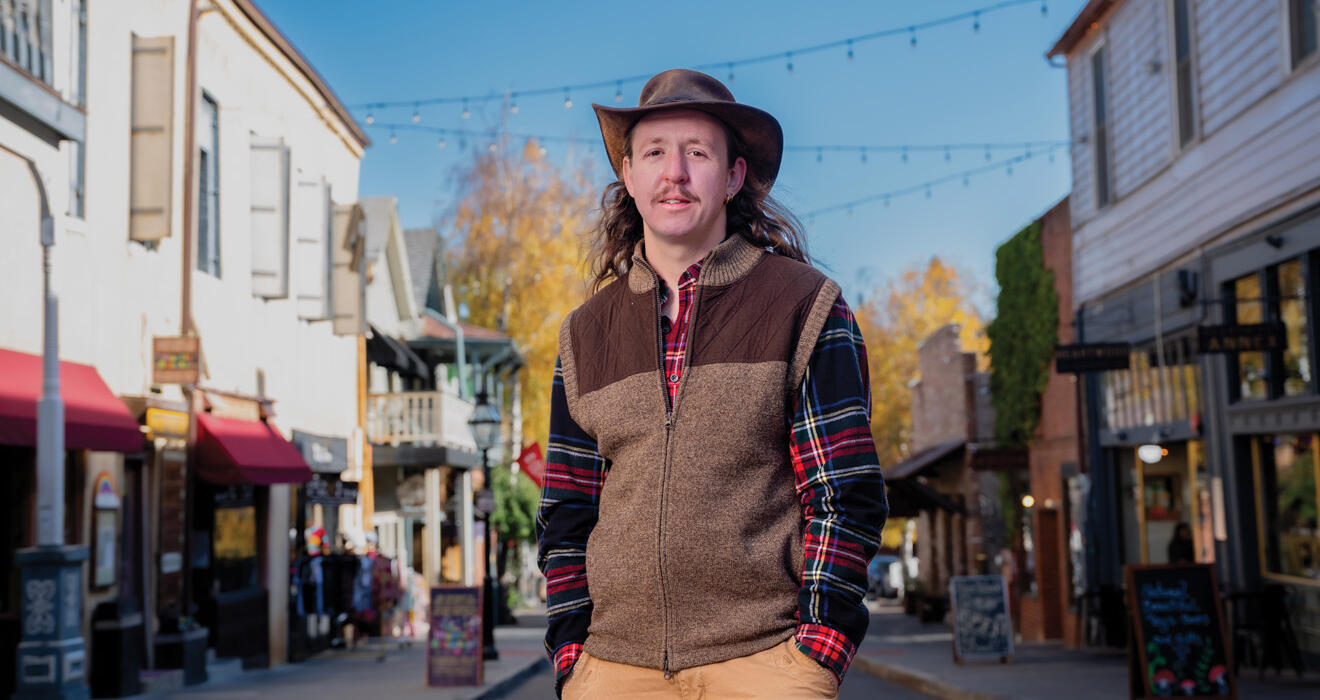

Angelo Campus ’16 lives in a small house at the end of a dirt road in Nevada City, California (population 3,244). Chickens peck around the yard, and he has plans to raise goats soon. He shares his homesteading dreams with his wife, Sabrina, and their 5-month-old baby, Cedar. Even though his base is just a few miles from where he grew up, Campus feels like an outsider when he tugs open the door of the local dive bar on a Friday night.
Campus chose to return home after attending Princeton for two reasons: His grandparents, who played a significant role in raising him, were aging and needed help caring for their farm and 150-year-old house. He was the only family member who could offer support. Also, he was in the process of bootstrapping his business, BoxPower, and could live cheaply on their property and ultimately, he hoped, create more jobs in his community.
As a teen, Campus washed dishes in the back of a local restaurant to pay for his expenses. He got to Princeton with the support of a guidance counselor and QuestBridge, an organization that acts as a kind of higher-education fairy godmother, pairing low-income, high-achieving students with four-year schools.
Because he came from a different background than many of his peers, Campus describes his Princeton experience as both an incredible opportunity and an “uncomfortable experience.” So uncomfortable that he contemplated dropping out before he became focused on using the University as a launchpad for his startup. Ultimately, BoxPower was a spinoff of a Princeton EPICS (Engineering Projects in Community Service) project, which Campus worked on exhaustively.
Yet when he came back home, he caught flak for leaving town to pursue an Ivy League education, with folks assuming he was now looking down on them.
“Sometime during undergrad, I realized I’m an outsider at Princeton because I come from this background, and I will now always be an outsider from my community that I come from because I went to Princeton,” Campus says.
He sees not really fitting in anywhere as the cost of leaving and coming back — but it was worth it. Campus was able to be with his grandfather until he died and is now caring for his grandmother, who is retired from working in the cafeteria of the local juvenile detention center.
Today, BoxPower has grown to more than 55 employees, half of whom live in the Nevada City area, and provides clean energy products to utility and commercial customers in rural areas.
“Just making ends meet is the norm here,” Campus says of Nevada City. Folks often bounce between restaurant gigs and work within the local cannabis industry. “Not a lot of people went to prestigious colleges, and very few of them came back.”
Even fewer of them came back and started a business. That’s because, unless it happens to be located near a booming urban center, the opportunities needed to pay for life, save for retirement, and advance professionally just aren’t always available. That’s true for many small towns around America — once thriving places that have been hit hard by mines closing, military bases or factories shuttering, or industrial jobs going elsewhere, and are now facing issues such as unemployment, food insecurity, an increase in natural disasters, and opioid addiction. Who is stepping in to offer these communities a hand, pathways to rebuild, or investment in their economic growth?
Over the years, academics, the news media, and alumni have argued over what happens when the best and brightest from small towns leave to attend Princeton and other elite institutions. Students graduate and tend to pursue the best jobs available, attaining upward mobility and sufficient financial security to pay off debt and support family members who remain home. The issue has become more acute as tech-related and high-paying jobs concentrate in urban areas.
Robert Wuthnow, a Princeton professor of sociology emeritus and author of the 2018 book The Left Behind: Decline and Rage in Rural America, explains the phenomenon like this:
“You’re a kid from a small town. All of a sudden you’re thrown into a place of 50,000 people. The college prides itself on recruiting students from other states and from other countries and so your friends now aren’t even from your state. Who are you going to date? Who are you going to marry? Probably somebody from another place. Of course, you’re going to move on. It might be that your job is one that you could have had back in your hometown, but by that time, you’ve kind of left your roots. That’s part of the dynamic that certainly applies to Princeton.”
PAW connected with alumni and faculty members from or living in small towns across America. A few of these towns are affluent, while others are struggling financially and have dwindling populations. Some alumni attended Princeton with a deep sense of loyalty to their roots and the single-minded purpose of bringing back skills that can strengthen their communities. Others grew up in cities but found their way to small towns, falling in love with the shared values, fresh air, and gentler pace.
The U.S. Census Bureau defines a “small town” as an incorporated area with 5,000 residents or fewer, while a “town” has 20,000 residents or less. Altogether, between 30 million and 50 million Americans live in small towns today.
Wuthnow left a small town. He was raised in rural Kansas, and after many years at Princeton, he retired to the Washington, D.C., area. He points to the economic reality: “How many neurosurgeons do you need in a small town? How many computer scientists do you need? How many economists do you need? Not that many.”
The pattern of folks in small-town America leaving to seek higher education opportunities and not returning is nothing new, Wuthnow explains. And the term often used to describe it, “brain drain,” is insulting to those who choose to stay behind or don’t have the opportunity to leave.
“Speaking as a sociologist, I have to lay some blame on my own discipline, which was founded at the end of the 19th century by people who were generally from small towns and had moved to cities,” Wuthnow says. “There was an argument about migration that said the smart people were capable of getting out, and so they did. The smart people went to the cities and the dumb people stayed behind.” Wuthnow vehemently disagrees with that assessment.
There are reasons to choose small-town life, say some Princetonians.
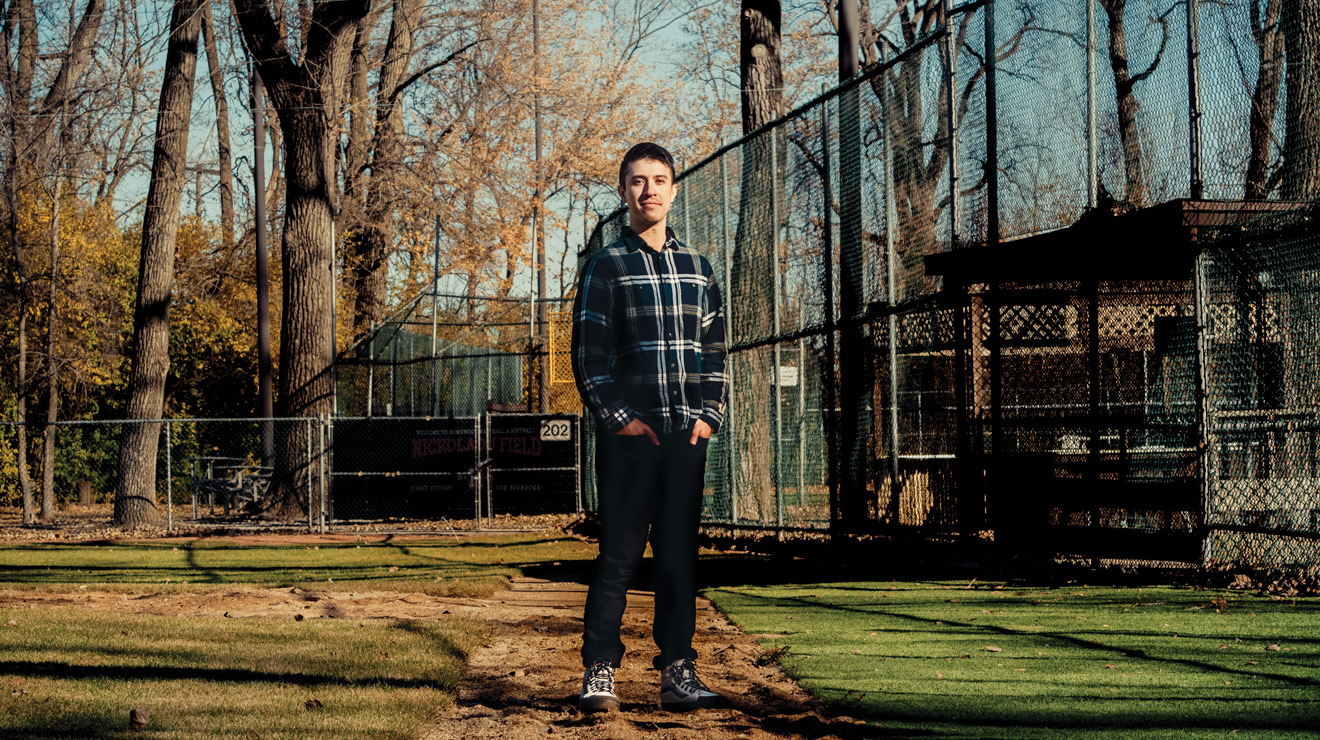
Kanoa Mulling ’15 made a big deliberate circle from his hometown of Homewood, Illinois (population 19,868), to Princeton, to Princeton in Asia, to grad school at Columbia University, and back to Homewood. He’s now an English teacher in Flossmoor, Illinois (population 9,700), at the same high school where he was a student. Standing in his classroom, he points to the desk where a teacher pushed him to fall in love with writing. Now he hopes he’s that teacher to his students.
Homewood is an easy train ride from Chicago, and Mulling describes it as a “minority-majority” community. As a kid, Mulling lived for after-school baseball practices at Izaak Walton Ballpark, which he describes as a family-friendly movie set, a field that is “all lit up at night in the forest.” His dad was his team’s coach, and then Mulling in turn helped coach his little brother’s team a few years later.
“I felt really enveloped growing up here,” Mulling says. “There are some beautiful traditions.”
At Princeton, Mulling attended career fairs but wasn’t tempted by consulting firms flaunting attractive starting salaries. There weren’t any recruiters trying to persuade students to work in rural America or faculty mentors generously offering to hook them up with phone calls to colleagues in small towns.
Princeton is known for its exceptional network, but its center of gravity points to big coastal cities and the sectors that boom within their limits.
Occasionally, alumni find their way to small towns, nonetheless.
Bonnie Lieu ’06 and her husband Andrew ’06 left Manhattan for Pennington, New Jersey (population 2,840), a wholesome yet affluent spot — about 9 miles from Princeton — with a median household income of $171,282, where the town turns out for the Fourth of July parade and a community Easter egg hunt.
They dreamed of their three kids being able to walk around on their own and staying off devices.
“It has played out for my kids exactly as I was hoping,” says Lieu, a homemaker, PTO president, and church Bible study leader.
Lieu, who previously worked as a secondary school educator with the Princeton University Preparatory Program, is one of five people in TigerNet who describe their current position as “homemaker.” She says that when she goes back to Princeton and sees all the things her peers are doing, she worries they think she’s “wasting” her education. Yet she feels a real sense of purpose in her volunteer work, which fills more than 12 hours a week.
“These systems — the church, the school — rely on people in the community, volunteers who are organized and on top of things, or else they can’t survive,” Lieu says.
From the time she was 10, Lieu’s oldest child was allowed to walk to the local pool alone. “She can’t make it to the pool without six people telling me that they saw her,” Lieu jokes. “That’s part of the small town thing. There’s something special about a community where you know and see everyone.”
“We have a romance with small towns,” says Kathryn J. Edin, a Princeton professor of sociology and one of the nation’s leading poverty researchers. “Yet small towns are struggling across the board.”
Edin, who comes from a tiny town in Minnesota where she says there would be “no job” for her as an academic, co-authored the 2023 book The Injustice of Place: Uncovering the Legacy of Poverty in America, the result of a five-year odyssey through South Texas, the Cotton Belt, and Appalachia.
“The small towns that I wrote about are of a particular kind. They’re these very disadvantaged places that have this history of resource extraction and human exploitation that you don’t find elsewhere in the U.S.,” Edin says.
She points to a tiny town where a pastor profiled in her book was successfully battling the local opioid epidemic on a shoestring budget. “You can do a lot of good in small towns,” she says.
That’s a story that would resonate with Jack Busche ’19, a pastor at Grace Lutheran Church in Gwinn, Michigan (population 1,268). Busche grew up in Stratford, an agricultural town in Wisconsin where he milked cows on dairy farms during summer breaks when he wasn’t a counselor at a Christian youth camp. A religious studies major, Busche found that Princeton’s scholars of diverse faith traditions fueled his curiosity and ultimately led him to the seminary.
He watched as many of his peers were recruited to high-paying jobs with Fortune 500 companies instead.
“The Orange Bubble is real, if you know what I’m talking about,” Busche says. “It’s not even a critique of the kids who are going to the school. What are they supposed to do? The environment is shaped by the money that’s all around. I think it’s good that Princeton advocates for service, but just to be frank, I think there’s a disconnect between the student population and what the actual needs of working-class communities are.”
Busche doesn’t have generational wealth to draw upon and would make a higher salary leading an urban church — but that’s not where he feels called.
“Rural places often have a lack of resources or connections to resources that urban centers have,” he says. “I was drawn to serving families that I understand a little better.”
Wuthnow, whose book research involved seven years of fieldwork across America, noted that a once-booming small town — lifted by a meat-processing plant or logging company — can quickly fall into unemployment and poverty when its economic mainstay shuts down.
That’s the pattern Busche is trying to break in Gwinn, a community with a median household income of $52,609. He and his wife live on land that was part of K.I. Sawyer, a U.S. Air Force base once home to 6,000 servicemen and women and their families that shuttered in 1995.
Gwinn was originally founded as a model town by a mining company in 1907. Later, when Sawyer was operating, “there was a sense that Gwinn was part of the wider world,” Busche explains. But nowadays the town has significant problems with drug and alcohol addiction and food insecurity, as well as infrastructure challenges such as buckling roads.
People ring up the church office for help when the government doesn’t come through.
“The church is here to fill the gaps for the person who won’t qualify for rent assistance but needs something to get through the month, or their gas tank is empty and it’s just one extra bill that they can’t pay,” Busche says.
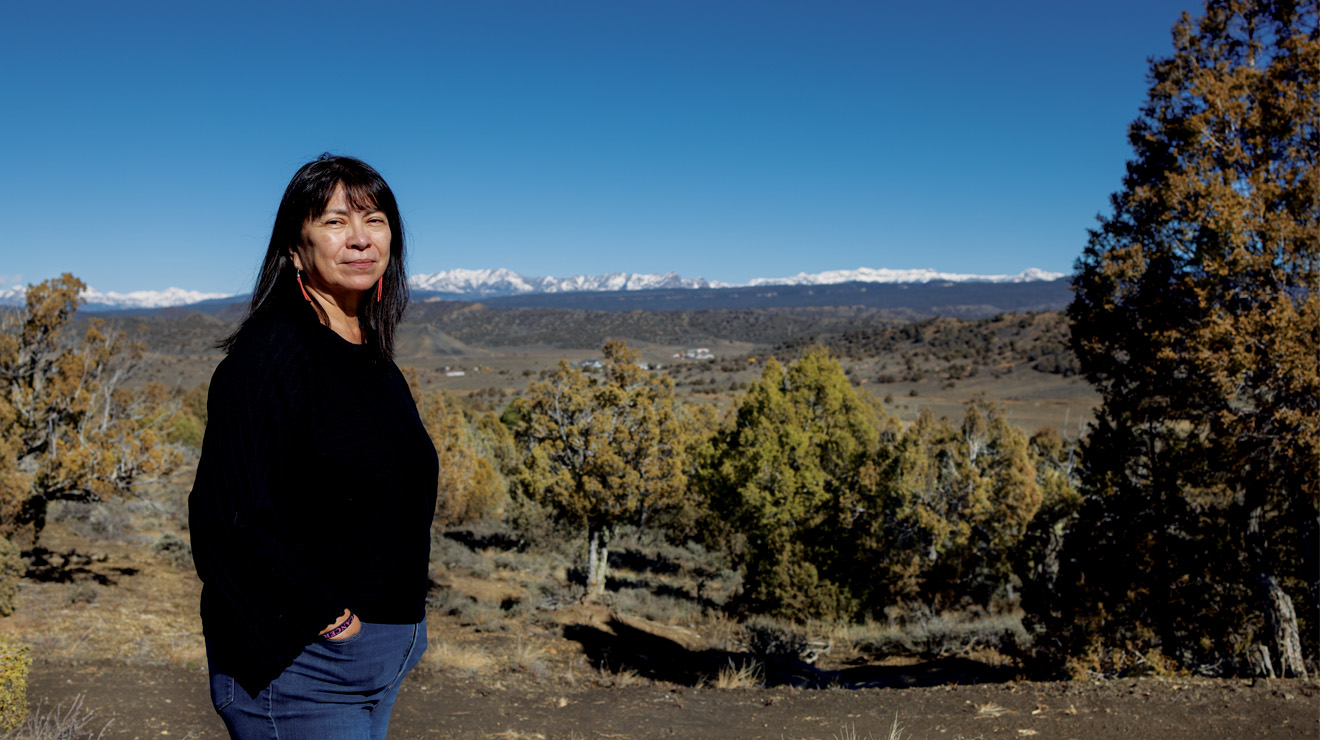
For Yolandra Gomez ’88, it was never about the money. From her first day on campus, she knew, “I always wanted to go home.” Born and raised on the Jicarilla Apache Nation reservation as one of 10 children, Gomez grew up just south of Dulce, New Mexico, a community of 2,141 on the reservation. Her intergenerational ranching family raised livestock outside town and lacked regular access to electricity and indoor plumbing.
“Traditionally, Apache people were very nomadic, and we were kind of like that,” Gomez says of her family. “We spent our summers traveling, following our herds of sheep and cattle.” One day she read about Princeton in a magazine and got it into her head that she would go there. The more everyone around doubted her, the harder she studied.
During her freshman year, Gomez missed a major Apache feast day, Go-Jii-Ya, and promised herself she would never again let an important cultural event slip by. After graduating with a degree from the School of Public and International Affairs, she went home and started job hunting.
“I felt like an outsider,” she says. Potential employers would skim her résumé and ask: “Why did you go to Princeton? Why didn’t you go to a state school? What’s wrong with our schools?”
She did eventually attend the University of New Mexico School of Medicine and became a pediatrician. In the past five years, she sensed an increase in discrimination against Native Americans in the health-care system and decided to move back to the reservation after 35 years living and working in the Albuquerque area.
“Yoli’s back,” people would say when she first moved her practice to Jicarilla. Young kids, her patients, run up to her, hug her knees, and call her “Auntie.”
According to Gomez, 40% of kids on the reservation live in poverty, and families often have to drive two to three hours for their little ones to receive basic pediatric care, be seen by specialists, or be treated in a pediatric hospital. She recently wrote and received a five-year grant from the state of New Mexico to get home-visiting services for pregnant women and children under age 5.
“I’m now working on projects to create a public health department run by the tribe and setting up a data and health information repository so we can collect, analyze data, and make our own research priorities in health care,” she says.
Gomez is a member of Princeton’s Board of Trustees and a founding member of Native Alumni of Princeton, a group that supports and strengthens Native students and alumni. She doesn’t have official numbers but insists, “Students who are enrolled in federally recognized tribes, a majority of us come home. Family is important to us. Our culture is important to us. The commitment to helping our tribal community is strong.”
She often asks tribal elders to share the parts of their Apache culture that should be taught to her young patients. They usually tell her some variation of the same thing:
“Take your children outside and tell them to listen to the sounds around them. The sound of the wind going through the different types of trees, the sound of things walking on the earth. Take your time and just listen,” she says.
In Gomez’s opinion, it’s nearly impossible to connect with the natural world and with one another to that degree in a noisy American city.
That sentiment is also what drew Karin Teague ’87 to a small community. Unlike Gomez, she lives in a town with tons of amenities available in nearby Aspen, Colorado, a playground for the 1%. Before she jumped from a fast-moving corporate train, Teague was on her way to joining them.
“I graduated in 1987 at the height of the Reagan era and all my friends at Princeton were going to Wall Street to make their millions,” she says from her kitchen table in Carbondale, Colorado, which has a population of 6,553 and killer views of a 13,000-foot-high mountain peak. She began her current work as director of the Independence Pass Foundation at 50.
After graduating from Princeton, she spent a year in New York City as a paralegal, attended UCLA School of Law starting in 1988, and then followed her peers to a corporate law firm. The Exxon Valdez oil spill brought her to Anchorage, Alaska, in 1993 as part of the team representing the multinational oil and gas company.
It was an extraordinary legal experience for a young lawyer but an even bigger life experience. From her temporary office, she could see the mountains, the icebergs floating in the bay, and moose hoofing their way through the outskirts of town. She vividly remembers flying back to Los Angeles. The plane circled the smoggy urban sprawl on its final descent and she burst into tears.
Although she loved the first chapter of her career, Teague yearned to live in nature and to no longer be fenced in by big law or the big city and to work on the other side of environmental law cases. At 30, in what she describes as “an epiphany born under the shadow of Mount Rainier,” Teague quit her job and moved to Colorado sight unseen. She practiced law locally until stepping away after the birth of her first child in 2001. She later returned to full-time work as co-founder and legal director of Public Counsel of the Rockies before transitioning to her current role.
Teague’s job involves collaborating on climate change-related scientific research, conducting wilderness restoration work to return the Independence Pass to its natural state, leading natural history outings, and maintaining trails, day use areas, and infrastructure on the pass.
Her most meaningful project involves connecting with crews of inmates on the pass as they work shoulder to shoulder on restoration. While her salary is modest compared to what she made as a lawyer, she has stayed afloat even as year-round populations ballooned and home prices skyrocketed.
“The things we do in a small town for entertainment are largely free,” she says. “We spend our time in the mountains. That can mean just putting on a pair of tennis shoes and climbing. You don’t need a lot of money to do that.”
Teague urges more Tigers to consider moving to small towns.
“The point I want to make about small-town living is that you really can make a difference at the local level.” She points to the divisiveness at the national level and says, “Focusing locally is empowering and it’s how you can escape that hopeless feeling.”
Christina Maida ’14, a recently elected local supervisor of Doylestown Township, Pennsylvania (population 17,945), finds that to be true. While taking a midday walk through the golden autumn foliage to break up eight hours of remote work as an investment operations manager at Pitcairn, she shrugs. “I had such a wonderful childhood in a small town. It’s just what I envisioned for my family.” Her kids will attend the same schools that she did, and shop in the same grocery store where they will often bump into someone they know. Her mom, who lives nearby, has popped over to watch Maida’s 4-month-old baby girl and toddler. That’s a support system that would never have been possible when Maida and her husband lived in New York City, and she worked longer hours at a job she describes as “a finance meat grinder.”
She walks past the railroad tracks that can get her to Philadelphia, the nearest major city, in less than 90 minutes, and yet Doylestown feels like a world away. “Shortly after the pandemic, we moved back down to Pennsylvania. I got a job that afforded me a lot more of a work-life balance, and I gained some perspective after my first child. I really just wanted to start giving back meaningfully,” she says. So she ran for local supervisor and won in November.
Her platform focused on affordability and giving younger voters a voice.
“We don’t have a lot of ethnic diversity, but we have a lot of socioeconomic diversity,” she explains. People are getting priced out. Maida’s biggest concern is that her town is becoming increasingly unaffordable, especially for those who want to own property.
Because Princeton is just an hour away, she wasn’t the only one from her town to attend the University, or even to have played on the field hockey team. But she did get a few snide remarks about her big city ways when she moved back years later.
Maida acknowledges that there can be a disconnect between people who live in small towns and those in big cities, but, she says, “I think you can still have a lot of common ground as it relates to things like your social and moral values.
“There were some people who said, ‘You’re bringing your New York City politics to Doylestown.’” She smiled and replied, “No. I’m bringing my Doylestown politics back to Doylestown.”
Danna Lorch is a freelance higher education writer and journalist based in Boston.
Related News

McCarter Theatre’s First South Asian Musical Took Me Back to Forbes Basement
A Beat of Our Own is about a college dance team not unlike Princeton South Asian Theatrics


8 Responses
Dan Feigelson ’90
8 Months AgoErasing Wilson’s Name
I just received the January 2026 PAW. In the piece about alumni who live in small towns, you wrote the following about Yolandra Gomez ’88: “After graduation with a degree from the School of International and Public Affairs, she went home and started job hunting.”
That statement isn’t just deceptive, it’s a lie. In 1988 it was called the Woodrow Wilson School of International and Public Affairs, or simply Woody Woo to those of us who majored in other subjects. The trustees didn't remove Wilson’s name from the school until 2020.
You could have written, “After graduation with a degree from the Woodrow Wilson School of International and Public Affairs (as it was called then), she went home and started job hunting.” But you didn’t.
This isn’t the first time I’ve seen PAW pretend that the institution was never called the Wilson school. Why is erasing the fact that Wilson was the president of the University so important that PAW lies about the past?
Daniel Sattizahn ’99
8 Months AgoDifferent Ways To Serve
I wanted to write in to mention what I believe was a missed opportunity from the January issue. The cover story, “Empower Couple,” was an engaging story about two amazing people, doing amazing things, with amazing amounts of money. I truly am impressed with all that Kwanza Jones ’93 and José E. Feliciano ’94 have accomplished and how they continue to help so many who are less fortunate than themselves. Immediately following that article, was (in my opinion) an even more heartfelt story, “Small Town Wonderers,” about multiple amazing people, doing amazing things, without amazing amounts of money. While both stories told about Tigers who are all clearly living out our motto of “in the nation’s service,” it would have been refreshing to see the cover story showing the latter individuals who have chosen to forgo lucrative opportunities to instead return home and contribute to their communities in a very different but equally (or perhaps more?) meaningful way. But then again, I doubt any of the Tigers in that story have buildings with their names on them.
Rocky Semmes ’79
9 Months AgoSmall-Town Ambition, Big-Time Career
Danna Lorch’s recent rewarding feature on rural area Princetonians brought to mind a college buddy of my dad, Rock Semmes ’44. Dad graduated among the accelerated war classes, starting active duty in 1943 and entering combat in France in June 1944. He did service in a battery of 8-inch howitzers as forward observer — a duty (often inside hostile territory) that can bring war right up close and personal. Mom later confided that it was years into the marriage before his screaming nightmares and wide-eyed waking in cold sweats finally stopped. Dad never told us war stories, and Mom suggested (aside to us) that this was self-preservation for him.
But Dad did share college stories, including one about a good friend, a guy originally from Wyoming (the town of Gillette as I recall, but memory is not my strong suit and even the man’s name evades me now). Dad said the man’s plan was law school and a return to Wyoming, fully intending to live out his days as a simple “country” lawyer back in his hometown.
The man indeed returned to his hometown. In time he unintentionally became a national coal law authority (not by design, but by circumstance, coal being king in Wyoming). He jetted all over the country as the “go-to” attorney for legal issues involving coal. Dad loved telling us that story again and again, about the simple ambition of his humble “small-town lawyer” friend. That story beats the inherent terror of any war story hands down, and it’s still a hoot.
Jean Telljohann ’81
9 Months AgoInspiring Alumni, Supported by Alumni
The inspiring article on rural alumni was fascinating, especially the section featuring the courage and perseverance of Angelo Campus ’16, who founded BoxPower. To hear more from Angelo about his initial support from the intergenerational alumni organization Princeton ReachOut 56-81-06, click here.
Tracy Pogue ’81 and Jean Telljohann ’81, co-chairs
Marty Johnson ’81 and Jon Wonnell ’81, co-chairs emeriti
Princeton ReachOut 56-81-06 Board of Trustees
Raphael Murillo ’12
9 Months AgoIn the Service of Rural America?
Here in southwestern South Dakota, life can be rather different than the cliches and euphemisms used to describe and to avoid describing “rural” America. Amidst the beauty of the Black Hills, one need not drive too far to witness the hollowing out of our country at the Homestake gold mine, the Powder River Basin coal mines, and the claims being made for future lithium and gold mining. Nor need one live here too long to experience a different hollowing out of our country at times: the poor education that fails to support families, the weakening institutional and social fabric that allows deleterious isolation and its supporting ideologies to thrive, and the ravages of suicide, among other difficult problems. Yet, because our issues have been papered over by a thriving tourism industry and retirees finding a few acres of land to live on, and because this relative prosperity stands in marked contrast to the adjacent Pine Ridge Reservation, even I would hesitate to describe mine as a “rural” experience. Imagine my surprise to see suburbs of major cities like Philadelphia here described as “rural”! Although I am glad to see some coverage of rural America in PAW, the sad reality is that Princeton has barely started to fulfill its commitment of working “in the nation’s service” in our rural places.
Peter Severson ’09
8 Months AgoRural Paths Deserve Deeper Exploration
I appreciate Raphael’s response here, coming from my own mostly-rural home state. I get that this piece is speaking of “small towns” rather than rural areas specifically, but I think the rural experience of alums could merit a deeper stand-alone exploration. The stories of people like Jack, Yolandra, and Angelo are the heart of this piece, and they’re much different that the experiences of people living in small jurisdictions that are still within major metropolitan areas.
Further, these three are also quite different because they clearly didn’t go somewhere else first to make a bunch of money at the usual Princeton pursuits — finance, consulting, law, etc. — and only then decide to move to a smaller community with the privilege of wealth in hand. There can be virtue in such a path, but it is fundamentally a different one, and this piece could’ve benefited from exploring more of the tension in that dynamic. It’s a counter-cultural choice for a Princeton grad to serve something besides wealth, especially in one’s early-career years, but those that do so will find deeply rewarding opportunities to be “in the nation’s service and in the service of humanity” in rural communities.
John E. Hohmann ’63
9 Months AgoRural Living and Farmland Preservation
After medical school, anesthesiology residency, and two years service in US Public Health Service, we chose to buy the 15-acre family farm from my grandparents’ estate and raise our three children while I practiced in the nearby urban center of the state capital. The kids all grew up learning responsibilities, enjoying freedom and independence. When I retired from medicine at age 68 I still had productive activities all year around at the farm and local community. I served many years on planning and zoning boards, and it is satisfying to see the preservation my neighbors and I have accomplished. Our biggest achievement was the merging of our former village and adjoining township to maintain local control and avoid creeping annexation from nearby urban entities. We have been actively involved in our state farmland preservation movement and are grateful for the privilege of stewardship of our 217-acre farm.
Ron Hall ’76
9 Months AgoMaking Your Own Path
I would add my vote for living in a small community/making your own path:
Grew up in a farm community in the Hudson Valley. Worked on my uncle’s (Cornell) farm all the way from high school through grad school — Wharton (MBA ’78). See if you can find a “farm kid” now. The best thing (there were many) about Philly was that I met my future wife. First job was as a high-end national insurance broker up in Westchester, New York. After two years in white collar jobs, we moved west (Pacific Northwest/Canada) where we spent over 20 years moving around building and renovating golf courses, many of them in smaller rural communities. Went back to Cornell and Penn State for ag/turf education. Became an expert heavy equipment operator. Settled near Spokane, in the early 1990s after we built a course here. Bought an original homestead property — the Funny Farm. Totally restored it. Added on, rehabbed the barn, built a shop, added more acreage, and out buildings. Moved into working with 3D modeling, GIS, and data visualization — all from home. Rewarding work with nonprofits/educators on wide variety of public awareness projects.
Fifty years after PU, I’m still willing and able to do farm chores. Make it a good day.