
At Alumni Day, Princeton Begins Celebration of the Alumni Association’s 200th Anniversary
The annual winter festivities honored math whiz Terence Tao *96, Smithsonian executive Kevin Gover ’78, and a half dozen star students
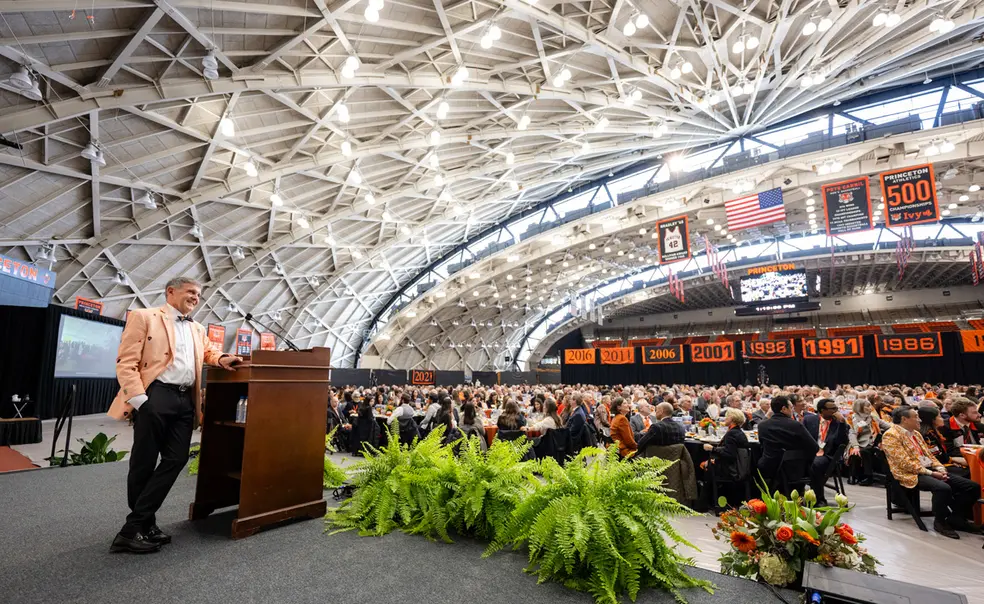

Princeton kicked off the 200th anniversary of the Alumni Association at its Feb. 21 Alumni Day celebration, which drew more than 1,000 alumni and guests to campus.
“We want to engage as many of our 101,307 [alumni] as possible in this anniversary year,” said Ryan Ruskin ’90, Alumni Association president.
At a luncheon at Jadwin Gym, Ruskin encouraged alumni to participate in the hundreds of events coming up over the next 200 days to mark the bicentennial, from athletic gatherings to lectures. For less engaged alumni, he said: “Let them know that there’s a place for them in the worldwide Princeton community.”
Patrice John *99, chair of the Princetoniana Committee, and University Archivist Dan Linke led a “Tiger Trivia” segment, highlighting the history of the Alumni Association.
They asked questions such as, “What founder of the United States was also the first president of the Princeton Alumni Association?” The answer: James Madison, Class of 1771.
This year, a registration fee of $45 for alumni who graduated before 2016, or $25 for recent alumni, was reinstated for the first time since 2021. Attendance was roughly in line with the average of the four years since the event returned after a pandemic pause (ranging from about 750 attendees in 2022 to 1,400 last year, according to the Alumni Association).
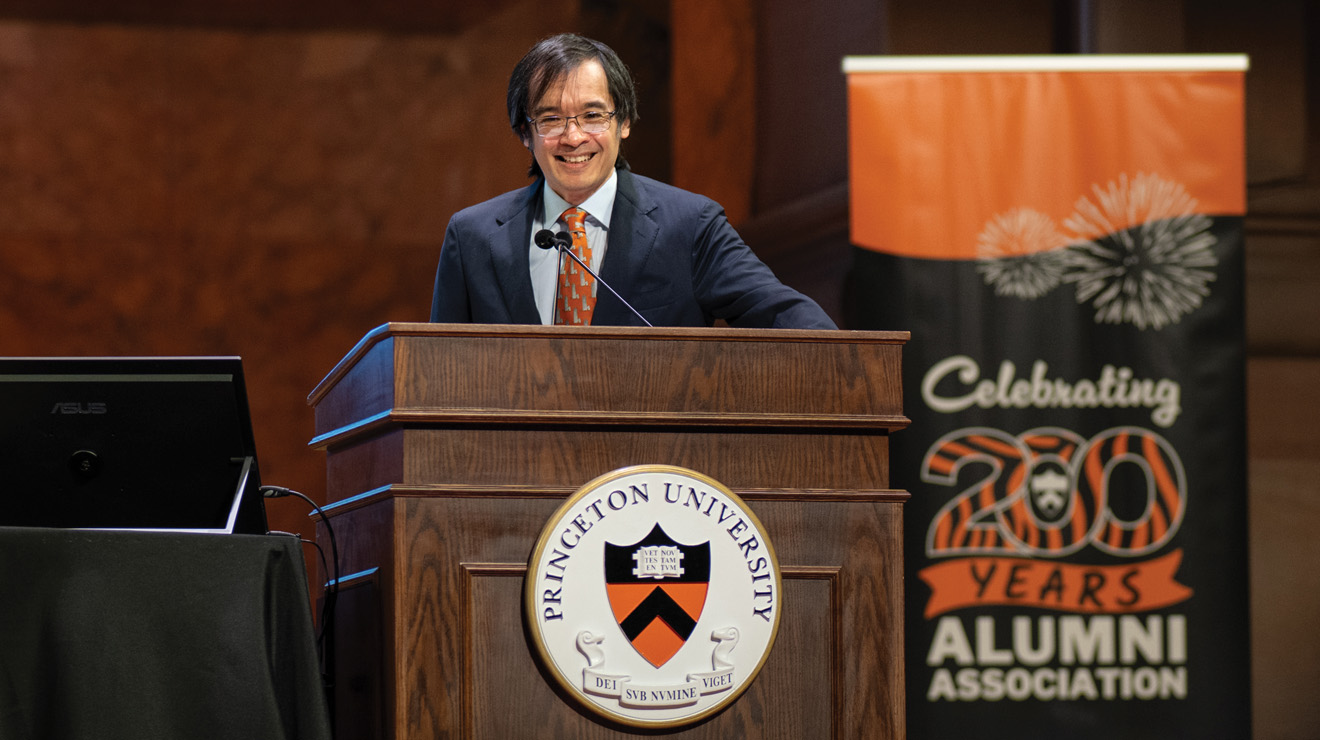
Alumni Day began in a nearly full Richardson Auditorium with an awards presentation honoring notable alumni and current students.
Terence Tao *96, a professor of mathematics at the University of California, Los Angeles, and this year’s James Madison Medal recipient, was the opening speaker. The award is annually presented to an alumnus of the Graduate School “who has had a distinguished career, advanced the cause of graduate education, or achieved a record of outstanding public service.”
Rodney Priestley, dean of the graduate school, introduced Tao as the “Mozart of math,” whose work has led to multiple pathbreaking discoveries and real-world tools, including developing algorithms to speed up MRI scans. In 2014, Tao won the Breakthrough Prize in mathematics and gave away much of the $3 million award to endow fellowships for graduate students from developing countries and for gifted American high school students. He has also spoken up against federal cuts to university research and funding.
Tao, raised in Australia, was brought to the Institute of Advanced Study by his father when he was just 9 years old to meet with famed mathematicians and judge his potential. “His father wanted to know, ‘Does this kid have real talent?’” Priestley said. The answer was clear eight years later when Tao entered Princeton for graduate study at 17. “I skipped a lot of grades,” he said.
Tao credited Princeton and his adviser, Elias Stein, for pushing him to mature professionally and academically. He said that Stein told him that mathematics is not just about proving theorems, but also that service is important, and he should always look for ways to serve his broader community.
In his lecture, Tao argued that mathematics is entering a period of transformation driven by new technologies, including artificial intelligence. He explained a shift from “math by depth” to “math by breadth,” in which large sets of problems, including the longstanding Erdős problems, can be scanned with computational and AI tools. Recent AI tools, he said, have helped uncover solutions previously missed in literature, and in a small number of cases, have found solutions to some of the easier Erdős problems. These tools, he argued, lower the barriers to math research.
Tao spoke up against federal funding cuts as a “combination of both general philosophy and existential need,” after his work had its National Science Foundation funding suspended for several months in 2025 before it was restored with a court order.
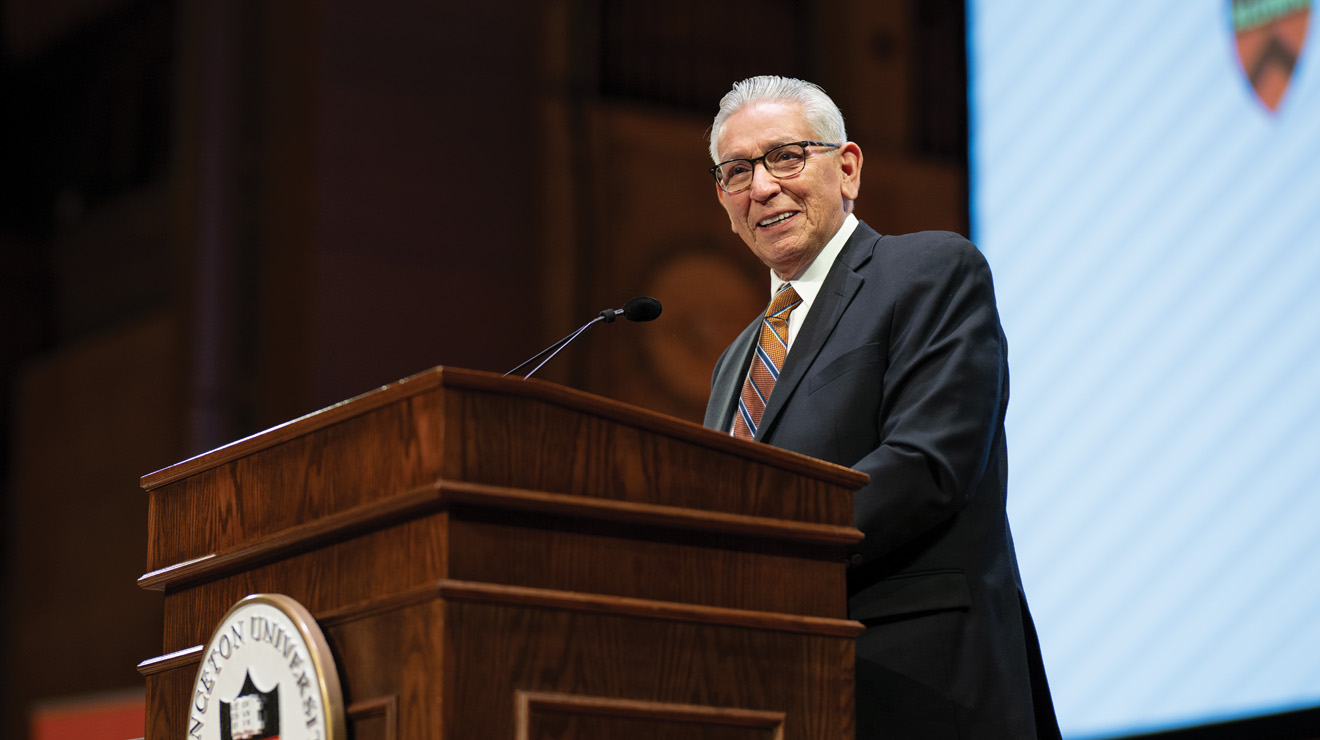
Kevin Gover ’78, under secretary for museums and culture at the Smithsonian, won the Woodrow Wilson Award, which is awarded each year to an undergraduate alumnus or alumna whose achievements exemplify the phrase, “Princeton in the nation’s service.”
Michael Gordin, dean of the college, introduced Gover, a Pawnee Nation citizen, as a longtime leader in federal Indian law and public service. Gover spent years advancing tribal sovereignty and served as assistant secretary for Indian affairs in the Department of the Interior during the Clinton administration. He rebuilt long-neglected Indian schools that had been unsafe and unfit for children and learning and expanded tribal and Bureau of Indian Affairs police forces throughout the country. He later directed the Smithsonian’s National Museum of the American Indian for 14 years before assuming his current position.
While at Princeton, Gover attended student protests against apartheid in South Africa and wrote opinion pieces for The Daily Princetonian. “Kevin stood up for his fellow classmates and spoke up for access and inclusivity,” Gordin said.
In his lecture, Gover reflected on the past half-century of Native American advocacy and described bipartisan legislative milestones that strengthened tribal sovereignty, including self-determination policies and the establishment of the National Museum of the American Indian, and emphasized the progress tribes have made in governance, economic development, and cultural preservation.
He also addressed the challenges facing federal institutions and argued that attacks on the Smithsonian are “an attack on knowledge itself.” He remained optimistic and emphasized that truth will prevail. “There are more of us who believe in the virtue of knowledge than there are those who don’t,” he said, noting that while President Donald Trump proposed a 12% decrease in the Smithsonian budget, Congress ultimately approved a 1% increase.
Gover praised Princeton’s Native alumni and students. “Princeton has been in the service of the native nations. Having met with the small but mighty cohort of Native students now at Princeton and the faculty working on Native American subjects, I’m confident that Princeton will continue to serve the native nations,” he said.
President Christopher Eisgruber ’83 recognized current students with two of Princeton’s top academic honors, the Moses Taylor Pyne Honor Prize and the Porter Ogden Jacobus Fellowships.
Braeden Carroll ’26, a civil and environmental engineering major from Kinnelon, New Jersey, and Katie Daniels ’26, a neuroscience major from Newtown, Pennsylvania, were awarded the Pyne Prize, Princeton’s highest general distinction for undergraduates.
Carroll, a varsity lightweight rower, described the experience of finding community in the boathouse and the classroom alike, and credited teammates, professors, and classmates with pushing him to pursue his goals. His research has ranged from sustainable infrastructure design to modeling structural forces in historic timber barns, all rooted in building both physically and socially sustainable systems.
He framed his Princeton experience through the metaphor of an elevator, one that’s lifted him to new possibilities. “I will step forward determined to uphold the generosity, leadership, and character that the Pyne Prize represents, and I’m absolutely certain that when I step out of the elevator in a few short months, the view will be nothing short of breathtaking,” he said.
In her speech, Daniels focused on messages of affirmation and inspiration that shaped who she is and who she aspires to be. Following her experience with multiple concussions as a teenager, Daniels felt inspired to pursue research on the neurological impact of repetitive brain injury, work that has already led to a peer-reviewed publication.
“I aim to live by the lessons I learned at Princeton … to answer the big ‘I don't know’ questions, while also finding moments to support individuals, one at a time, by treating the smallest interactions with great care and attention,” said Daniels, who aims to have a career in academic medicine.
Four doctoral students, Philip Decker (history), Victor Geadah (applied and computational mathematics), Sayash Kapoor (computer science), and Eliana Rozinov (English and gender and sexuality studies), received the Jacobus Fellowships, which provide a year of tuition and stipend for the honorees.
The program concluded with the annual Service of Remembrance at the University Chapel, which paid tribute to alumni, faculty, and staff who died in the last year. At a closing reception at the Art Museum, alumni toasted the 200th anniversary of the Alumni Association.
The Latest
See all


Related News
McCarter Theatre’s First South Asian Musical Took Me Back to Forbes Basement
A Beat of Our Own is about a college dance team not unlike Princeton South Asian Theatrics

No responses yet