

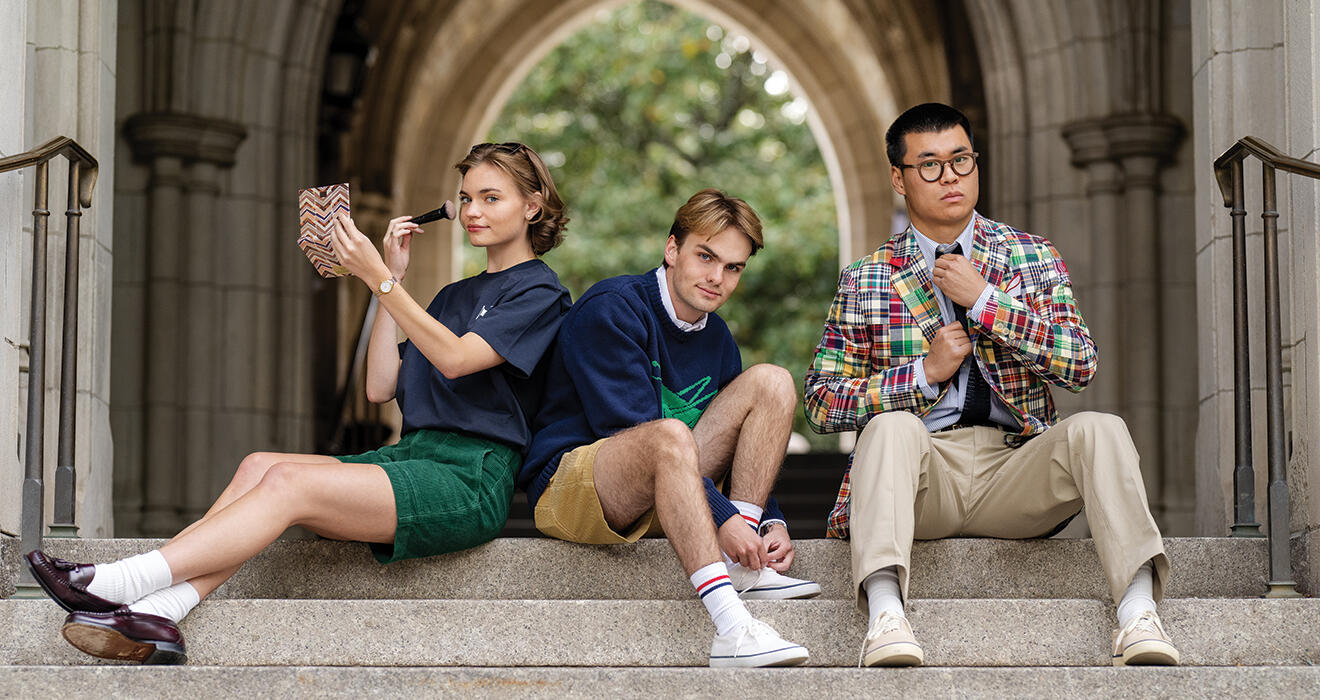

Collegiate logo sweatshirts are a common sight in thrift stores in Japan. In Niigata-shi, a medium-sized Japanese port city known for its rice fields, Yamazaki-san worked a clothing store on a humid August afternoon. He’s never visited the U.S., let alone Princeton — fair enough, he lives 6,600 miles away — but he wore a white Champion tee with orange letters that read “Yale Sucks.”
When asked about the shirt, he knew exactly what it meant. He knows about Ivy League rivalries. He knows what the orange refers to. He knows that his tee is a vintage single-stitched, a discontinued manufacturing technique from the 1980s and ’90s. Whether Yamazaki-san and his thrift store shoppers realize it, they are among the latest generation to embrace a form of Ivy Style.
In a bygone era, Princeton stood at the forefront of fashion. The three-button navy blazer, brushed Shetland sweater, and beer jacket were among Old Nassau’s contributions to what became known as Ivy Style, a look that developed on northeastern college campuses in the 1920s and gained popularity in the 1950s.
Fashion at Princeton has since departed from its once dominant cultural status. But as navy blazers, oxford button-downs, and penny loafers fell out of favor on campus, Ivy Style found an unlikely home across the Pacific and continues to thrive there. As Tokyo Weekender put it last year, Japan has witnessed “the rise, fall and revival of Ivy Style fashion.”
In the early 20th century, elite college campuses were filled with young men from prep schools who sought to blend the formality of traditional British tailoring with more casual attitudes. Ivy Style might feel like dressing up today, when hoodies and sweatpants are perfectly acceptable classroom attire, but it began as a way of dressing down. Suit jackets became blazers. Broadcloth shirts became oxford shirts. Pleated wool trousers became chinos. It was the “hoodies and sweatpants” of its day. An air of nonchalance is vital to Ivy Style.
Princeton, like most Ivy League schools during the early 20th century, was restricted to male students. So while Ivy Style has since become a unisex genre of fashion, its roots come from traditional menswear garments.
Ivy Style began to draw national attention in the 1930s. A Saturday Evening Post article read, “The fashions in clothing worn by our male population, between the ages of 14 and perhaps 25, usually get their start at Princeton. … Harvard is a very large university, in a great city which influences the students’ styles heavily. [But] it holds to a tradition of careless dress — well-made clothes seldom dry-cleaned and never pressed. Yale is more compact and more finicky, but New Haven is also a large city. Princeton is in a smaller town, off by itself where it can incubate a style effectively. Practically every Princeton student is well dressed, whereas only one-third or so of the Yale men can qualify by our standards.”
A 2012-13 exhibition at the Fashion Institute of Technology pointed to Princeton’s “relatively rural location, the homogeneity of its student population — nearly 85% white, Protestant men, graduates of elite private schools from wealthy families — and its reliance on a unique student-regulated society” in the mid-1900s.
In 1938, Life Magazine wrote that “Harvard and Yale men like to say that Princeton undergraduates are the prototype for Hollywood’s conception of how the well-dressed college boy should look. The fact of the matter is that tailors and haberdashers watch Princeton students closely, [and] admit they are style leaders.”

David W. Marx, a Tokyo-based author and cultural critic, explained to PAW that a persistent feminine connotation was attached to fashion for the majority of Japanese history. Men were discouraged from expressing interest in fashion. From the gakuran uniform of his school days to the corporate business attire of his working life, a man’s wardrobe was just cycles of drab outfits. Opting for a striped button-down shirt instead of a white one was enough to cop a stern talking to by his superiors at work.
This made life difficult for people like Kensuke Ishizu, who struggled for years to sell ready-to-wear suits with his brand Van Jacket. In postwar Japan, tailor-made, British-style formal wear was the industry standard. Many consumers and clothing manufacturers alike scoffed at Van Jacket.
Not only were clothes that strayed too far from the Japanese conformity deemed delinquent, spending too much money on “unnecessaries” like fashion was also taboo in the rebuilding economy of 1950s Japan.
On a trip in 1959, Ishizu took the train from New York City to Princeton University. What awaited him behind FitzRandolph Gate was the answer he was looking for. Students walked around dressed in tweed blazers, knitted ties, oxford shirts, khakis, and blue jeans. It was fresh yet sensible. The signature Ivy Style. As Marx wrote in The New Yorker in 2015, “Ivy clothing was also a good investment for the impoverished Japanese postwar consumer: durable, functional, traditional, and in easy-to-clean natural materials.” Japan’s love affair with Ivy Style began.
Ishizu gave up on the older demographic skeptical of ready-to-wear garments and switched his focus to the younger generation.
Ishizu had made good progress, figuring out what to sell and who to sell to. He just needed young men to start buying. His other job, as an editor at the menswear magazine Men’s Club, gave him the perfect opportunity.
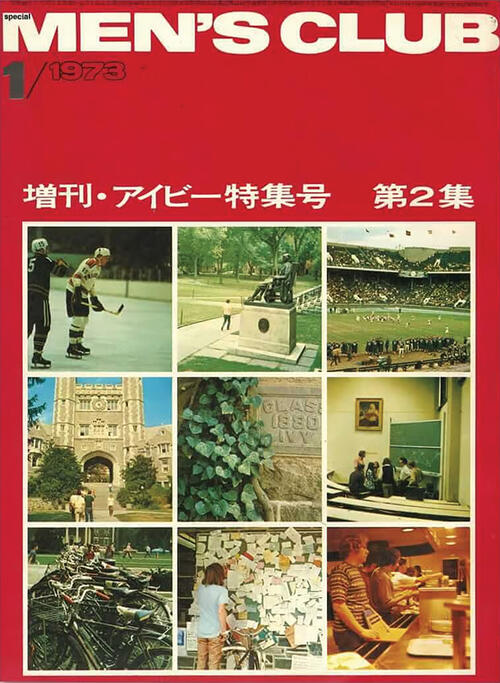
In a pre-internet age when few Japanese people traveled abroad, Men’s Club became the definitive authority on what was and wasn’t trendy. In many ways, Ishizu was ahead of his time, a precursor to today’s social media influencer. He wrote articles on the Ivy League, the rules of Ivy Style, the lifestyle of Ivy League students, and more. “Readers understood the imagery in Men’s Club — a world where everyone lived surrounded by Ivy suits, Coca-Cola bottles, and jazz records — as a pleasant fantasy,” Marx wrote in Lapham’s Quarterly.
To convince the domestic audience that Japanese people adopt the Ivy Style, Men’s Club also launched a column named “Ivy Leaguers on the Street (Machi no Aibii Riigasu).” Men’s Club photographed young Japanese men wearing blazers, chinos, and loafers in trendy areas like Tokyo’s Ginza district. This style of street photography remains a key component of Japan’s thriving fashion magazine scene today.
While Ivy Style was passed down through parents, peers, and professors in the U.S., Japan lacked this crucial context. People were familiar with Waseda not Princeton, Todai not Yale, and Keio not Harvard. No such culture surrounding collegiate clothing existed. Men’s Club had to entice people to dress like an American when most had never even met one. Men’s Club’s persistent focus on Ivy Style became equal parts education and advertisement.
One of the most popular sections of Men’s Club was a “Dear Editor” column where Ishizu sternly answered readers’ questions on Ivy Style, describing the concrete dos and don’ts with a good dose of bluffing. For instance, pocket squares must be worn in the “Ivy fold,” neckties ought to be exactly 7 centimeters wide, and button-down shirts must have a center-box pleat. One must not stray and fashion any “anti-Ivy” techniques.
Conveniently, readers of Men’s Club could get the Ivy Style look through Van Jacket. Ishizu’s two-pronged retail/editorial strategy worked. Maybe even a bit too well. By 1964, Van Jacket became the most in-demand brand for upper- and middle-class Japanese youth. Van Jacket’s “Ivy Model” suit, a replica of Brooks Brothers’ No. 1 Sack Suit, became one of the label’s bestsellers.
The Van Jacket shopping bag alone became a status symbol. Those who had one flaunted it on the streets of Ginza. Those who didn’t have one had to compromise with Van Jacket stickers on old rice bags.
In a 2016 interview, Ishizu’s secretary Takeyoshi Hayashida admitted that the articles in Men’s Club were all written by Van Jacket employees. “It wasn’t like we wanted Ivy [Style] to be like a religious cult. But we needed to build the clothing base for people in the 1960s up until the mid-1970s. And we succeeded.” Even during the early days of Ivy Style in Japan, this was an open secret in the industry.
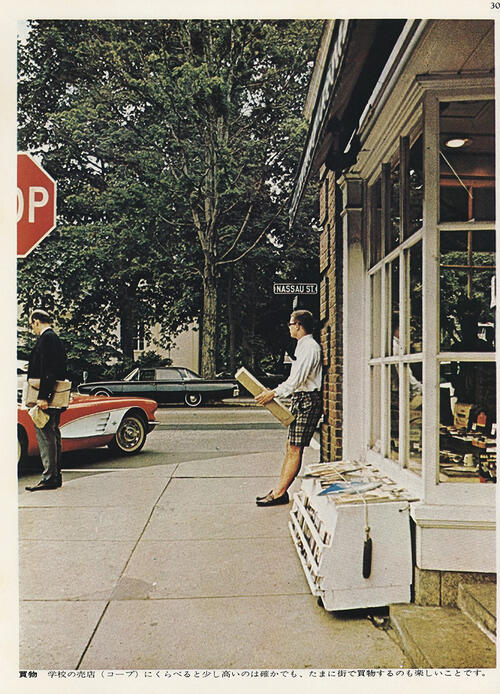
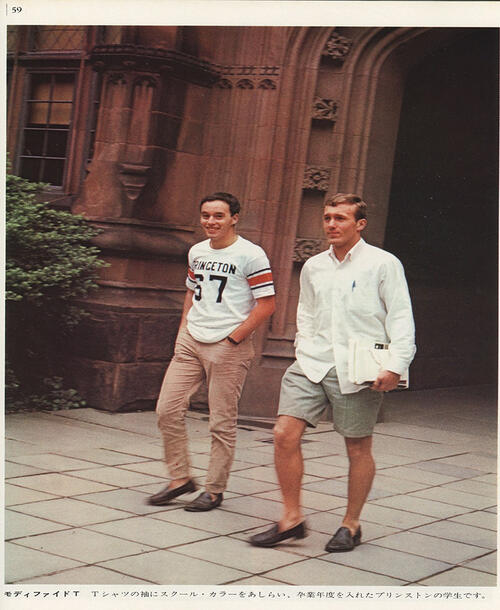
To solidify Ivy Style’s role in Japanese pop culture, Ishizu had to show that Americans legitimately embraced the style themselves. Reminiscing on his visit to Princeton in 1959, he decided to return on an Ivy Style pilgrimage in 1965. Along with some other Van Jacket employees, Ishizu and company set out to visit Ivy League campuses with the intention of producing a photobook titled Take Ivy.
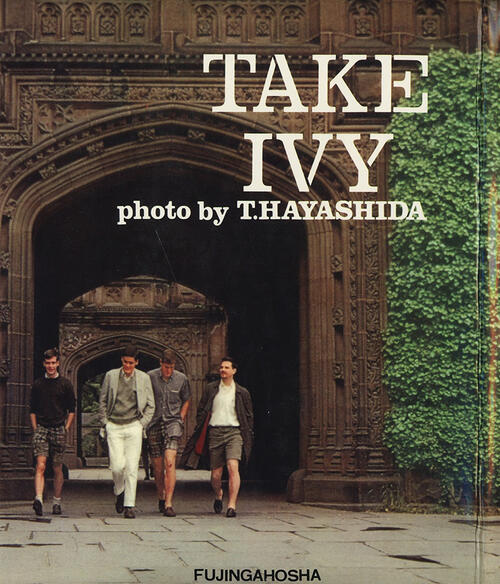
Unfortunately, Ivy Style had largely fallen out of fashion by 1965. Even more unfortunately, Ishizu did not realize until he set foot on the campuses.
Nonetheless, Ishizu could not afford to admit defeat. As fashion commentator Derek Guy explained on the 99% Invisible podcast, “when [Take] Ivy was written, the majority of students were also not dressed like this.” Desperate, Ishizu had to ask students to stage some scenes for the photobook and scoured campuses for more “watered-down” Ivy Style looks. Ishizu hardly saw students in three-piece Brooks Brothers suits, but he captured plenty in collegiate sweaters, chinos, and loafers. On the same podcast, Avery Trufelman elaborated, “For the company [Van Jacket] that published this book, there were very high stakes to make the Japanese public think that Americans dress this way.”
Intentionally or unintentionally, Take Ivy captured a more authentic, organic look. A look that departed from the rigid guidelines Ishizu wrote about in Men’s Club. Authentic Ivy Style never followed those rules anyways — an air of nonchalance was crucial, after all.
Take Ivy described Princeton, the final destination on Ishizu’s trip: “They arrived to find an intramural softball tournament and a wild party hosted at Nassau Hall, sponsored by a beer company, where grounds of drunken students sang fight songs in good spirits. Once they committed these events to celluloid, the campus production was officially over.”
What was originally intended as a photobook (and an accompanying short film) for in-store promotions accidentally became an icon in modern fashion history. Or perhaps it wasn’t so accidental. The crew behind Take Ivy did not care too much for clothes alone. They cared for the context, lifestyle, and romance of a style and an era. They didn’t show consumers back home what to wear, but how to wear it.
Take Ivy became an unintentional ethnography that captured, and saved, a fading era of Americana.
Marx, the author of Ametora: How Japan Saved American Style, explains now that “saved” holds two meanings in the Ivy Style story. Japanese tastemakers saved Ivy Style from spiraling into obscurity when the genre lost its popularity in the U.S. Consider how the label J. Press, a quintessential Ivy Style brand founded in New Haven, Connecticut, recovered from bankruptcy when it was purchased by the Japanese label Onward Kashiyama. In the process, Japanese industry insiders categorized, documented, and “saved” the style by preserving it.
Japanese fashion designer Nigö has a vast personal collection of vintage clothes and Americana memorabilia with a healthy dose of Ivy Style garments. An autumn/winter 2024 jacket from his brand Human Made references Princeton’s Reunions jackets.
Japanese fashion’s biggest and most mainstream export, Uniqlo, is rooted in Van Jacket lineage. The parents of Uniqlo’s founder, Tadashi Yanai, owned a Van Jacket store in Ube city. In a 2019 interview with Nikkei News, Yanai said, “Van Jacket formed the basis for Uniqlo.” In a full circle moment, Van Jacket founder Kensuke Ishizu told Nikkei News that Uniqlo is “what I wanted Van Jacket to be.”
Ishizu took his fateful train ride from New York City to Princeton in 1959. Today, Princeton students can leave the Orange Bubble to find the legacies of that 1959 visit in Uniqlo, street fashion labels, and even quiet thrift stores in Niigata-shi.
Simon Xiao ’26 is a UWC Davis scholar studying politics with a minor in East Asian studies. He is from Auckland, New Zealand.
Related News
McCarter Theatre’s First South Asian Musical Took Me Back to Forbes Basement
A Beat of Our Own is about a college dance team not unlike Princeton South Asian Theatrics


15 Responses
Peter S. Paine III ’85
3 Months AgoBrings Back Memories
This brings back memories! It was the fall of 1981 or the spring of 1982 when I was intercepted while walking to class by two Japanese gentleman who asked if I would consider being photographed for Men’s Club, because I looked, in their words, like a “tall preppy type.” I was skeptical, but they offered me $50 — which bought a lot of beer in early ’80s! — so I agreed. They arranged to meet me at Langrock on Nassau Street, which was to Princeton then what J. Press was to Yale. It has long since closed. I was kitted out in various “looks” and duly photographed. I, along with other Princeton students, later appeared in a “back to campus” issue of Men’s Club, which was essentially a sartorial tour of the Ivies. The editors kindly sent me a copy of the issue. Being a loyal Tiger, I’d like to think we showed up better in the Men’s Club pages than our Ivy League peers. But, looking back, our youth made us all equally attractive. Sic tempus fugit...
Murphy Sewall ’64
3 Months AgoDressing the Same
I was there, but I missed it entirely. As far as I know, I dressed the same as everyone else but I was completely unaware that “style” of any kind was involved.
James Cunningham ’73
3 Months AgoPreppy Preferences
While pleased to see an effort to move back from T-shirts and jeans to a clearly “preppy” look, I was shocked to see J. Press as the article’s standard bearer. J. Press is a Yalie brand, with its flagship store in New Haven. Aficionados who do not get enough at Brooks Brothers and L.L. Bean should take a shopping trip to the Andover Shop in Andover or its Harvard branch in Cambridge. When in doubt, please refer to The Preppy Handbook.
Peter Baum ’87
4 Months AgoMen’s Club Magazine Returned in ’86
The tradition of Men’s Club going back to Princeton extended at least until the ’80s. I, as well, as some of my fellow Colonial Club members, were recruited to be in an on-campus photo shoot they took in the summer of 1986. We blended in with the Japanese models they had brought with them and had a wonderful experience. Our pay was a dinner at Lahiere’s afterward. We were told that we would get copies of the issue when it came out, but we held out little hope that we would actually see it. Amazingly, they were sent to us via FedEx, arriving the same day the magazine hit the newsstands in Tokyo. Looking back, it was one of the more random and wonderful of my Princeton experiences.
Rob Sprinkle *90
4 Months AgoBig Green Connections to Ivy Style
Courtesy Rob Sprinkle *90
I earned my second doctorate, one in Public and International Affairs, at Princeton and receive PAW at my University of Maryland faculty mailbox. I found the most recent cover, crediting Princeton for its contributions to “Ivy Style,” remarkable both for artful nostalgia and for innocent error. I understand from the J. Press website that their 1902 sweater “pays homage to the boatneck sweaters seen on several Dartmouth men from the era emblazoned with their graduation year. Our version bears the year of our founding, 1902.” More particularly, to me and to thousands of others, it calls to mind the 1902 Room, a 24-hour study venue in Baker Library at Dartmouth. (I leave for reunion tomorrow, will once again visit the ’02 Room, and may then buy a sweater from J. Press.)
Mahalia Gayle ’94
4 Months AgoBrotherhood of the Traveling Jackets
Interesting take on the changing fortunes of Ivy League menswear at home and abroad. Well before The Sisterhood of the Traveling Pants, we see the brotherhood of the traveling jackets, today most likely on tour with the Tigertones.
Robert Buntrock *67
4 Months AgoIvy Went Ratty in the ’60s
As a naive Midwesterner, I guess I was aware of the Ivy Look in the ’60s, by reputation in national magazines. However, when I entered grad school at Princeton in ’62, I found the Tiger dress to be considerably more casual. Even The Daily Princetonian poked fun at the casual, even sloppy dress of the undergrads, often a grungy T-shirt, chinos or shorts, and, of course, taped Bass Weejuns. To add insult to injury, when grad students tried shopping at the stores on Nassau Street, we were often ignored, upstaged by sloppily dressed undergrads as described (because we didn’t have the money that the undergrads did). I only attended a couple of undergrad classes but they didn’t seem to dress up for that either. Sloppy dress at the eating clubs was notorious. They didn’t seem to dress up for meals either, although a jacket and tie were required. Ratty, frayed jackets were quite common as were bad ties tied over the collar of a tee shirt, not a collared shirt. I knew a couple of undergrads and got invited to meals a couple of times and witnessed the ratty looks by many.
John Milton Cooper Jr. ’61
4 Months AgoJ. Press and an Ivy Style Memory
Madras and J. Press — what delightful nostalgia!
I got my first sport coat from J. Press when I was 16. The senior salesman was huffing and puffing: “Paul Press’ son is going to Dartmouth!”
Three decades later, when I was in the New York store, one of the salesmen put his hand out and said, “I’m Dick Press.” Judging his age to be about mine, I asked, “Are you the one who defected and went to Dartmouth?”
He laughed and said, “I had to get out of New Haven.”
Dartmouth must have seemed a safe haven. Princeton would have made his heresy too obvious.
Reade Ben ’22
4 Months AgoModeling Ivy Fashion
I wore and walked the East Pyne look in the 2026 J. Press Take Ivy New York Fashion Week Show!
Hallie Graham ’27
4 Months AgoRepping Ivy Style
This is so cool. Thanks for representing Princeton! I hope J. Press eventually recognizes Reunions as an annual opportunity and opens a pop-up/tent with limited edition Reunions merchandise and styles.
Larry H. Pastor ’80
4 Months AgoOde to a Cheeky, Classic Chapeau
My Princeton hat is the bucket,
When I don’t wear it I tuck it.
Its color is khaki,
It looks kinda wacky,
And if you don’t like it, then chuck it!
Michael J. Shannon ’57
4 Months AgoAdopting Ivy Style
One conforms, at least I did, without a thought. As is said, “it just comes naturally...”
John Vine ’86
4 Months AgoPreppy Look Has Staying Power
Fashion trends come and go, but the “preppy style” has remained a wardrobe staple for many both in and out of the Ivy League and in the United States and abroad. In addition to Japan, South Korea has embraced the preppy look for many years. They love fashion in general and many Americans have followed their sartorial styles.
William Price ’66
4 Months AgoTriangle’s Take on the ‘Ivy League Look’
On YouTube, there is a recording of the Princeton Triangle Club’s “Ivy League Look” from the 1957-8 production, “After a Fashion”:
https://www.youtube.com/watch?v=dAApPlrYXs8
Lila Gavin
4 Months AgoConvergence of Clothing Cultures
Really liked this piece! Initially, this statement did catch my eye: “While Ivy Style was passed down through parents, peers, and professors in the U.S., Japan lacked this crucial context. People were familiar with Waseda not Princeton, Todai not Yale, and Keio not Harvard. No such culture surrounding collegiate clothing existed.” After thinking about it, I realized the core point is completely true/structurally sound given that, as you already covered, Japan didn’t have multi generational pipeline for casual menswear, nor that same commercial culture as in the West. That being said, I think the specific phrasing of the last sentence (to me) read almost as implying a lack of culture itself? Whereas this is more of a case of lack of Western cultural awareness/cultural difference (which is what was already articulated). And also Japanese universities actually possessed a massive clothing culture related to academic merit/pride, and also student identity/modified uniforms, long before the 1960s Ivy influence. This article does such an amazing job of narrating how those two different worlds eventually converged in Japan. Really great read!