

Amid Global Uncertainty, Princeton Strives to Keep Students Safe Abroad
International travel remains a key part of Princeton, with more than 3,800 travelers — mostly students — in 2024-25
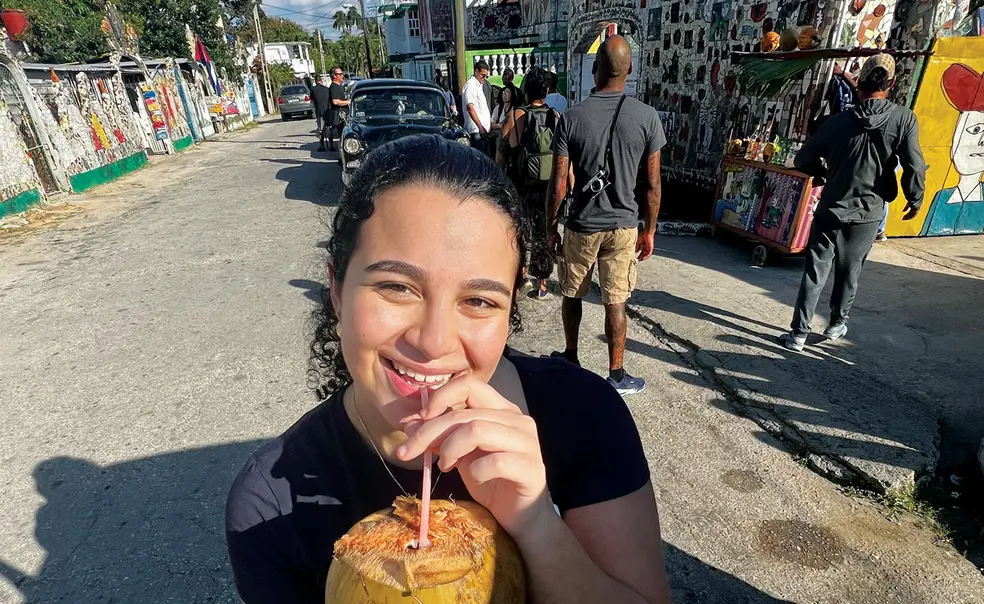

While Mariem Elgendy ’26 was on a trip to Cuba with the School of Public and International Affairs in January 2025, Cuba’s status on the U.S. State Sponsors of Terrorism list changed twice. President Joe Biden removed it, and just days later as President Donald Trump began his second term, he added Cuba back to the list.
“We got to experience the bits of joy that the people had when they were taken off the list, and then what happened right when they got back on the list, and the disappointment filled the air,” Elgendy said.
The six students on the trip also questioned whether they would be able to get back into the United States following the policy reversal, though they ultimately encountered no issues beyond a few flight delays and rescheduling due to a storm.
Elgendy’s experience reflects broader uncertainty facing students traveling abroad through the University, as geopolitical shifts, expanded travel restrictions under the Trump administration, and recent high-profile cases involving Princeton researchers have raised concerns about safety and preparedness. As international travel remains a key part of Princeton, the University has emphasized risk assessment, pretravel planning, and institutional oversight as core components to support students and other members of the University community abroad.
In the past decade, two Princeton-affiliated scholars were detained abroad while conducting research: Graduate student Elizabeth Tsurkov was kidnapped in Iraq in 2023 and released in 2025, and Xiyue Wang *15 was imprisoned in Iran from 2016 to 2019.
Princeton’s Global Safety & Security (GS&S) oversees the University’s travel security risk management program. According to Chris Holmes, the director of GS&S, the office focuses on predeparture engagement and education, in-country support for travelers, and continuous monitoring of security developments to enable successful academic travel through effective risk mitigation, preparedness, and support.
During the 2024-25 academic year, more than 3,800 travelers made more than 6,300 international trips to 140 countries and territories, with students accounting for 80% of travel — faculty and staff make up the remaining 20% — according to Holmes. The most common destinations were the United Kingdom, France, Germany, Italy, and Japan, followed by China, Kenya, Greece, Spain, and Canada.
To manage travel risk, GS&S uses a tiered risk-based framework that assesses destination risk to determine baseline requirements for University travel to be authorized. Travel to higher-risk countries requires completion of GS&S’s higher-risk travel process, including an approved exception, during which GS&S collaborates closely with travelers to identify risks, develop mitigation strategies, and reinforce security best practices related to lodging, movement, and in-country activities. Holmes declined to comment on whether Tsurkov’s travel was an approved exception.
While all travelers have access to the same support resources, including emergency medical and security assistance through International SOS, a medical and travel risk service company, Holmes emphasized that different forms of travel pose different risks. He explained that short-term group travel may involve exposure to petty crime risks in tourist locations or transportation hubs, while longer-term independent research activities may encounter different or overlapping risks depending on the local environment and nature of their work.
Many of the safety measures Holmes described were reflected in Elgendy’s experience in Cuba, which is considered a medium-risk destination. The Havana workshop, which focused on assessing Cuba’s role in achieving sustainable development goals, was led by Carol Martin, a lecturer of public and international affairs, and Paul Lipton, SPIA’s senior associate dean for academic administration. Two individuals from the group travel program joined the trip.
When Elgendy applied for the trip, she had an interview where she was asked if she was prepared to handle certain situations that might come up in Cuba, such as if there was no water or a power outage. Once all the students were chosen for the trip, they had a predeparture meeting on safety rules while traveling.
Because U.S. credit and debit cards cannot be used in Cuba, faculty and staff on the trip carried cash with them to cover group expenses and told students they only needed their own cash for souvenirs or if they wanted to eat on their own. In the meeting, students were advised not to bring their cards on the trip. They were also informed about internet safety in the country, and that many of them would not have cell service while on the trip. In addition, they were advised not to say they were in SPIA because it sounded too close to “spy.” A professor who teaches a history class on Cuba also spoke to the group ahead of departure to share her experience living in the country and provide historical context.
For Holmes, preparation is central to reducing risk. “We encourage students to approach international research with strong situational awareness and cultural understanding. This includes learning about local laws and norms, understanding how authorities operate in-country, and being thoughtful about how their work may be perceived in the local context,” he said.
The GS&S office continuously monitors global developments, including geopolitical tensions, civil unrest, citizenship-based considerations, and transportation disruptions, and updates guidance for travelers as conditions evolve.
To Elgendy, the trip was well worth it. Each night, the group debriefed over dinner, discussing local norms and observations from the day, from learning that all grocery stores were government-owned to the importance of drinking bottled water. The experience ultimately prompted Elgendy to pursue her junior independent research on Cuba.
“It’s one of my favorite travel experiences that I’ve had here at Princeton,” she said.
The Latest
See all


Related News

Janice Lee ’09 Worked to Renovate One of Hollywood’s Best-Kept Secrets
An engineer by training, Lee has been deputy project manager on the renovation of Hollywood Burbank Airport


No responses yet