

Claudia Peirano *01 Has Made Argentina’s Forestry Sector Safer and Greener
Peirano has been executive director of the Argentine Forestry Association for two decades
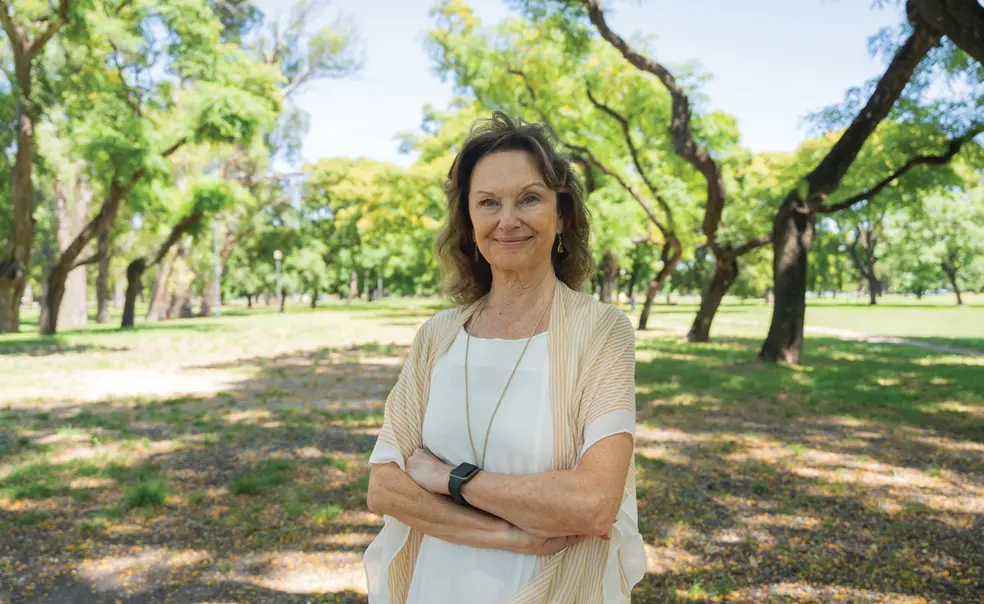

The first time Claudia Peirano *01 left her native Argentina for the United States, in 1988, she spent a lot of her days working at a McDonald’s in Columbia, Missouri.
“I was an accountant and manager at a bank,” she says of her prior life in Buenos Aires, “but I couldn’t work like that in the U.S. So, McDonald’s was a way to work flexibly with my son and with my husband doing his Ph.D.”
Within three months, Peirano — who had worked in agribusiness financing in Argentina — went from being a crew member to a shift manager at her local restaurant. She also befriended a frequent customer whose half-Uruguayan daughter also worked at McDonald’s. The customer, Michael Cook, was a University of Missouri professor who had just launched a new master’s program in agricultural economics; he suggested Peirano apply to the program, which she did — and got in.
She graduated from the program in 1992. Then, after nine years at a think tank, she was invited to lead the Argentine Forestry Association (AFOA) as its executive director, a role she has now occupied across two decades, five Argentine presidencies, and dozens of policies that have worked to make Argentina’s forestry sector safer, greener, and less susceptible to extreme weather events due to climate change.
“Well, you know — it’s serendipity,” she says, smiling, on a hot afternoon while sitting beside a lake in Buenos Aires. “Things go that way.”
When asked what location in the city best represented her line of work, Peirano suggested meeting at one of the city’s beloved Bosques de Palermo: a stretch of parks in the Palermo neighborhood — often likened in size and atmosphere to New York’s Central Park — that stud the city’s eastern border with the Río de la Plata estuary. The place reminded her, she said, of her hometown in Paraná, where her childhood among seven siblings revolved around the Paraná River.
“I need nature, I need the trees,” she says. Especially in a busy city such as Buenos Aires, “a person cannot be without a good environment around them.” But it is one thing to write and research the environment, and another to act as its advocate. While working at an Argentine think tank after returning from Missouri, Peirano grew frustrated with the amount of writing she was doing relative to the degree of acting.
“How do you bring closer what you say, what you study, and the papers you write with political decisions?” she wondered, before quickly realizing: “Probably what I need to do is to write less and do more.”
A serendipitous encounter with an advertisement in The Economist led her to Princeton in 2000, where Peirano pursued a master’s in public policy at the School of Public and International Affairs (SPIA). Her return to America was a fruitful and memorable one: Highlights include meeting Bill Clinton when he came to visit Princeton; working with Nobel Prize-winning economist Paul Krugman; and befriending classmates such as Kevin Sullivan *01, who would go on to become the deputy chief of mission at the United States embassy in Argentina.
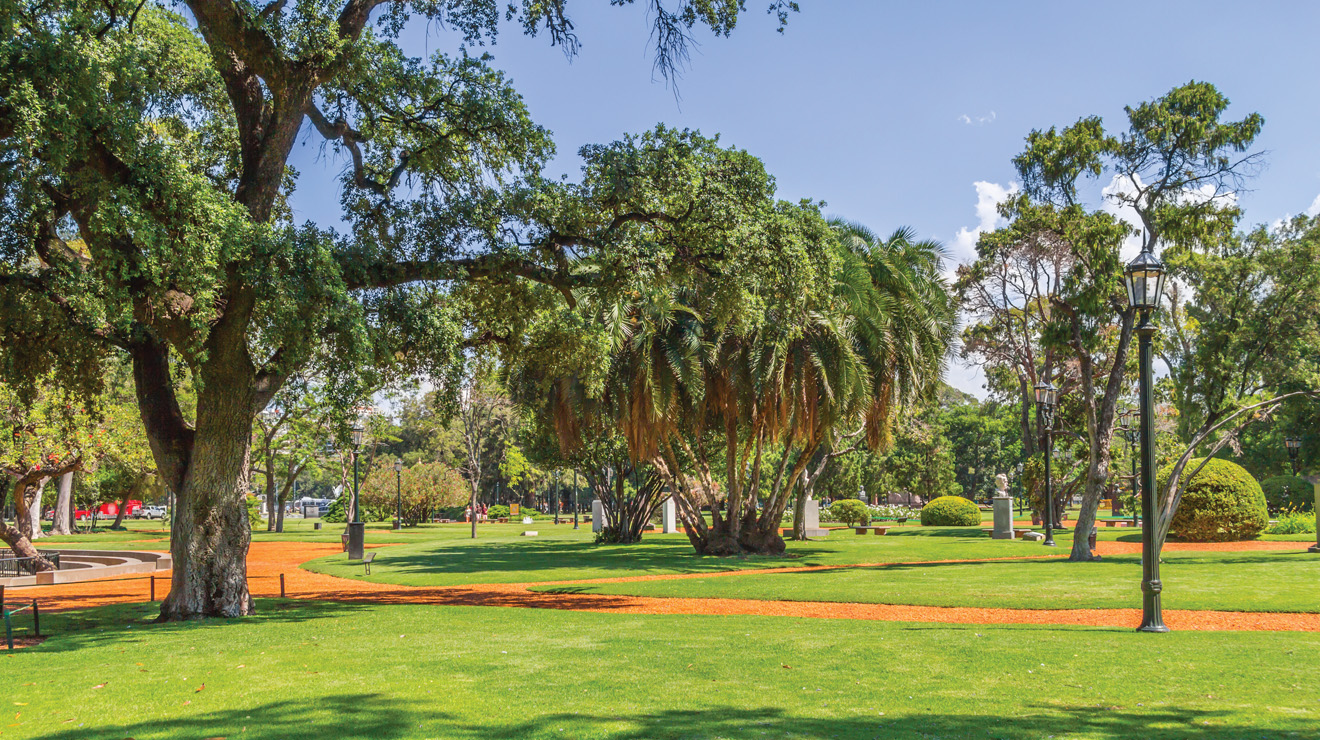
To serve as an intermediary between the private sector and the government in relation to Argentina’s forests is not a job for the weak. Established in 1946, AFOA is a consortium composed of hundreds of businesses, students, professionals, and industry experts who research, work, and trade in all things forest-related, including paper production, furniture, construction, and carbon markets. There are more than 1 million hectares of managed forests in Argentina, where over 100,000 people are employed by a forestry sector that in 2022 exported about $328 million worth of wood products. (Argentinian forests are, compared to the global average, incredibly productive: A pine tree that takes about 60 years to grow in Finland or Canada takes 16 years in northern Argentina due to the region’s climate and soil quality, Peirano explains.)
Yet the industry has struggled with a lack of government-supported infrastructure, as well as regional conflicts with neighbors such as Uruguay. In 2004, when Argentina and Uruguay fell into a dispute over the construction of pulp mills along the Rio Uruguay, Peirano’s team worked to educate the public and combat misleading information on the environmental effects of the project.
“The government has changed a lot in 20 years, but I’ve been the same,” she says. “I’ve been responsible for going to the new minister and saying, ‘OK, we are here. Let’s start here. Let’s not start at zero again.’”
The election of Javier Milei in 2023 has sparked a fresh batch of challenges for not just Peirano but those who work in the environmental sector writ large. Milei, who has significantly downsized the nation’s environment ministry under austerity measures, has previously described climate change as “a socialist lie.”
For Peirano, however, climate change is not only an unmistakable truth but a major policy issue on which AFOA, under her leadership, has seen impressive results. Of the over 500,000 hectares of forests that were burned by a massive wildfire in Argentina’s Corrientes region in 2022, less than 2% of forests protected under AFOA’s fire management policies were affected, Peirano said. AFOA’s “biodiversity monitor” training programs have reached Indigenous communities such as the Mbyá Guaraní in Misiones, where young people are being trained to translate ancestral environmental knowledge into jobs and sustainable forestry techniques.
Beyond leading initiatives to combat climate change, one of Peirano’s biggest achievements has been significantly improving labor safety among forestry workers, who have historically struggled with poor working conditions. During the first six years of Peirano’s leadership, the incidence rate of forest accidents — from potentially dangerous activities like felling trees and dressing timber — was halved with the introduction of an industry-wide labor competency program and worker safety evaluations that have rendered forestry work less informal and better protected.
“My job is to identify the best practices in the sector,” Peirano says. “We see how they work, and we translate these into general norms that we use to evaluate working conditions.”
This October, AFOA was recognized by the UN’s Food and Agriculture Organization for modeling best practices and innovative approaches relating to forestry, which Peirano considers “the best recognition that we could’ve aspired for.” Though Peirano, now 66, plans to retire in the next couple of years, she remains optimistic and motivated about the role she has played in her country over the past two decades. “What makes me happiest is that I’ve always done what I wanted to do,” she says of her career to date. “This doesn’t mean I didn’t face any resistance, but I could always be honest with myself and do the things that I believed in.”
The Latest
See all


Related News
With Prominent Journalists and Hoagies, the ‘Prince’ Celebrates 150 Years
A gala at the New York Historical raised roughly $400,000 for the independent student newspaper

No responses yet