

David Silverman *00 Studies Native Americans’ Impact on Race in the U.S.


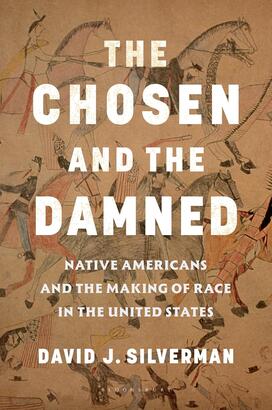
The book: In The Chosen and The Damned (Bloomsbury) historian David Silverman *00 traces racial tensions throughout American history beginning with the colonial era. Issues of race are often framed as Black and white, but Silverman recounts and restores the role Native Americans played in defining the country’s views on race today. Drawing on deep research, this book traces racial arguments in relationship to Native and white Americans across four centuries to offer a more nuanced perspective.
The author: David Silverman *00 is a professor of history at George Washington University. His areas of expertise include Native American history, Colonial American history, and American racial history. He is the author of six books including This Land is Their Land and Thundersticks.
Excerpt:
By the late 1760s, Indians throughout eastern America feared that the dark elements of colonialism were about to combine into an overpowering storm that would sweep them from the earth. Over the previous century, the population of the British colonies had expanded dramatically, from less than 150,000 in 1660 to some half a million in 1710, to nearly 1.5 million in 1760. Meanwhile, the Native population east of the Mississippi River had plummeted due to epidemic disease, intertribal warfare, colonial warfare, and slaving from its previous unknown heights to less than half a million. Colonists took advantage to expand from their Atlantic beachheads into the rich agricultural land approaching the Appalachian Mountains, and there appeared to be no end in sight. Britain’s triumph in the Seven Years’ War (1754–63) had won it France’s vast American claims, which was consequential even though Indians still considered the land to be theirs alone. The Anglo-American assumption that Indians would be unable to defend their territory without France’s help contributed to a surge of Whites across the Appalachian Mountains into the Ohio country (home of the Shawnees, Delawares, Mingos, Miamis, Wyandots, and others), Cherokee country, and Creek country. These intruders provoked Indians endlessly, expected to displace them entirely before too long, and were quick to call for their extermination whenever they resisted. Imperial and colonial officials bemoaned the chaos but frequently had profits at stake in it, for if White squatters could harass Indians out of their lands or incite a war to the same end, the elite’s land corporations had a better chance of collecting on their speculative investments, including selling that territory back to the original interlopers. The Indians’ superiority in forest warfare—and desperation— meant that sometimes they were able to reverse the White advance, but only temporarily. Their entire way of life, in which people lived with extended kin, ruled themselves, put only light pressure on the land, and engaged with the spirits of the surrounding world, faced utter destruction.
The young, Connecticut-born Presbyterian missionary Samuel Kirkland learned about the Indians’ apprehensions firsthand during a visit to the Senecas in spring 1765. Kirkland’s aim was to convince Indians that their worldly comfort and eternal salvation required them to become Christian and civilized, but many Senecas had already concluded that this agenda was against the sacred order of things and led only to woe. One man named Onoonghwandekha explained that the Bible “was never made for Indians.” The Great Spirit had already taught the Senecas to memorize, not write down, everything they needed to know. Consequently, Onoonghwandekha argued, “if we receive this White man and attend to the book which was made solely for White people, we shall become a miserable, abject people.” As proof, he pointed to Indians who had adopted Christianity under colonial pressure, only for the English to reduce them to poverty and degradation, even servitude. “This will be the condition of our children and grandchildren in a short time if we change or renounce our religion for that of the White people,” he warned. “We shall soon lose the spirit of true men. The spirit of the brave warrior and good hunter will no more be discovered among us. We shall be sunk so low as to hoe corn and squashes in the field, chop wood, stoop down, and milk cows like Negroes among the Dutch people.” Missionaries faced this critique nearly everywhere they went in Indian country. How were they supposed to convert Indigenous people who believed, as the missionary David Brainerd put it, that “’twas not the same God [that] made them who made us,” that the two peoples were “not of the same make and original”?
Indians living near the coast under colonial subjugation largely agreed with Onoonghwandekha’s assessment of their condition. The people of the tiny Choptank community on Maryland’s eastern shore, which was one of the only groups of Natives left in the colony, described themselves as “dead and dispersed . . . [a] remnant . . . pitiful.” They remembered “when there were great numbers of us Indians and but few White people in this nation, we enjoyed our privileges, profits, and customs in quiet, but it is quite contrary now.” Their colonized existence, like that of other so-called Settlement Indians, was an endless succession of “malicious and hateful treatment” at the hands of “White people,” including schemes to appropriate their meager lands and force them and their children into bondage.
Not even Natives who lived up to Whites’ civilized standards were immune from this debasement. In the mid-1770s, a cross-section of Christian Indians from southern New England and Long Island, including Narragansetts, Mohegans, Pequots, Niantics, and Montauketts, decided to form a community they called Brothertown and flee their colonized homelands for a new a start in the territory of the Oneidas, in what is now upstate New York. This remote location, they hoped, would both insulate them from colonial pressure and provide an opportunity to evangelize other Native people. Though these goals might seem to have been at cross-purposes, the Brothertown Indians did not view it that way at all. Led by a team of preachers who had attended English boarding schools, they believed that God wanted Indians to become civilized Christians, but that this course was impossible with underhanded White Christians as neighbors. Their leading light, the Mohegan minister Samson Occom, used a parable of “a poor Indian boy” to capture the trials he and his people faced on a daily basis in colonial society. This boy, as Occom told it, was “bound out to an English family” that beat him bloody for the least faults and often no fault at all. “Most of the time,” the semifictional boy bewailed, his master abused him simply “because I am an Indian.” “I can’t help that God has made me so,” Occom appealed, switching back to the first person. “I did not make myself so.” Better to escape the endless indignation of life among White Christians for refuge among the Oneidas, who, though pagans, at least “look upon us to be as the same blood,” as expressed by Occom’s son-in-law, the Mohegan Joseph Johnson.
The widely held Indian principle that Native people were of the “same blood” and fundamentally different from Whites contributed to the equally common belief that the Great Spirit had originally put Native people in America and Whites in Europe because he wanted them to pursue distinct ways of life. Europeans had violated His plan by crossing the ocean to America. Now, Indians demanded a halt to White encroachment on their lands and were prepared to fight back if necessary. As the Senecas urged the Delawares and Shawnees in 1767, “Brethren, those lands are yours as well as ours. God gave them to us to live upon, and before the White people shall settle them for nothing, we will sprinkle the leaves with their blood, or die every man of us in the attempt.”
To do nothing was to accept death anyway. The militants reasoned, as the British general Thomas Gage understood, “that as the White people have advanced from the coast, the original Natives have been destroyed, and of the numerous Nations which formerly inhabited the country possessed of the English, not one is now existing.” With the Whites “drawing closer and closer” to the interior tribes, “they see it must soon be their turn to be exterminated.” Moderate Indian leaders repeatedly bowed to colonial demands for more territory in the futile hope that, by currying favor with White authorities, this time, the line would hold. Yet most Indians had determined that there was no end to White people’s greed at Indian expense. Their great fear, they told the British Indian agent Sir William Johnson, was that “we design shortly to fall upon and destroy all the Indians in alliance with us.” Put in modern terms, Indians feared that White people had marked them for genocide.
They were not wrong. “Backcountry” or frontier Whites, after suffering brutal retaliatory Indian raids for the better part of fifteen years and returning that violence blow for blow, were increasingly unwilling to make fine distinctions between Indian enemies and allies, Christian and civilized or not. They intended to protect themselves, or so they believed, and seize vast Indian territories in the process, by treating every Indian as hostile. When provincial authorities pleaded with the White people of Lancaster County, Pennsylvania, to stop murdering local “friend Indians,” the killers answered that it was “dangerous to our frontiers to suffer any Indians of what tribe [what]soever to live within the inhabited parts of this province, while we are engaged in an Indian war; as experience has taught us that they are all perfidious.” The country people’s excuse for slaughtering Native women and children was that Indians were “cruel monsters” and “lest out of the serpent’s egg . . . his fruit should be a fiery flying serpent.”
These ideas encouraged race war. After all, when Whites and Indians alike proclaimed that they were fundamentally different groups by God’s design, and that the other was an evil, existential threat, it was an invitation to violence without limits. Such thinking justified Whites in their assaults on Indian land and autonomy, and galvanized Indians to unite in defense, but achieving those ends required mass murder. The legacy of this dark era was not just the blow to ideas rooted in religious faith and basic humanity that Indians and Whites could coexist, but the unleashing of mutual brutality that included a White campaign of genocide against Indigenous people.
Excerpted from The Chosen and The Damned: Native Americans and the Making of Race in the United States. Used with the permission of the publisher, Bloomsbury. Copyright © 2026 by David J. Silverman
Reviews:
“A wide-ranging consideration of Indigenous people in a nation driven by white supremacist ideology… A charged argument for fully including Native Americans in America’s racial history.” — Kirkus Reviews
“An eye-opening and masterfully crafted book. David Silverman dismantles the myth that Native peoples were a doomed race, while insisting that their stories are the core of the American story.” — Andrew Lipman, author of Squanto: A Native Odyssey
The Latest
See all


Related News

Janice Lee ’09 Worked to Renovate One of Hollywood’s Best-Kept Secrets
An engineer by training, Lee has been deputy project manager on the renovation of Hollywood Burbank Airport

No responses yet