

Defense Secretary Pete Hegseth ’03 Axes Military Fellowship at ‘Elite Colleges’
The one fellow Princeton hosts each year brings important perspective to discussions, says SPIA professor Jacob Shapiro
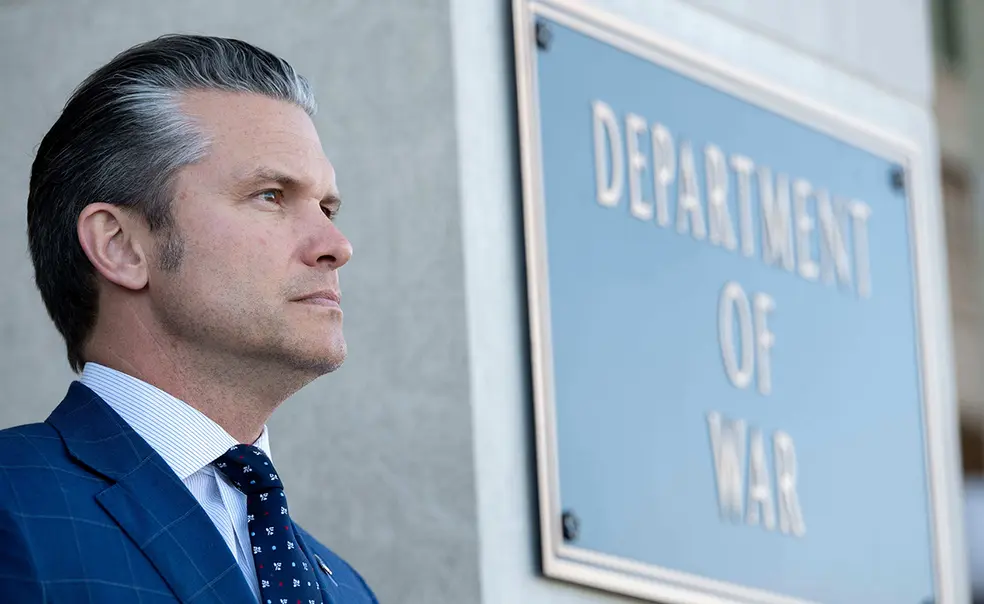

In a Department of Defense video posted to X on Feb. 27, Defense Secretary Pete Hegseth ’03 announced the termination of the Senior Service College Fellowship programs at 22 elite colleges, including Princeton, saying the political bias he perceives in those programs promotes a culture of “wokeness and weakness.”
Though Hegseth’s video statement announced, “the complete and immediate cancellation of all Department of War attendance at institutions like Princeton, Columbia, MIT, Brown, Yale, and many others,” suggesting the termination of all undergraduate and graduate military attendance at certain elite schools, a Pentagon memo dated Feb. 27 only targeted the Senior Service College Fellowship at select universities for the upcoming academic year. The same memo said those fellowship hosts could be replaced with alternative institutions, including conservative-leaning Liberty University and state universities such as Michigan and North Carolina.
The one-year Senior Service College Fellowships offer mid-career military personnel an alternative to education at a military war college. A relatively small program, the cohort typically consists of about 80 fellows per cycle. According to Jacob Shapiro, a U.S. Navy veteran and professor at the School of Public and International Affairs who brought the program to Princeton in 2018, one fellow joins the Princeton University community each academic year. “These are experienced leaders who are committed to mentorship, who we get to have on campus, contributing to the community for 10 months every year,” Shapiro told PAW. “We’ll be very sad not to have them.”
Distinct from the Senior Service College Fellowships, many other military service members attend Princeton as enrolled students, whether as undergraduate students in the Reserve Officer Training Corps (ROTC) program or as officers pursuing graduate studies. These programs remain unaffected by the Feb. 27 order.
In the video announcement, Hegseth, who majored in politics at Princeton and holds a master of public policy degree from Harvard, was unsparing in his critique of what he perceived as the left-leaning nature of Ivy League programs, risking service members’ “indoctrination” in leftist viewpoints on campus. “For decades, the Ivy League and similar institutions have gorged themselves on a trust fund of American taxpayer dollars only to become factories of anti-American resentment and military disdain,” Hegseth said. “They’ve taken our best and brightest, the men and women who have pledged their lives to this nation and subjected them to a curriculum of contempt.”
Shapiro disagrees with Hegseth’s view that elite schools have “indoctrinated” Senior Service College fellows. “In our experience at Princeton, it has been quite the opposite,” Shapiro said. “They help develop a richer understanding among our students and our community of the perspectives and sacrifices made by the uniformed military.”
Peter D. Feaver, a professor of political science at Duke University who served as a White House adviser in the George W. Bush administration, adds that military officers can “put a human face on what are otherwise abstract academic concepts like military intervention, or casualties, or risk.” Such interaction can help foster understanding of the real-world impact of policy decisions. “When you’re sitting next to the guy who might bear that risk with his life, it becomes more real,” Feaver said. Duke is not affected by the cancellation of the program.
One intent behind the Senior Service College Fellowship, Shapiro argued, is to help military officers build networks with civilian leaders and the military personnel of allied nations. “Building those networks is a long-run investment in our military’s ability to operate and develop relationships in the U.S. and overseas,” Shapiro said. “When we take away those networking opportunities, there’s a real opportunity cost for the future operational effectiveness of our military.” Shapiro said he worked to bring the Senior Service College Fellowship to Princeton in 2018 after noticing fellows during his Ph.D. program at Stanford. “I saw firsthand how much they enriched the community and how much they got out of being at that institution, and felt like we should have that at Princeton,” he said.
Feaver also suggested that exposing military officers to different perspectives within the campus environment can shape more effective military leaders. “You want to hone the strategic mind of your military leaders by exposing them to the best minds and the best arguments, including arguments that might go against what the military might be inclined to do,” he said. “They can sharpen their thinking, rather than be in an echo chamber where they’re constantly just hearing from people who agree with them.”
One graduate alumnus with a military background, who did not participate in the Senior Service College Fellowship and spoke to PAW on the condition of anonymity for fear of retribution, cited the importance of the fellowship as a chance for officers to connect with civilian perspectives before ascending to the highest levels of military leadership. “It’s really kind of the last opportunity for people to academically, professionally, and relationally develop before they take these large senior roles,” the alumnus said.
Another graduate alumnus with a military background, who also did not participate in the impacted fellowship and spoke to PAW on the condition of anonymity due to his active-duty status “kind of applauds” Hegseth’s decision, arguing that Princeton’s intellectual atmosphere is “not military-friendly at all” and hostile to ideas coming from real-world, battlefield experience. The alumnus expressed hope that Hegseth’s decision would be an opportunity for Princeton to be “a little more introspective” about the viewpoints the University tolerates on campus.
In his tenure as defense secretary, Hegseth has presided over a campaign attempting to restore a “warrior ethos” against what he has characterized as the incursion of “woke ideology” into the military under previous Democratic presidential administrations. This effort has included the rebranding of the department as “the Department of War,” per President Donald Trump’s 2025 executive order to use the name of the cabinet department that ran the U.S. Army from 1789 to 1947. (Congressional approval is required to make the name change permanent.)
Editor’s note: The article was revised to clarify the history of the Department of War.
The Latest
See all


Related News
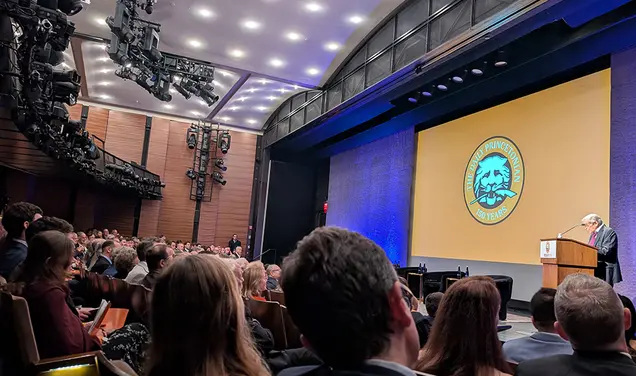
With Prominent Journalists and Hoagies, the ‘Prince’ Celebrates 150 Years
A gala at the New York Historical raised roughly $400,000 for the independent student newspaper


4 Responses
Rocky Semmes ’79
5 Months AgoOutdated Pivot to the ‘Warrior Ethos’
Pete Hegseth ’03 seems to be a brazenly brash bit of a blowhard. The blowhard is that person who “talks too much and too loudly, especially in a boastful or self-important manner.” The public should expect, in the pivotal role of his title, that he knows whereof he speaks.
However, PAW reports that "in his tenure as defense secretary, [he] has presided over a campaign attempting to restore a ‘warrior ethos’” to his department. The historic nation-state military apparatus abandoned that warrior ethos long ago, going back centuries.
The soldier is a product of standardized rigorous training, operating within a structured military organization. The warrior, in contrast, embodies a more individualistic approach to combat, often within tribal or clan-based societies.
In the fourth Century B.C.E., Titus “Torquatus” Manlius (renowned general of the Roman Republic), ordered his son executed, for disobeying military discipline and engaging in warrior-like single combat. Centuries later, General George S. Patton Jr. (in his famous D-Day speech addressing the Third Army), noted that “an Army is a team; it lives, eats, sleeps, and fights as a team. This individual hero stuff is a lot of horse s--t!”
Both Patton and the military machine of the Roman Empire are universally recognized (and respected) authorities on the topic of warfare. Pete Hegseth as a politics major undergrad, maybe not so much, though perhaps an otherwise well-informed person.
Ronnie Raviv ’95
5 Months AgoDon’t Fear the Battlefield of Ideas
Pete Hegseth (do I have to add the ’03?) and the second anonymous quotee applauding him must be right about Princeton promoting weakness. After all, these two illustrious alums are so afraid of the battlefield of ideas they and others might encounter on this hostile campus of ours, I fear how they’d fare against actual bullets on an actual, you know, battlefield.
As for being corrupted by wokeness, however, apparently we still have little to fear there, if these two are any example. Phew!
Stamos Metzidakis ’74
7 Months AgoThreat to Princeton’s Service Tradition
Hegseth is an absolute embarrassment to our beloved institution. His disgraceful American “crusade” (his telling word) and shameless support of an authoritarian would-be dictator will leave a permanent stain on our long tradition of being truly in the nation's service. While nobody in her right mind thinks Iran, Cuba, Russia, etc. have been admirable or friendly to us for quite some time now, putting one’s considerable political (and war) power, as Pete has, behind an out of control, mostly incompetent regime run by a convicted felon is calamitous for those who still believe in truth and the law.
Jim Perry ’57
7 Months AgoPrinceton’s History of Military Service
It might help to mention the Class of 1942 book documenting that 85% of the class served in uniform and 25 of its members died in service. My old friend and mentor the Rev. Bill Eddy ’42 was awarded a Navy Cross for action at Iwo Jima. Service, not bone spurs.