
Facing Barriers, International Students Make New Plans
The federal government has sent international students scrambling with a mix of visa and immigration restrictions

Editor’s note: The international students interviewed for this article requested anonymity because they feared that speaking publicly could jeopardize their visa status. Each is identified by first initial and class year.
In the summer of 2022, S. ’26 took a taxi from Damascus to Beirut for her visa interview. The American Embassy in Syria had been closed since 2012, shortly after the country’s civil war broke out. After receiving her acceptance to Princeton, S. withheld excitement, worried her visa case would get rejected or delayed. To her surprise, the official approved her application immediately.
Shortly after her arrival in the U.S., S.’s visa expired. The standard length for student visas to the U.S. varies by country, and for Syria, the norm is just three months. Without a valid visa, S.’s status in the country remains legal until she gets her degree. But this security comes with a catch: She could not leave the country without the risk of not getting back in. Before January, she would have had to reapply for a visa, and since then, travel to the U.S. for Syrian nationals has been banned.
Now a senior, S. longs to see her family. As she has progressed with her degree and worked internships in the U.S., her brothers have grown up without her. “When I left, my brothers were, like, shorter than me,” she told PAW. “Now I almost don’t even recognize them.”
Hoping to reunite with her relatives at graduation, S. started helping them apply for visas, but when the Trump administration imposed the travel ban from Syria, S. scrambled to figure out what it meant. “Will my family be able to come see me?” she recalls wondering. “Probably not at this point.”
The uncertainty she feels is widespread. Over the past year, President Donald Trump’s administration has targeted international students in a series of restrictions, citing concerns about national security. Fear has spread among international students at Princeton, where 13% of undergraduates — and 45% of grad students — come from abroad. “This is not the safe haven that it was supposed to be,” B. ’27, a Princeton student from Latin America, told PAW.
For decades, the U.S. has been a global leader in attracting talent from abroad. Last school year, there were close to 1.2 million international students in the U.S., the highest number of any country on record, according to a report from the Institute of International Education. In the last decade, though, the percentage of international students around the globe coming to the U.S. has been declining, from 20% in 2013-14 to 16% in 2023-24, according to the Migration Policy Institute.
The Trump administration’s restrictions on travel, visa issuance, and speech are likely to damage the country’s reputation among international students even more.
On his first day back in office, Trump issued an executive order demanding increased vetting of student visa applicants. Soon after, another executive order threatened to deport students and faculty involved in protests that the administration deemed antisemitic. Then, the U.S. government revoked thousands of student visas and altered the status of many in the Student and Exchange Visitor Information System (SEVIS), a digital database tracking international students, according to Inside Higher Ed. Weeks later, facing lawsuits, the administration reversed the changes in SEVIS.
In defense of these restrictions, the Trump administration has underscored its commitment to national security. “Whether they be [a] student or if you’re a tourist who needs a visa, or whoever you are, we’re going to be looking at you,” said then-spokesperson Tammy Bruce at a press conference in May, responding to a question about student visas. “Every nation should take seriously — and does — who’s coming in.”
Meanwhile, advocates see international students as a boon, and not a threat, to U.S. interests. “When international students succeed in America, we all win,” said Jill Welch, executive director of U.S. for Success, a multi-sector coalition that supports U.S. competitiveness through attracting international students.
The Trump administration’s visa revocations affected a fraction of the international students in the U.S., but they caused widespread fear. To protect their status, international students at Princeton who spoke with PAW said they cleansed their phones of possible red flags, wiping chat histories, unfollowing social media accounts, and even deactivating their social accounts.
Students also began to tread cautiously in politics. Several described staying far away from campus protests to avoid appearing in photos or videos. The effect was one of “total silencing,” said one student.
M. ’27, an international student from Europe, attended poetry readings in support of Palestine and occasionally manned the spring 2024 encampment protesting the war in Gaza. But after his parents expressed concern over his legal status in the U.S., M., a politics major, opted out of political expression. “To some extent I decided to prioritize my safety,” he told PAW. “Even though, like, it goes a little bit against my morals.”
In May, the Trump administration blocked Harvard from enrolling new international students. (A federal judge later ruled against the measure.) B., a rising junior at the time, was on a lunch break at his internship when he saw the news. Immediately, he feared Princeton would be next. Though the proposed restrictions would only affect prospective students, B. worried about his ability to finish his degree. “I don’t know if I just wasted, like, two years of my life,” he recalls telling his mother on the phone.
B. returned to campus last fall, but not without anxiety. For several weeks, he avoided venturing off campus, fearing law enforcement. Having observed the way the administration has targeted international students and Hispanic migrants, B. said he feels especially scrutinized. “It’s like I’m in a panopticon,” he told PAW. He noted how unfair this feels. “We pay taxes. We don’t break laws,” he said. “It just feels like no one wants us around.”
“I don’t think I’m exaggerating if I say that almost everyone has, at the very least, reconsidered their future plans and thoughts on staying in the U.S.”
— M. ’26, International student from Spain
As a freshman, B. had ambitions to apply to law school in the U.S. He no longer wants this — and he’s not alone.
“I don’t think I’m exaggerating if I say that almost everyone has, at the very least, reconsidered their future plans and thoughts on staying in the U.S.,” M. ’26, who is from Spain, told PAW over text. Though his request to OPT, the program authorizing international students to work in the country, has been approved, he suspects that employers are less inclined than before to hire international graduates.
M. said daily life distracts from the precarity international students feel. But occasional reminders resurface his concerns — emails from the Davis International Center or news headlines, for example. M. and several other students who spoke to PAW described the cumulative feeling as one of culpability. “That’s the craziest feeling,” he said. “The feeling is that you’ve done something wrong.”
In addition to this uncertainty, concrete restrictions loom. In August, the Trump administration proposed to end “Duration of Status,” which allows students to switch programs, transfer schools, or take time off without reapplying for a visa.
“In some ways, it doesn’t sound unreasonable,” said Dan Berger, a lawyer and immigration scholar. But the change, which would require students to go through additional steps to extend the length of their visas, comes with a cost. “When you’re talking about adding in millions of applications with a smaller workforce, and a large backlog, and a policy of extreme vetting,” Berger said, “it’s a recipe for things not getting done in time.”
The proposed change would make it harder for students who need more than four years to complete their program of study. It would also make it harder for them to work in the U.S. after graduation. The changes affecting international students will likely make campuses look different. Workplaces too.
For many, the U.S. has long signaled safety and the possibility of upward mobility. It is home to excellent universities and a competitive job market. But international students have always had other opportunities beyond an American education. As life gets harder for international students in the U.S., they might just start to take them.
“As an international student, you sort of just, like, have to watch helplessly,” said M. ’28, who came to Princeton from Australia. Still, he acknowledged that, as an Australian, he is in a more stable position than many international students. “It really matters where you’re from,” he said.
Indeed, there are as many international student experiences as there are international students. Those from countries that issue short-term visas face unique challenges.
For P. ’29, a freshman from Cambodia, it was a feat to even get a visa. At the time she applied, operations at the American Embassy in Phnom Penh had slowed. A week after her interview, the Trump administration paused all student visa interviews as it planned new screening processes. Interviews resumed in June. Still, P. fears leaving the U.S. and renewing her visa, which was only valid for three months. “I really want to visit family,” she told PAW. “But I’m scared.”
The Latest
See all


Related News
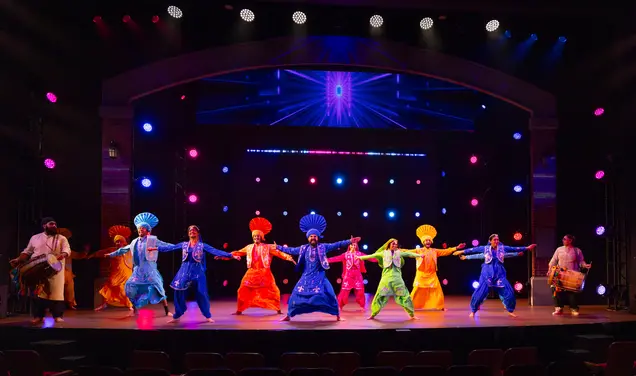
McCarter Theatre’s First South Asian Musical Took Me Back to Forbes Basement
A Beat of Our Own is about a college dance team not unlike Princeton South Asian Theatrics

No responses yet