

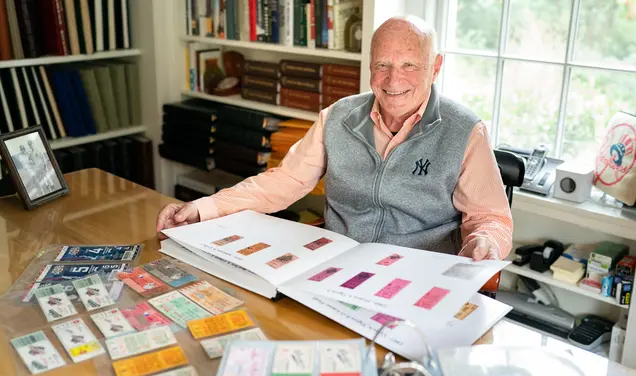
Fighting Cancer, Skip Hovsmith ’80 Runs Marathons With His Family
‘Our dad really taught us that we can do hard things,’ Elayne Hovsmith says


What would you do if you were told you have maybe four months to live? And what would you do if that hypothetical time horizon had been extended due to life-saving treatments and you were still alive a year and a half later?
For Skip Hovsmith ’80, he needed to run a marathon.
Hovsmith ran his first — the Big Sur International Marathon — in 2006 to “check it off my bucket list.” He got hooked and went on to run about 50 more marathons. “It’s great to push yourself to the limit and to cross the finish line. There’s a whole rush of accomplishment and great feeling,” he says, adding that his favorite part was meeting other runners along the route. “People who run marathons are weird, so they’re awesome to talk to.”
A soccer player at Princeton, Hovsmith continued playing competitively when he moved to northern California after graduation. Years later, at the end of 2023, a suspected soccer injury to his shoulder brought him to a doctor. An MRI traced the injury to an infection that had originated in his liver, and doctors found a tumor. By March 2024, he was diagnosed with a rare cancer called epithelioid hemangioendothelioma that affects cells lining blood vessels. His first surgery in May was aborted when the cancer was found to have metastasized outside of his liver to his lungs, bones, and the linings of multiple other organs.
“From there, I was pretty much on the track to be dead,” Hovsmith says. “The first thing I probably did was just not think about it. I was like, ‘Yeah, well, I believe miracles can happen. I don’t necessarily have to agree with what they’re telling me,’ and so I just kind of carried on.”
Since then, miracles have happened. Hovsmith’s cancer has been managed by another surgery and courses of chemotherapy and radiation, but not without a cost: The treatments caused fatigue and loss of strength and stamina. His doctors at Stanford Medical Center advised him to stop playing soccer to avoid injury, but they said he could keep running. So Hovsmith’s mind went back to marathons.
“There are two reasons to try and do marathoning when you have cancer, even though it’s a somewhat crazy thing to do,” Hovsmith says. “One is, obviously: Building up your strength is key to improving your ability to fight back against the disease. Secondly, I have so much of a tighter connection with my docs and my care team, my nurses.”
He was in the middle of a radiation course when the Big Sur International Marathon took place last April. He couldn’t run very far, but Hovsmith was able to work with the race director to run the last 11 miles of that race so he could at least aim to cross the finish line. After he was able to finish in the middle of the pack, he set his sights on a full marathon in December — the California International Marathon, which he says is easier because it’s a mostly flat course — and planned to run with his three adult children.
“I was excited to tell him the same things he told me to motivate me when I was giving up,” says Nick Hovsmith ’23, “that there was no shame in calling our mom to come pick us up, and that I didn’t want him to hurt himself, because I know that really pushed me — not wanting to give up — and I think it had a similar effect for him.”
But the call to Kathy Hovsmith ’81 was never made. The Hovsmiths crossed the finish line together on Dec. 7 in about 5 hours and 45 minutes. It was Skip’s worst marathon time, but he reported in the days afterward that his body felt good. “I actually hurt myself less by having to start and stop so many times — I just didn’t have enough energy to hurt myself. It’s a strange paradox, but, yeah, it was an easy run for me, even though it was a really hard run for me.”
A week after completing the marathon, Hovsmith had another round of scans. Though he admitted after the fact that he did have some concerns that running a marathon might do more harm than good to his liver and overall health, he said he felt stronger thanks to all the running. His doctors are now recommending he participate in a stage-two clinical trial led by the Dana-Farber Cancer Institute — and they say that the drug might actually help Hovsmith’s running.
“Our dad really taught us that we can do hard things, and so it was just really special that we all got to do that together,” Elayne Hovsmith says. “The fact that we’re here today talking about this is huge, and it’s just, like, a testament to his character and who he is as a person.”
Jaclyn Hovsmith ’20 added that running the marathon was not unlike her father’s cancer journey: There were moments when running was really hard and she just had to focus on putting one foot in front of the other. “I don’t know if we’re going to be able to make this or what’s going to happen, but we’ll just keep trying and see where it gets us.”
Now Hovsmith is looking ahead to April, when he’s hoping to run the Big Sur International Marathon in its entirety with his daughter, Jaclyn. He joked on a call with his three children, “I think everything went in our favor, and we could do faster next time — right, guys?”
The Latest
See all


Related News

With Prominent Journalists and Hoagies, the ‘Prince’ Celebrates 150 Years
A gala at the New York Historical raised roughly $400,000 for the independent student newspaper

2 Responses
Demaree Peck ’81
9 Months AgoSetting a Beautiful Example
I’m a friend of the Hovsmith family. Kathy and I were friends in the Class of ’81, often mistaken for twins, and my son Nate and Kathy’s and Skip’s daughter Jacquelyn were friends and roommates in the Class of ’20. Skip’s optimism and perseverance in the face of a harsh diagnosis are truly inspiring! The amazing support of the whole family is what pushed him across the finish line. Whatever lies around the bend, the journey itself is the most important thing. In life as in marathons, it doesn’t matter whether we win or lose the race, but how we run it. Skip has set a beautiful example for his children and all of us to give your all to each moment.
Congratulations Skip! The mind-body connection is powerful. Never give up! Keep running and continue to set your own best pace.
Kathy Hovsmith ’81
9 Months AgoFamily Pride — and Grit and Grace
I could not be more proud of our three kids, for supporting their dad in this way. And I’m in awe of my husband’s mental fortitude, courage, and physical tenacity, to demonstrate this grit and grace through Stage 4 cancer. Skip is simply amazing; and I love him more than words can express.