

Grad Students Compete to Explain Their Theses in Just 3 Minutes
More than 50 students applied to compete for prize money at the Graduate School’s first 3-Minute Thesis showcase
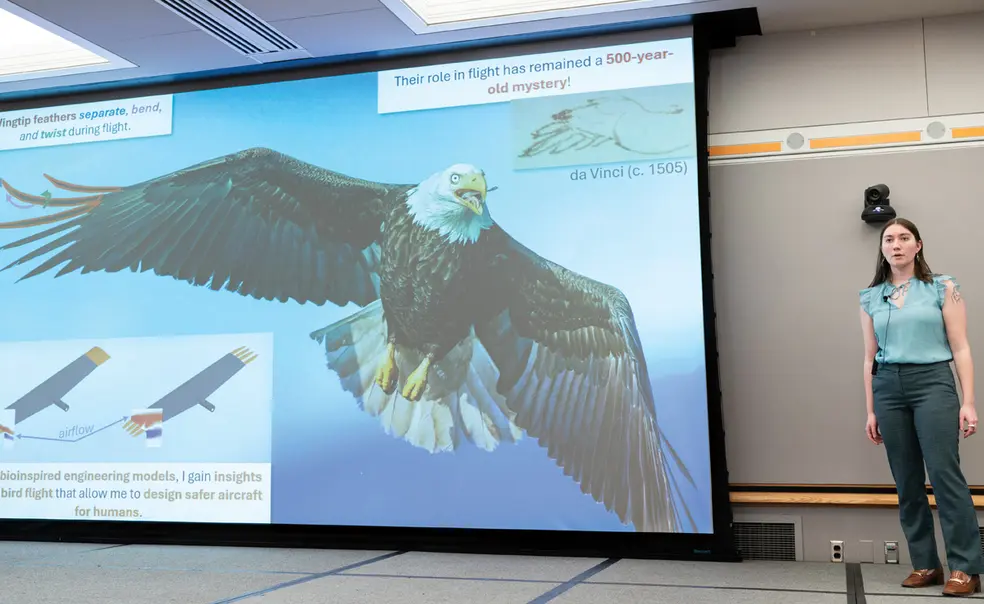

At the Graduate School’s first 3-Minute Thesis showcase in the Frist Multipurpose Room on March 25, mechanical and aerospace engineering Ph.D. student Hannah Wiswell soared to first place with her presentation on bio-inspired design research, such as using birds’ feathers as inspiration for creating manmade wing models.
“I not only gain insights about biology but improve the design of aircraft to make flights safer for humans who seek to soar alongside the masters of the skies,” she said to the audience of about 200 attendees.
More than 50 Princeton graduate students applied for the competition, which challenges students to present their research in layman’s terms in three minutes or less with just one static slide. The worldwide competition, known as 3MT, began in 2008 at the University of Queensland in Australia, and more than 900 institutions now take part.
Finalist David Shlivko, a physics Ph.D. student, said 3MT is unique because “most of the talks that I’m used to giving are on a very particular part of my research and last about an hour long. So, this is going on six years of research and lasts about three minutes.”
As the final judges — Dean of the Graduate School Rodney Priestley, Dean for Research Peter Schiffer, and philosophy professor Sarah-Jane Leslie *07, a former dean of the Graduate School — tallied their scores, three faculty members gave 3MT-style presentations and then took part in a panel.
“This is one of the worst experiences of my life,” Sophie Gee, professor of English, jokingly said as she prepared to pitch her research as an encore to the student presenters. “I’m so impressed by you guys.”
In April, Wiswell was named one of two winners at the Northeastern Association of Graduate Schools 3MT competition and advanced to the national 3MT competition, which will take place in December.
Wiswell received $1,500 for her win at the Princeton event; runner-up Katja Kochvar, an ecology and evolutionary biology Ph.D. student, received $1,000; and after an audience vote, Hasan Hameed, a doctoral candidate in history, received $500 as the People’s Choice winner. One of Hameed’s young daughters ran up on stage to join him as he received his giant check, delighting the audience.
Sonali Majumdar, an assistant dean of professional development at the Graduate School, helped organize the event and told PAW she hadn’t anticipated the strong community-building element of 3MT.
“It just generally ended up becoming a celebration of these students and their incredible work and the community that’s beside them on really putting that forward,” said Majumdar.
About 40 students competed in preliminary rounds from mid-February to early March, and all of them will receive a GradFUTURES research communication certificate. In the weeks leading up to the final showcase, the 10 finalists were given access to coaches — University staff across campus who are part of the Princeton Research Communicators Network. Alma Paola Hernandez Gonzalez, a graduate student in chemistry, said she felt lucky to be practicing her final presentation with a “really helpful” coach.
Earlier this year, before initial applications were due, the Graduate School offered three workshops — on communicating research to general audiences, storytelling structure, and stage presence and oration skills — that were open to all and attended by about 50.
Majumdar, who competed in 3MT herself as a graduate student at the University of Georgia, organized the trainings around each facet of the standard 3MT scoring rubric. “The goal was to help them prepare for different aspects of the 3MT talk and, broadly, also give them skills that would be applicable for broader research communication.”
“The workshops really help students realize how much jargon” they use, said finalist Yubin Lin, an electrical and computer engineering graduate student.
Majumdar said she believes public engagement skills are “a personal responsibility [of] academics to really talk about why we are doing what we are doing, what we are finding out — and the lack of doing that has created this environment of misinformation where there’s skepticism.”
At the competition, Priestley said he believes research isn’t done until researchers can convey their complex and original ideas to a broad audience. “We live in a moment when it has never been more important for those of us in academia to share our work,” he said.
The Latest
See all


Related News
With Prominent Journalists and Hoagies, the ‘Prince’ Celebrates 150 Years
A gala at the New York Historical raised roughly $400,000 for the independent student newspaper

No responses yet