

Professor Daniel Heller-Roazen Dissects Words
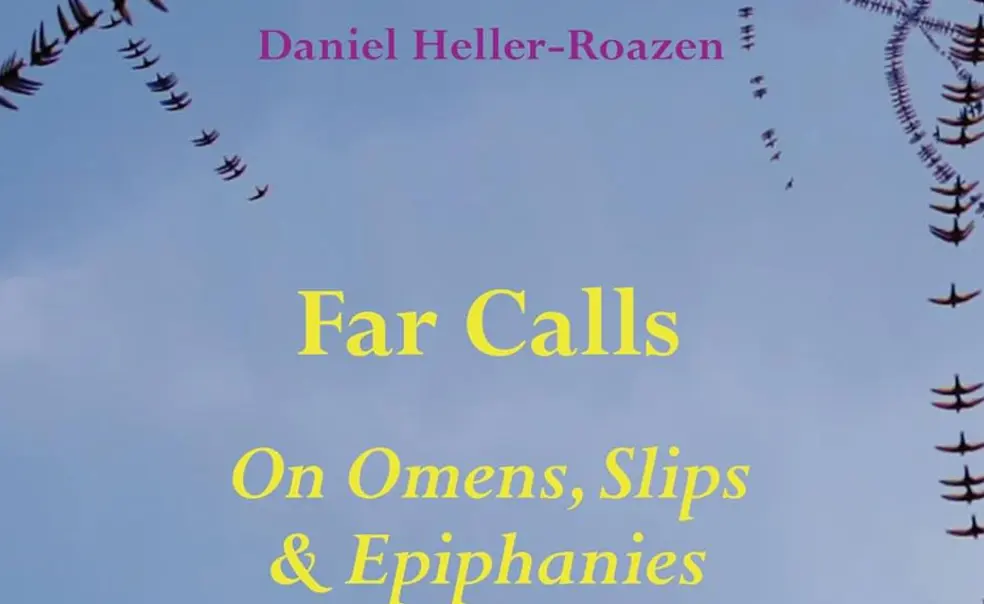

The book: The value of dialogue and the ways people interpret events is at the heart of Heller-Roazen’s new book, Far Calls (Zone Books). In it, he examines the interpretation of events through the eyes of prophets, priests, philosophers, novelists, and others who often shepherd narratives to understand the ways words are constructed and passed on. This is particularly interesting in cases where words are missed, received out of context, or misstated. Heller-Roazen’s analysis of all of this offers deeper insights into how words impact our understanding.
The author: Daniel Heller-Roazen is a professor of comparative literature at Princeton University. His research focuses on medieval studies, philosophy, poetics, linguistics, and psychoanalysis. In addition to Far Calls, he is the author of several other books including Absentees and No One’s Ways.
Excerpt:
The act of speaking implies an act of hearing – another’s or one’s own. Between these two events, however, there is an interval. It may consist of a gap in time, which is due to the process of articulation; it may appear as a lag in cognition, which lasts as long as it takes for what has been said to acquire sense and consequence. It is tempting to dismiss such transient phenomena as accidents of articulation and comprehension. Yet they attest to a precious possibility. When speaking and hearing imply each other without being coincident, what is said can be heard otherwise than as it was intended. There is a chance, then, for language to be more than an instrument of communication. When what has been uttered must be grasped part by part, when it runs the risk of being heard solely in part, and when it may, therefore, be understood too soon as well as also too late, meanings shift. Senses accrue and are effaced. Diverse, conflicting, and even contradictory phrases and propositions become audible. The saying itself, in its shifting relation to understanding, becomes an event.
What appears in such circumstances may seem to be a mere perturbation in the course of discourse. Yet the membrane that separates articulation from comprehension can also allow a truth to sound. That truth can be the fruit of a concerted effort to listen or to listen in, to hear or to overhear, if not to eavesdrop; but it can also be the unintended effect of a momentary distraction, or the result of concentration on some unrelated matter. It can be audible in a fleeting resemblance: an echo or a pun, by which a syllable, word, or phrase suggests several meanings at once. It may be sealed in a slip in the Freudian sense, in which an apparent blunder of the tongue or ear turns out to be the index of a thought that can assume no other shape.
Whether such moments are understood as accidents or as the effects of a hidden cause, they imply the variety of event known as “coincidences,” which can be neither foretold nor repeated. Those who have dared to consider such happenings as objects worthy of study in themselves compose a company of interpreters at once motley and distinguished. In various settings and for the most dissimilar of reasons, prophets, priests, and rabbis, poets and philosophers, linguists, psychiatrists and psychoanalysts, novelists and filmmakers have all suggested that, in the hazards of speaking and hearing, misspeaking and overhearing, there are indications that can gleaned by no other means. To catch and read them, they have also held, arts of inference and elucidation are required.
Those arts are the arts of divination. Cicero, who is the first recorded author to employ the Latin source of our English word, defines divination as the foretelling and foreseeing of what seems to occur by accident. An earlier Greek source states that divination consists in knowing the invisible by the visible and the future by the present. In the modern period, divination has been studied from almost innumerable perspectives, in research informed by anthropology, sociology, political science, philosophy, and religious studies. Yet there is one account that has perhaps not received the attention it deserves. It was developed by Walter Benjamin in the early 1930s. Benjamin roots divination in an ability that he calls “the mimetic faculty,” which he understands as the capacity to see similarities and to become similar. That capacity, he argues, consists in grasping “non-sensuous resemblances.” Such resemblances involve likenesses between things that do not or that no longer share a single perceptual property, such as a shape, form, feature or set of traits. For Benjamin, the detection of non-sensuous resemblances is the basis of games and make-believe, in which children and adults imitate human and inhuman objects and processes. It is the origin of painting and dance. Above all, it is the foundation of divinatory practices, such as astrology, graphology, and the study of the viscera of sacrificial animals in extispicy.
All such procedures, for Benjamin, involve the perception of non-sensuous similarities. To employ his term of choice, they are practices of “reading.” Today, reading is generally understood to involve the coordination of a graphic sign, such as a letter or a character, with a sound, word, or idea according to a convention. Benjamin proposes a different account, in which the habits of children and adults and the practices of earlier and later stages of humanity converge: “The schoolboy reads his ABC book, and the astrologer reads the future in the stars. In the first sentence, reading is not separated out into its components. Quite the opposite in the second case, though, which clarifies the process at both its levels: the astrologer reads the constellation from the stars in the sky; simultaneously, he reads the future or fate from it.” Moved by the “compulsion to become similar and to behave mimetically,” readers, whether children or astrologers, grasp correspondences between orders that share no stable likeness: orders such as script and speech, or the constellation and a present, past or future moment. In such practices of the setting into relation of the unalike, a “non-sensuous resemblance” comes to legibility in a sudden “flashing up.” To read, for Benjamin, is to grasp the resemblances that appear in such moments. Far from corresponding to a given script, reading is in this sense what enables writing. Benjamin finds the formula for such a generative activity in a phrase of Hugo von Hoffmannsthal’s: “reading what was never written” (lesen, was nie geschrieben wurde). Benjamin takes that to be “the oldest reading”: “reading prior to all languages, from entrails, the stars, or dances.”
The ancient Romans were familiar with a saying that sets out the conditions of such reading in the perception of oral speech. The saying is a dictum that yokes together two words of a resemblant sound: nomen omen. The meaning of the proverb is at first glance clear. It states that the name (nomen) is a portent or a presage (omen). The second term of the phrase, one might note, is implicit in the first, just as the Latin omen lurks within the word nomen. According to the grammar of the ancient language and the ambiguities that mark assertions of identity, however, the proverb also suggests an inverse thesis: omen nomen, “the portent or the presage is a name.” The two sentences concord in suggesting that the unexpectedly revelatory signs that the Romans called “omens” are discernible not only in phenomena such as constellations, natural occurrences, and the shapes of living bodies. Presages are also to be found in the field of names, which is speech.
Yet when exactly might words and portents, nomina and omina, converge or coincide? The answer proposed in Far Calls is that it happens in the gap that separates utterance from understanding, in moments of hesitation and confusion, when speaking cannot be distinguished from misspeaking and hearing fades into unanticipated mishearing or overhearing. At such points, in the least repeatable of situations, signs become susceptible to divination, defined as a reading of “what was never written.”
How to conduct such “reading” is a question that this book treats by example, case by case, through study of the ritual, literary, psychological, and philosophical uses to which the seeming accidents of speech have been put. Such an endeavour requires that one entertain the possibility that the mishaps of communication may be more than they appear to be. Such a supposition may, of course, prove to be unfounded, and it cannot be granted in advance that the interpretations that it enables explain more than misunderstandings. Yet there is also no certainty that the unanticipated coincidences in the emission and the reception of discourse are but senseless stumbles. It may be that that, in concentrating on the fleeting interval that ties and disjoins hearing from speaking and in attending to what comes to pass in it, one may catch sight of a thing rarer than error: truth readable in the unexpected, be it necessity or chance.
Excerpted from Far Calls: On Omens, Slips, & Epiphanies by Daniel Heller-Roazen. © 2025 and published by Princeton University Press. Printed with permission of the authors.
Reviews:
“The brilliance of this book is that it brings to the surface one of those mysterious properties of utterance that we can’t quite locate. It’s the enigmatic communication that emerges from chance, from darkness, from inadvertence, from a child’s babble, from the gods, where more is meant than was said or known. We travel through Mesopotamia, catch our breath as Scipio and Napoleon portentously stumble, and linger with Joyce’s epiphanies and Heidegger’s ‘call of conscience,’ all the while observing our human inability to control the way the heavens speak to us and indulging our unstoppable desire to keep overhearing their fragmentary messages in the hope that we will.” — Ardis Butterfield, Marie Borroff Professor of English and Professor of French and Music, Yale University
“Far Calls culls a remarkable trove of glints and inklings, omens and names, echoes, auguries, and fleeting indications of a powerfully resonant counter-sublime. Daniel Heller-Roazen is a masterful interpreter of literary interstices, openings in language that take us into an endangered place of wisdom’s alternative beginnings. This is a steeply beautiful book, stunning for its insight, erudition, and range, and — above all — for its powers of vision and audition.” – Peter Cole, author of Draw Me After: Poems
The Latest
See all


Related News


Janice Lee ’09 Worked to Renovate One of Hollywood’s Best-Kept Secrets
An engineer by training, Lee has been deputy project manager on the renovation of Hollywood Burbank Airport


No responses yet