

Professor Samuel Holzman Explores Greek Architecture

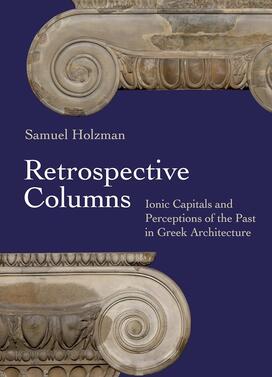
The book: Holzman examines nine Ionic monuments from different periods in Ionia of varied designs to show and understand the tendency to merge older and new styles of architecture. Drawing on various historical material, Retrospective Columns (Princeton University Press) argues that these hybrid capitals are an intentional part of Greek architecture as a way to establish continuity with the past. Holzman’s technical analysis narrows in on these tiny details that ultimately make Greek architecture stand out and contribute to its longevity.
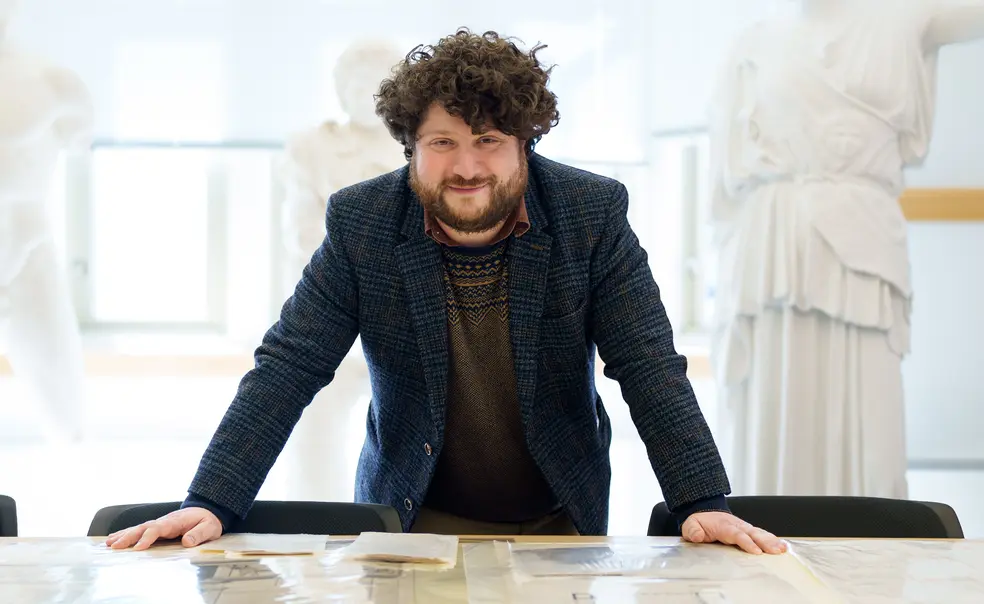
The author: Samuel Holzman is an assistant professor of Greek architectural history at Princeton. His work focuses on Greece and Anatolia, from the Early Iron Age through Hellenistic periods, with a special focus on the technical study of ancient building methods. Retrospective Columns is his first book.
Excerpt: A fame-seeking arsonist burned down the temple of Artemis at Ephesos in 356 BCE; it was one of the largest temples of the ancient Greek world and — supposedly — the first built in the Ionic order. The Ephesians confronted this trauma in three ways, two of which are well-known. First, the Ephesians rebuilt the temple on the same plan and footprint, but they traded the old, doughy style of carved decoration from the sixth-century temple for the rich, relief style that had become standard in the fourth century. Second, they tried to erase all memory of the arsonist by decreeing that anyone caught repeating his name would be put to death. The third response has not yet been understood: the creation of another new temple, which was dedicated to Athena at the spot where, according to local legend, Ephesos was founded. This new temple had Ionic column capitals that contrasted an outside face carved in contemporary style with an inside face that recreated the convex volutes of the ancient, burned temple. As a visitor entered the colonnade toward the spot of the city’s beginning, she might have felt from the changing appearances that she was stepping back in time.
The temple of Athena Trecheia at Ephesos looked back to the past, and its juxtaposition of the old and new offered a narrative of resilience in the face of disaster. Indeed, this temple and its retrospective columns illustrate the power of architectural style, which could become a component of civic, religious, and ethnic identities. By reproducing obsolete elements from the old Artemision, Ephesian builders preserved destroyed physical testimonies of a local history of architecture that centered the city of Ephesos among the Ionians. The temple of Athena Trecheia at Ephesos, however, is not the only one of its kind: eight other Ionic monuments have Ionic column capitals juxtaposing the convex volutes characteristic of Archaic-period Ionia with the concave relief styles of later periods on opposite faces. These are discussed individually under names such as “convex-concave-capitals” and “capitals with hollow and solid volutes.” This type of Ionic capital appears on buildings and monuments at Oropos, Delos, Neapolis (Kavala), Thessaloniki (likely originating at ancient Therme), Eretria, Pallene in Attica, Ephesos, Delphi, and Selinous, ranging in date from about 550 BCE to about 250 BCE. They have a 300-year chronological scope and a wide geographic range across the modern countries of Turkey, Greece, and Italy. Essential to understanding these monuments, therefore, is documenting and presenting them all together, as this book does for the first time with original measured drawings and orthographic images based on photogrammetry.
The Ionic order is arguably the most complex of ancient Greek building traditions. Its early history is quite different from the other major Greek building tradition, Doric, which followed a rather linear pattern of early development and had most of its canonical features fixed by the first quarter of the sixth century BCE. Ionic buildings varied greatly by region, and developments rarely follow a strictly linear sequence. The Roman architect Vitruvius, in his Ten Books on Architecture (composed in Rome in the 20s BCE), relays a tidy origin story to explain the Ionic order, a system of columnar design to which he devoted the majority of book three. According to his account, the sons of the legendary hero Ion ventured to establish the Ionian cities on the coast of Asia Minor and built a temple to honor Artemis at Ephesos. Rejecting the manly Doric order of their mainland brethren as unsuitable for the goddess, the first Ionians crafted a temple with more delicate proportions and more elaborate ornamentation — establishing the model for the Ionic order. This account, relayed in the only surviving ancient architectural treatise, is a convenient, explanatory myth. Archaeological discoveries have shown that the conventions of the Ionic order as Vitruvius knew them took shape gradually over the course of the sixth and fifth centuries BCE. Not only was there no one first Ionic temple, but temples alone were not the only place where this design idiom developed. Numerous freestanding Ionic columns used as pedestals for statues set up as dedications in sanctuaries show that votive columns were just as important as temple porticos in establishing the conventions of Ionic column design. There were also other early columnar forms that never caught on, most notably capitals with volutes that rise vertically, dubbed “Aeolic” in modern scholarship because they are primarily known from the region of the Aeolian Greeks in the northeastern Aegean. In the last two decades, it has become clear that the most important temples of Ionia had not just Ionic capitals with volutes, but a second type without volutes entirely, which topped off the column shaft with only the pillowy echinus. Vitruvius also offered a second explanation for the origins of temple design, relating how the entablature of Doric and Ionic buildings originate in wood rather than stone. The triglyphs of the Doric frieze took the place of plaques at the ends of timber joists, and Doric mutules and Ionic dentils preserved in stone the ends of wooden rafters. This proposal of wooden origins has occasionally been extended to Ionic capitals, where the volutes were envisioned as a fossil of a horizontal wood bracket (Sattelholz in German) that reduced the span of the beam between columns. Scholarly consensus, however, now holds the Vitruvian doctrine of petrification to be legendary. Doubt arises in large part from the Ionic evidence, which does not appear completely formed as a replication in stone of a preexisting manner of building in timber but takes shape gradually in stone over the course of the sixth century. A fixed architectural canon for the Ionic order only solidifies in the fourth century BCE. Much of the meaning of the Ionic order, therefore, lies not at a single point of origin — whether a primeval wooden prototype, a single exemplary temple, or a first inventor — but in the process of consolidation. As builders returned to and selected certain elements over others, they layered on meaning over time. Ionic capitals that plainly mix forms from different periods and places show the making of an architectural tradition in action.
Scholarship has understandably prioritized sorting buildings into a chronological sequence of styles to establish the dates of buildings and to present a larger historical narrative. Yet ancient builders were not oblivious to the persistence of older structures in their built environment. This book emphasizes that ancient builders revisited venerable old temples in new creations. It is tempting to borrow from the study of Greek sculpture the term “archaistic,” but this term does not quite fit Ionic capitals that only half reproduce Archaic forms and that emerged at the tail end of the Archaic period. The archaistic style in relief sculpture is hard to miss. It is distinguished by rigid figures, mannered gestures, and geometric drapery folds, deployed in complete compositions. It first occurs for a full sculptural program on the frieze of the Hall of Choral Dancers on Samothrace (third quarter of the fourth century BCE). Yet sculptors began to look back to stylistic features of early sculpture already in the fifth century, including in two metopes of the Parthenon where the stiff, frontal posture of older sculpture was borrowed to distinguish inanimate cult statues in mythological scenes where characters seek refuge in temples. Long before the archaistic style was a full-blown sculptural model, elements of retrospective design crop up within specific, representational scenes, almost always in sanctuary contexts, mixed with other styles but always recognizable. In a similar way, archaism in architecture has generally been identified with bursts in specific historical contexts, such as Athens in the time of the statesman Lykourgos. Yet Ionic capitals with opposite convex and concave faces illustrate that retrospective design in architecture began at the end of the Archaic period and ran parallel to the wide-ranging pattern of retrospection in sculpture. These Ionic columns also parallel the repair and reconstruction of temples and altars, which sometimes called upon stonemasons to carve new pieces that matched older elements. They also coincide with the symbolic reuse of older architectural members in new building contexts (i.e., spolia), a practice that took on particular importance in Athens in the aftermath of the city’s destruction in the Persian invasion of 480–479 BCE. Together this pattern of revisiting, reusing, and reinterpreting earlier monuments has been dubbed the “archaeology of the past,” material evidence that shows a concern for the past and the shaping of memory independent from the writing of historical accounts. Retrospective Ionic columns show patron communities embracing the pluralism of Ionic styles and juxtaposing elements from different places and times to embody histories and myths that were integral to community self-image.
Excerpted from Retrospective Columns: Ionic Capitals and Perceptions of the Past in Greek Architecture by Samuel Holzman. © 2025 and published by Princeton University Press. Printed with permission of the authors.
Reviews:
“Illustrated with original diagrams, this is a rigorous and revelatory look at how style shaped cultural identity.” — Indulge Magazine
“Samuel Holzman offers fascinating insights about a wide range of subjects of real importance to the study of Greek architecture — the visibility of ornamental details, architectural energetics, the play of light and shadow, and polychromy. Retrospective Columns examines small details but illuminates a much broader topic.” — Christopher Ratté, author of Lydian Architecture
The Latest
See all


Related News


Janice Lee ’09 Worked to Renovate One of Hollywood’s Best-Kept Secrets
An engineer by training, Lee has been deputy project manager on the renovation of Hollywood Burbank Airport


No responses yet