

Skating Banned on Lake Carnegie Despite Coldest Winter in Years
The rare opportunity has been ruled out because of safety concerns, according to municipal officials
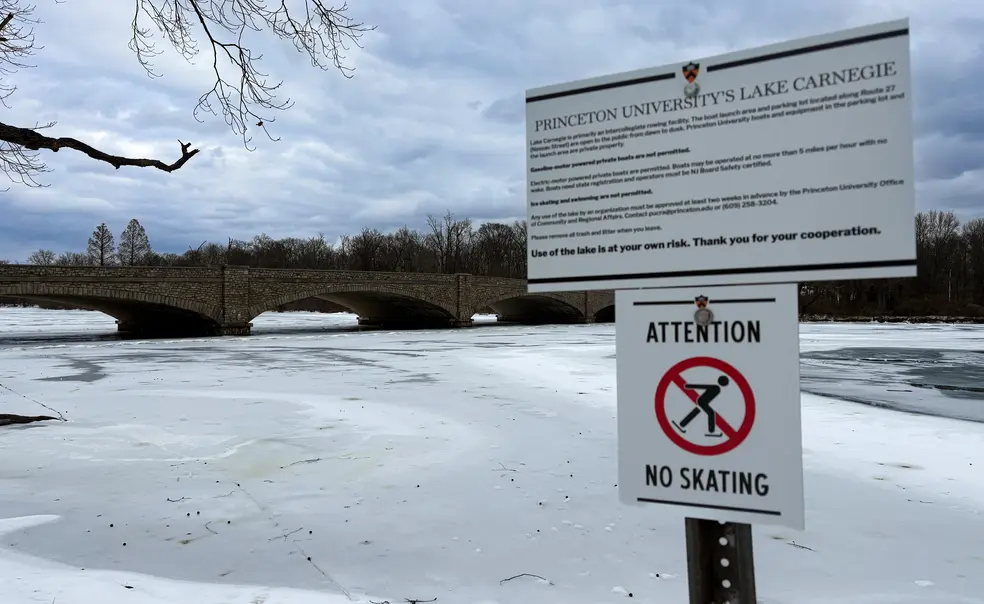

Nearly every winter, Lake Carnegie used to be reliably safe for skating, a cherished tradition for Princeton students and townspeople. In the past 30 years, however, it’s only met the municipality’s safety threshold a few times, most recently in 2015. Even as New Jersey experiences some of the lowest temperatures recorded in recent history, the lake remains closed due to safety concerns for skaters, potential rescuers, and those testing the ice.
“The municipality is no longer checking ice conditions at Lake Carnegie as of last winter,” Evan Moorehead, executive director of the Princeton Recreation Department, wrote in an email to PAW. “The municipality in working with Emergency Services and Princeton University identified some safety concerns and if and until we can work them out, there will be no skating on the lake.”
University spokesperson Jennifer Morrill wrote that the University is not currently reviewing safety concerns in coordination with the town.
Following the decision, the University and the recreation department updated Lake Carnegie’s signage and webpage, which now simply states: “Ice skating is not permitted on Lake Carnegie.” For parts of this winter, the municipality has permitted skating at Smoyer Park, about two miles north of campus.
At a Feb. 9 Princeton Council meeting, council members and Mayor Mark Freida addressed the prohibition following several inquiries from residents. In a recording of the meeting available on YouTube, municipal administrator Bernie Hvozdovic said that emergency services officials determined that the skating area of Lake Carnegie, which stretched from Harrison Street to Washington Street, was too large for first responders to reach skaters in time in the event of an emergency. He also cited concerns regarding a lack of parking spots nearby, including the unavailability of the University’s lot 21 and the boathouse.
Council president Michelle Pirone Lambros, who served as the recreation liaison when the decision was made, echoed these concerns. She noted how a bubbler, a de-icing device that keeps water moving near boats to prevent ice damage, near the rowing center, poses an additional risk.
Although the policy change occurred last year, councilmember Mia Sacks said: “I don’t think any council members other than possibly the liaison to the [Princeton recreation department] at the time was aware of this decision.” She added that she wished the council had discussed it.
Sacks said that she learned how to skate when she learned how to walk. “I don’t know which was first,” she said.
“It’s an important, valuable memory for those of us who feel a strong connection to this town,” she added. She hopes that the town can work on a compromise in the future to potentially skate in a constrained area with emergency services stationed nearby.
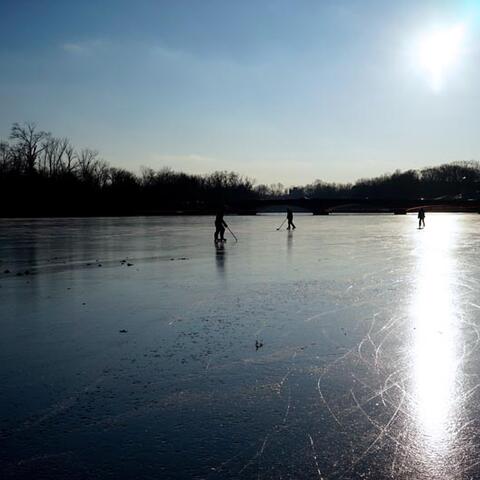
Despite the lake’s infrequent accessibility for the last few decades, community members were looking forward to getting out there on the ice. During the meeting, four residents spoke about their experience skating and teaching their kids to skate. “It’s magic skating out there,” said Seth Mellman, a Princeton resident.
Princeton’s winters have warmed significantly since the 1960s, and according to research conducted in 2020 by Grace Liu ’23, then an intern at the High Meadows Environmental Institute, and advised by geosciences professor Gabriel Vecchi, the probability of Lake Carnegie freezing deeply enough for safe skating has declined sharply.
Liu reconstructed the history using archival accounts from local papers and interviews with longtime community members. Her findings showed that while Lake Carnegie was once reliably skateable nearly every winter, the probability of safe ice has fallen to about one in five winters in recent decades.
Vecchi attributed the shift to warming winters linked to long-term climate change. “The reduction in lake freeze is related to the warming winters,” he said in a 2021 interview with PAW. “And the warming winters are related to the long-term warming of the planet, caused by increasing greenhouse gases.”
The Latest
See all


Related News

With Prominent Journalists and Hoagies, the ‘Prince’ Celebrates 150 Years
A gala at the New York Historical raised roughly $400,000 for the independent student newspaper



2 Responses
Christine M. Carstens ’78
8 Months AgoSkating on the Lake
I have fond memories of skating on Lake Carnegie with many others in January or February 1978. It was great! Felt like Hans Brinker. This was during the Blizzard of 1978, which really disrupted life in New Jersey.
Steve Hiltner
8 Months AgoMore Skating Years This Century
This article, like many others on the subject, falsely stated that skating has only been allowed on Carnegie Lake twice in the past 30 years. My PrincetonNatureNotes.org blog documents five times this century when skating was permitted: 2007, 2009, twice in 2014, and in 2015.
Also, a search of Papers of Princeton yielded no articles about death related to skating on the lake. One incident in 1943 involved two boys who had skated up the Millstone River. There is also no documentation that the bubbler at the boathouse would influence ice some distance away where skating has been permitted in the past.
Links to the photos/text about those five wonderful opportunities to skate on Carnegie Lake can be found in this post.
Editor's note: The article has been updated. A column in the PAW archive indicates that skating might have been permitted in 2003 as well.