

Students Rebuild Heating System at Rockefeller College
Students retrofitted a cross-section of a wall into an ideal radiant heating system
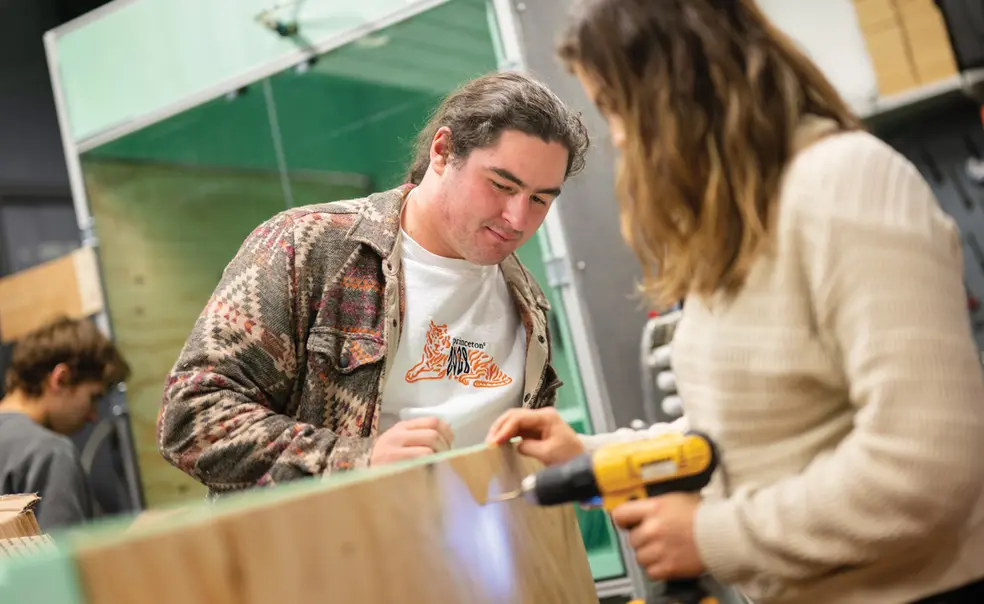

Students at Princeton are all too familiar with campus construction, from the newly opened art museum and engineering and environmental sciences complex to the ongoing conversion of the campus-wide steam heating to an electric heat pump and geo-exchange system. Professor Forrest Meggers wanted his class to be a part of the action.
For the final project in his fall semester course, Designing Sustainable Systems: Beating the Heat of Climate Change with New Building Paradigms, students were working to sustainably and optimally heat Rockefeller College, a group of collegiate Gothic dorms up-campus that were built more than a century ago. Staff from the campus facilities office were expected to be on hand for their final presentations.
Forty-three students were split into groups to retrofit a cross-section of a wall in Rocky into an ideal radiant heating system, working as plumbers, carpenters, or electricians to regulate the temperature inside the box, which serves as a model for the building. Meggers said he enjoys watching the students test what may or may not work. “That’s my favorite part of the class: recognizing how to learn from failing, because, really, it’s a cliché, because you’re never really failing. But nothing works on the first try,” he said.
Meggers explained that “every building is supposed to be a smart building, but they’re actually pretty stupid buildings. It’s not hard to make them quite a bit smarter.” Buildings around campus come with their own challenges, he said: Some are outdated and weren’t designed with modern sustainability in mind or run on inefficient heating and cooling systems. “They are all stupid for their own special reasons,” he said.
While students worked on the heating hardware, they also learned about sustainability and environmental science fundamentals. Although the class included traditional lectures, Meggers described it as “even more of an experiential learning class.”
“You kind of get to do your own thing, in a sense of like, you can design your own things and have a lot of freedom to do different things,” Imani Kegode ’28 said. She added that she was excited to see her team’s ideas come together.
As part of the course, students visited Meggers’ house, which he has retrofitted with a heat-pump water heater, custom shower controllers, and cooling elements under his floors. “I didn’t realize how useful my house would end up being on the academic side,” he said. Students examined the heat pump in action and then applied the concepts to their projects. They explored the house, where they saw a curvy roof with solar panels on the back, reclaimed wood floors covering radiant piping, copper tubes that run cold water in the summer, and a network of wires and pipes in the basement.
“It’s one of the more interesting labs you can take,” Parker Lenoce ’27 said.
The Latest
See all


Related News


McCarter Theatre’s First South Asian Musical Took Me Back to Forbes Basement
A Beat of Our Own is about a college dance team not unlike Princeton South Asian Theatrics


1 Response
Marc M. Cohen ’74
9 Months AgoSustainable Heating Systems
Last week we installed a new heat pump system for heating and air conditioning here in Milford, Connecticut. It is working beautifully. Our project qualified for state of Connecticut “CT-Energize” rebates worth up to $1,500, 0.99% financing through the CT Green Bank, and the federal tax credit worth up to $2,000. It is very unfortunate that the Trump administration is cancelling the tax credit incentive after 2025.