
Does a Sitting Men’s Hoops Star Signal Trouble for the Ivy League?
Princeton and its Ivy peers try to keep pace in an era defined by NIL and the transfer portal
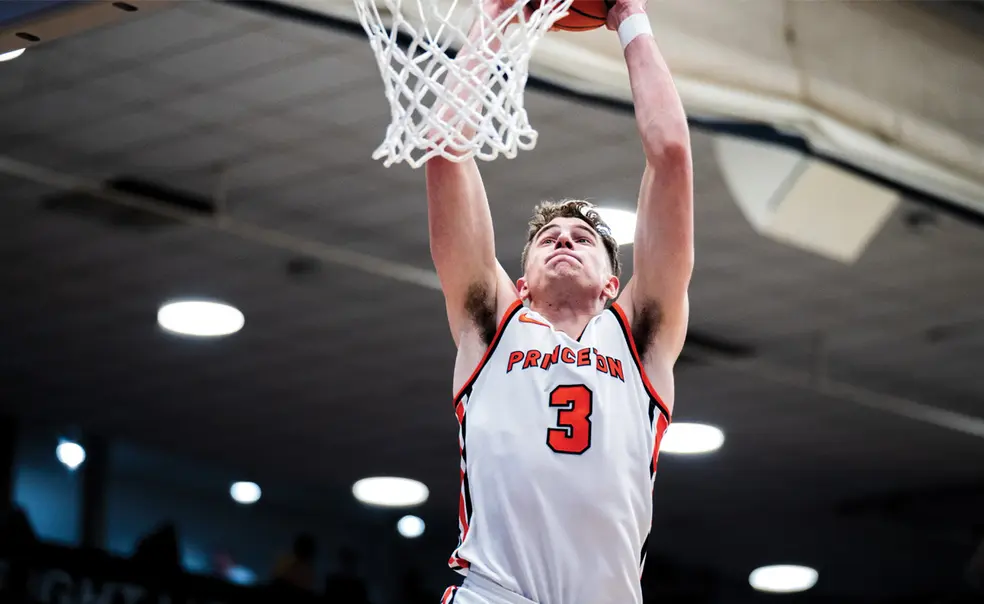

In early December, the Princeton men’s basketball Class of 2026 was together under one roof, but the venue was Duke’s Cameron Indoor Stadium, not Jadwin Gym.
Xaivian Lee, the former All-Ivy point guard, was playing for visiting Florida; guard Jack Scott was on the sidelines as a reserve for Duke; and behind the home bench, Caden Pierce, the former Tigers forward and Ivy League Player of the Year who is sitting out his senior season as he prepares to play one more year of college basketball as a graduate transfer, was there for a recruiting visit with Duke’s coaches.
“I was going to go to that game regardless,” Pierce said, “and it just so happened that they had interest in me.”
It has been an odd year for Pierce, who made his decision to leave the basketball team in July, after Lee and Scott transferred. Without the structured schedule of a varsity athlete, he has more control over what he does and when, from workouts to meals to studying. Even with a senior thesis in the works and occasional road trips to the schools that are recruiting him (including Purdue, UConn, and Duke), he has more free time than he’s ever had. Meanwhile, with no seniors on the roster, Princeton struggled to a 4-11 nonconference record before opening the Ivy schedule 2-2 with wins over Penn and Yale and road losses at Harvard and Dartmouth.
Pierce has one year of athletic eligibility remaining and could earn a significant amount of money through name, image, and likeness (NIL) deals and revenue sharing, which was adopted following the House v. NCAA settlement last year. (The Ivy League does not participate in revenue sharing.) His priority, he said, is developing as a player in hopes of building a pro career in the NBA or overseas.
“I’m making this more of a basketball decision rather than an immediate, one-year financial decision,” he said. “I’m trying to find the situation that lifts up my basketball potential as best as possible.”
Under the framework set by the House settlement, any NIL deal worth $600 or more must be cleared by the new College Sports Commission (CSC). The commission’s CEO, Bryan Seeley ’00, said in a July 2025 statement that “every NIL deal done with a student-athlete must be a legitimate NIL deal, not pay-for-play in disguise.” Through Nov. 1, the CSC approved 12,175 deals totaling $87.5 million.
Since transferring to Florida, Lee’s sponsorships have included a national fast-food chain, a major wireless carrier, skincare products, and a sports drink. By comparison, Pierce, in his time playing for Princeton, had a partnership with P.J.’s Pancake House — and was thrilled for that opportunity.
The NIL landscape at Princeton’s peers might be changing: In November, Penn men’s basketball coach Fran McCaffery made headlines in The Daily Pennsylvanian and The Philadelphia Inquirer after suggesting in a Zoom call with fans and media that his program was using a “collective” run by alumni to provide paid internships for its players. The Ivy League has not publicly addressed the issue. Princeton athletic director John Mack ’00 declined to be interviewed for this story, but in one of the alumni office’s TigerSide Chats last year, he spoke out against collectives and the use of NIL as a recruiting inducement.
“We believe completely that student athletes should benefit from the legitimate use of their name, image, and likeness,” Mack said. “But what we won’t do is engage in pay-for-play.”
Pierce said he understands that stance “because it’s kind of a slippery slope and you would never want to change something that has made the Ivy League so different and so prestigious in the past.” But a stronger emphasis on NIL, he added, could make Ivies more competitive in recruiting.
“There’s so many opportunities financially elsewhere that it’s difficult for an 18-year-old brain to kind of comprehend, you know, the money versus the degree,” Pierce said. “So a lot of kids are choosing to go elsewhere.”
The Latest
See all


Related News
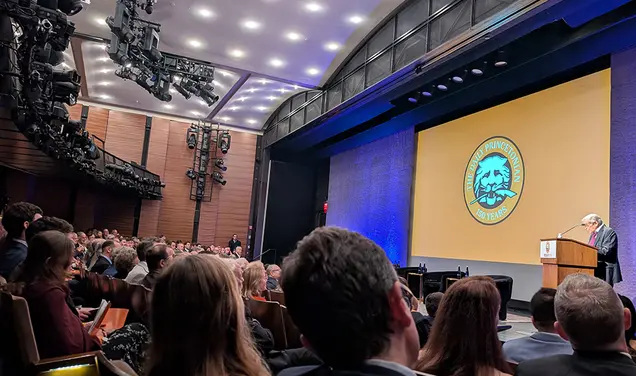
With Prominent Journalists and Hoagies, the ‘Prince’ Celebrates 150 Years
A gala at the New York Historical raised roughly $400,000 for the independent student newspaper


5 Responses
Dave Fulcomer ’58
8 Months AgoOn NIL and Pay for Play
In the interesting article in the latest PAW, the demon of money being paid to college athletes raised its ugly head, this time in the Ivy League.
Caden Pierce ’26, one of Princeton’s best basketball players in decades, has been caught in the crosshairs. Caden was freshman of the year and then Ivy League Player of the Year as a sophomore. An ankle injury limited his effectiveness as a junior, and I hope that was not part of his decision to sit out his senior year.
During my basketball years at Princeton (1955-58), I believe two of my teammates would have been vulnerable. Carl Belz ’59 and Jim Brangan ’60 were both first team All-Ivy for several years. It’s hard to imagine the impact their leaving would have been, but the Ivy League championships they experienced as seniors would never have happened.
How long would Bill Bradley ’65 have stayed at Princeton? The two-time All-American and eventual college player of the year would certainly have been tempted with gigantic offers.
Yes, I am old school and think the whole pay-for-play thing puts loyalty to your school in dire jeopardy. Maybe that’s because no one ever offered me “the big bucks.” But the toothpaste is out of the tube and can never go back in. What a shame!
Paul Hauge ’80
8 Months AgoThe Future of Princeton Basketball
Say goodbye to the days of Princeton men’s basketball making any noise at the national level. NIL means that the team’s best players will heed the siren call more and more. It’s only a matter of time before the same happens to the nationally ranked women’s team.
Donald Nortman ’68
8 Months AgoCollege Sports Look Like Pro Leagues
Yes, it’s true, the NIL is already ending the men’s basketball program at the national level and sadly, with the success of women’s basketball and the WNBA, the women will be following shortly. It’s a tough call for the athletes as the money is very attractive and most will not be NBA caliber. Sad. Men’s college football and men’s college basketball and soon women’s college basketball and probably even men’s hockey are all becoming professional sports.
Steven Jay Feldman ’68
6 Months AgoIt’s Already Started
In the April PAW, in the Inbox, Paul Hauge ’80 laments that it is only a matter of time before the Princeton women’s basketball team begins to lose players due to NIL and transfers to other teams.
Unfortunately, Princeton already lost an excellent player before the past season even began. Tabitha Amanze, who played a key role for Princeton during the 2024-25 season, transferred to Virginia and played a key role in Virginia’s march to the Sweet 16.
William D. Watson ’65
8 Months AgoIvy Schools’ Institutional Goals
“Trouble for the Ivy League”? The Ivy League has lost some sports stars to high-profile athletic scholarship and friendly booster schools for years. It seems certain that revenue sharing and NIL money will increase the losses. Are those losses of sports stars a threat to the institutional goals of any Ivy school?