

Elementary: Campus Architecture Certainly Isn’t

Any truth is better than indefinite doubt. —Sherlock Holmes, The Yellow Face, 1893
For you, the Enthused Historian, and your ever-eager quest for arresting Princetoniana tales to enliven your austere winter hours, Alexander Hall certainly stands as one of the great perennial opportunities for bathing in nostalgia. Even more fun because its peculiar architecture begs for outlandish stories to explain the deluge of symbolism, it maintains to this day a strange dual pastiche of daily University and community activities — and highly desirable ones, given its homey closeness to the action and wonderful acoustics — combined with a continually growing backstory of colorful apocrypha attempting to explain and/or excuse its appearance and prominence. These are all the more addictive given the deep-down suspicion that such structures do not spontaneously occur in nature, but must needs have a conscious designer, some blueprints (or at least sketches?) and a huge pile of artisans to busily chip away at figures, tiles, and engravings that gawkers can argue about for a significant number of decades.
So let’s be honest. Alexander Hall, a gift honoring three generations of 19th-century college trustees by the wife of the youngest of them, was purposefully solicited as a building where the entire community — having grown much during the McCosh presidency of 1868-88 — could convoke and evoke; and indeed, Commencements were held there for decades. It could seat 1,500 people in its initial form. Which of course does nothing to address its outward design, but it was — honestly — Romanesquely concocted with real papers by architect William A. Potter, who had also built the Chancellor Green Library. He envisioned the college tearing down the adjacent Presbyterian Church, with a resulting front campus stretching from Chancellor Green (the Joseph Henry House was elsewhere) all the way to the western edge of Alexander. Oddly, he was additionally then the first to fall under Moses Taylor Pyne’s edict creating the Collegiate Gothic era — Potter was hired to design the Pyne Library, now East Pyne, otherwise known as the Crime of ’96 because it involved the destruction of East College.
Anyway, Potter’s big Alexander Hall space — with the artisans still working on the varied embellishments during the daytime — was now ready and waiting when the big shows came to town. And the very first to appear was the young British literary lion Arthur Conan Doyle, who on Nov. 15, 1894, gave the first public lecture in the hall (50 cents a pop, 75 cents reserved). He was in the middle of a 39-stop American tour booked by showman J.B. Pond, who also promoted American biggies like Mark Twain and Henry Ward Beecher. Thirty-five-year-old Doyle was a draw because of his character Sherlock Holmes, who had debuted in 1886 and whose legend now included two hit novels and 24 short stories. The great irony was that Doyle felt Holmes to be frivolous, and the prior fall had killed him off for good in The Final Problem, so Doyle could get back to his “serious” fiction writing about the Napoleonic Age, medieval knights, stuff like that. Indeed, his lecture consisted not only of Holmes passages, but segments from those other novels, which his audience patiently sat through, only to perk up whenever Holmes came to the fore. Reviewers seemed highly satisfied with this anyway, and the great space in Alexander Hall was now an integral part of the college landscape. Doyle had dinner with the faculty, President Francis Landey Patton, and a selected number of students at The Nassau Inn, and everybody basked in the notoriety.
And indeed, Arthur Conan Doyle did return to Princeton, although the world changed in ways large and small before that could happen. While Holmes remained literarily dead, Doyle decided to build a new estate. To come up with enough cash, he wrote a Holmes play, which was floundering until it came to the attention of the great American actor/producer William Gillette, who at 45 years old had semi-retired. He saw Doyle’s script, completely rewrote it in 1898 as a four-act play with new characters (keeping only Holmes, Watson, and Professor Moriarty), traveled to Britain and met Doyle in character as Holmes, and the two became not only friends but very, very rich. Gillette would go on — and on and on and on — following the Broadway opening in November 1899 to play Sherlock Holmes over 1,300 times in the next 30-some years across America and England. Indeed, Gillette as Holmes could be regarded as the first great multimedia character triumph, appearing in a 1916 silent film version and on two early phonograph records.
Doyle, always tempted by additional pocket money and getting precious little from Napoleonic romances, published a Holmes prequel novel — The Hound of the Baskervilles — in 1901. It remains today the best of Holmes, with the arguable exception of the short story The Red-Headed League of 10 years prior. It was such a public smash that demand reignited for more short stories; by 1903 Doyle caved under the pressure and brought Holmes back from the dead to huge acclaim in The Empty House, and the stage was set for another 32 short stories published sporadically until 1927.
But Doyle still thought that was a mere pop culture phenomenon — which has since grown to something like 25,000 different versions of the Holmes/Watson buddy tales — and was always out researching “serious” history, science, or even paranormal psychology. His lecture tours evolved into complex presentations on Spiritualism, which he espoused since beginning to dabble in 1887, to define and set in contrast to the daily physical humdrum of mankind. On his speaking tour through New Jersey in 1922, he was buttonholed by The Daily Princetonian, trying to understand where his paranormal beliefs were coming from, and whether this amounted to a new technology-abetted religion. He said to the contrary, that those dead souls who still existed beyond the physical plane were exhibiting the life after death that virtually every religion espoused, and so his Spiritualism was harmonious with any of them. In his view, it exclusively taught love, kindness, and mercy. Of course, confining himself to Spiritualism limited his tour stops; he didn’t appear in Alexander Hall again because the demand wasn’t there — if he had opted for Holmes readings he could have sold it out multiple times.
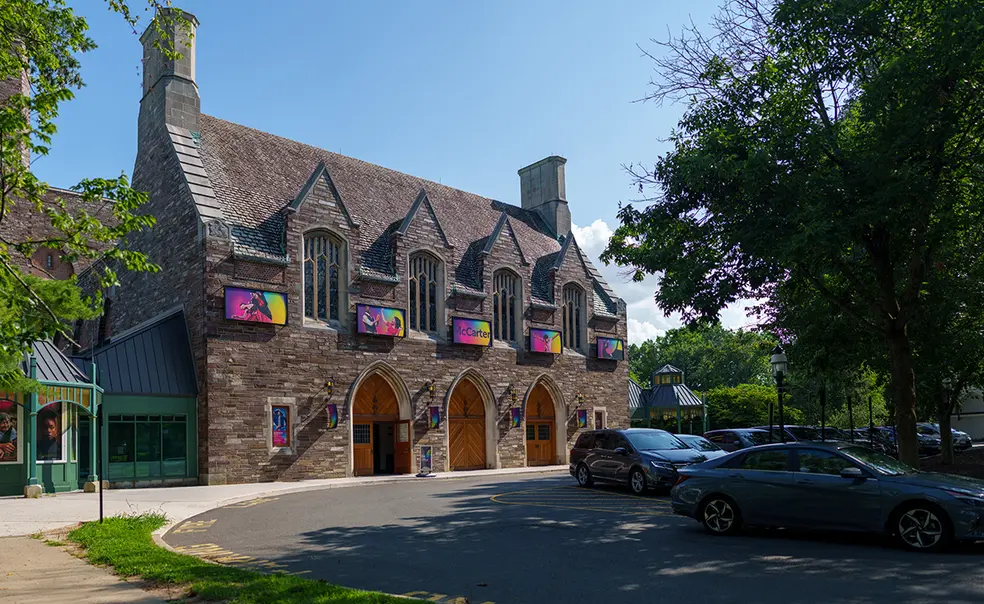
Meanwhile, after World War I the arts activities among the Princeton student body were becoming more popular. The burning of the ramshackle Casino in 1924 caused a number of groups to face the lack of performance space, and the successful campaign (just prior to the Depression) to construct McCarter Theater opened a new era. Triangle inauguratedthe new playhouse space on Feb. 21, 1930, with Jimmy Stewart, Joshua Logan, and their cronies premiering The Golden Dog to strong reviews.
The theater was designed to the Broadway specs of the day to attract touring and tryout productions, and one of the first professional shows to take advantage of the space was — wait for it — now 74-year-old William Gillette as Sherlock Holmes, raking in a few more bucks for Doyle and Gillette in what was loudly billed as his farewell tour. Only 10 weeks following the Triangle premiere, on May 12 he and his troupe presented the same show he had done 31 years earlier on Broadway, with a single major exception. After the third act — and the third set of curtain calls for the play, which still had an act remaining — Gillette came to the lip of the stage to address the audience. This was promoted as his final show of the tour, the production, and his career. With the entire space crammed with people and Triangle legend Booth Tarkington 1893 in the front row, Gillette kidded gently and was almost shy in his thanks:
The time has come to say farewell. This is the farewell season. It is a grand feeling, except for the fact that you have to say farewell. The shorter we can make it, the better. I am glad to say personally to you a farewell, good luck, and Merry Christmas.
It won’t surprise you to learn that, over his remaining seven years of life, Gillette was bribed into returning to the stage on infrequent occasions to recreate his “last” performance — if you thought the eternal live farewell was the creation of the rockstar generation, your touching naivete is duly noted. But the McCarter Theater performance was officially The Last Waltz, and The Prince and The New York Times both concurred.
Eight weeks following that concluding performance, on July 7, 1930, Sir Arthur Conan Doyle — only three years after publishing his final Holmes story — died of a sudden heart attack, joining the world of the spirits he spent much of his life seeking and justifying. It’s perhaps worth considering that his real eternal life, and that of his friend William Gillette, lie not so much with them, as it does at Alexander Hall, at McCarter Theater, and at 221B Baker Street in London.
The Latest
See all


Related News


Janice Lee ’09 Worked to Renovate One of Hollywood’s Best-Kept Secrets
An engineer by training, Lee has been deputy project manager on the renovation of Hollywood Burbank Airport


No responses yet