
Experts Debate Eisgruber’s ‘Constrained’ Budget Strategy
Of six experts interviewed, five supported President Christopher Eisgruber ’83’s new financial strategy
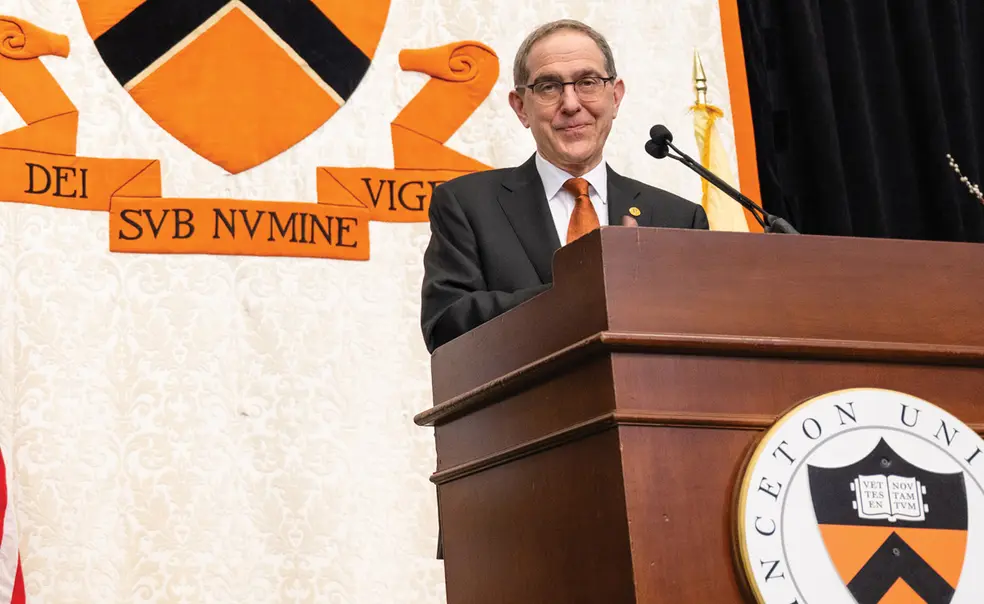

Declining average endowment returns, political headwinds, and a gradual change to Princeton’s income structure over the past few decades are some of the reasons financial experts largely endorsed President Christopher Eisgruber ’83’s announcement that the University is adopting a new, more austere budget strategy.
Directly following the conclusion of Venture Forward — which Eisgruber called Princeton’s most successful capital campaign at a Council of the Princeton University Community meeting in February — the University is focusing on “efficiency and substitution rather than addition,” according to Eisgruber’s annual State of the University letter, released Feb. 2. The University’s operating budget will recognize “a lot of constraint,” he said at the February CPUC meeting.
PAW spoke with six experts — including former members of the University’s Board of Trustees, major University donors, former employees of Princeton University Investment Co. (Princo), and managers of investment firms — and five supported Eisgruber’s new financial strategy.
Ted Karns, a managing director at Princo from 2008 to 2023 and author of the 2026 book A Compounding Life: Lessons in Long-Term Thinking from a Leading Endowment, praised Eisgruber’s “reasoning and honesty,” and said the issue “is not one institution’s problem, it is a secular shift,” adding that he “watched this compression happen in real time.” In his letter, Eisgruber included a graph of annualized returns for Princeton and several peer schools that showed a decline across the board over the past two decades.
Karns cautioned that “a lower expected return does not just change a spreadsheet, it means telling a campus and a board that there will be less to go around. It means making hard choices.”
University departments have already cut 5% to 7% of their budgets since last spring, according to Eisgruber’s letter, including changes such as the cancellation of Wintersession. This year, Princeton is planning to have a smaller incoming graduate cohort and a 1% raise or no raise for many faculty and staff. In a February email to faculty and staff, the University said headcount will decline but has not announced any layoffs.
Paul Haaga Jr. ’70, a former University trustee, former chair of the Capital Research and Management Co., and a major donor to Princeton, maintains cutting the budget won’t be that difficult. “I see [cutbacks around 5%] as being within the desirable range of rethinking things more than being disruptive,” he said, adding that Princeton would likely be slowing down spending anyway given that most of the 10-year campus plan has been completed.
Not everyone supports Eisgruber’s new strategy. Leonard Milberg ’53, a major University donor and chairman of the commercial finance firm Milberg Factors, wrote an op-ed in The Daily Princetonian last year warning that “Princeton’s investment strategy is, I believe, far too risky,” because of its dependence on illiquid assets, such as private equity investments. In his February letter, Eisgruber noted that the University previously benefited from investing in long-term, illiquid assets, which have become increasingly popular with investors outside of the higher ed sector.
In an interview with PAW, Milberg criticized the timing of the budget shift, announced so soon after the end of a successful campaign. “How can you go around to the people who gave you [funds for Venture Forward] … and say, ‘Oh, by the way, we need [more]’?”
Brad Swanson ’76, a partner at Developing World Markets and author of the forthcoming book Profit vs. Progress: Why Socially Responsible Investment Doesn’t Work and How to Fix It, said Eisgruber is “smart to recognize the new conservatism coming about in portfolio management” given that “every institution has to deal with the decreasing profitability relative to other assets” such as private equity. But Swanson also warned that expecting 8% average endowment returns, as Eisgruber noted, “frankly … seems a bit optimistic to me.”
Given that “we are in a very difficult period in terms of financing higher education,” expecting lower endowment returns than in the past is “completely reasonable,” said Phillip Levine *90, an economics professor at Wellesley College, but it’s not an exact science. “You’re making an informed but imperfect forecast.”
Levine authored a piece published by The Chronicle of Higher Education two weeks before Eisgruber’s letter that predicted long-term financial problems for higher education due to factors such as new Trump administration policies and operating costs in the sector that have been rising faster than inflation for decades. In addition, an upcoming demographic cliff — an annual decline in the number of high school graduates — could pose problems.
Levine told PAW that Eisgruber’s decision to scale back “is placing [Princeton] in a better position than what many other institutions are experiencing, which are outright cuts.”
Carl Ferenbach III ’64, a former director of Princo, co-founder of Berkshire Partners, and co-founder with his wife of the High Meadows Foundation, a major University donor, recalled when Eisgruber as provost helped steer the University through the 2008 recession while Ferenbach was on Princeton’s Board of Trustees. “He’s tried, true, and tested in terms of needing to make an adjustment like the one that he’s laid out, and it’s absolutely the right thing to do.”
Ferenbach said universities as a whole now rely more on endowments to fund operating budgets than previously. According to a 2026 Higher Ed Dive article, “On average, endowments funded 15.2% of colleges’ annual operating budgets last year. That’s up from 14% in fiscal 2024 and 10.9% in 2023.” This academic year, the endowment will fund 64.5% of Princeton’s operating budget. In 2012-13, the year before Eisgruber became president, the endowment funded 47% of the budget.
The Latest
See all


Related News

With Prominent Journalists and Hoagies, the ‘Prince’ Celebrates 150 Years
A gala at the New York Historical raised roughly $400,000 for the independent student newspaper



1 Response
Leonard L. Milberg ’53
6 Months AgoTime for a New Investment Strategy
Regarding President Eisgruber’s new budget plan, of course the University has to cut back significantly — $11 billion is a lot of money. I wrote to Eisgruber for a number of years explaining to him the risk of Princeton’s foolish investment strategy. He never replied, and unfortunately, I was correct.
Princeton will need more money in the next few years, and Eisgruber and Weezie Sams ’79, the chair of the Board of Trustees, who just began her 21st year on the board, are not the ones to approach people for it. Consequently, they should be replaced, as well as the Princo board and its old investment strategy.