

From Imposition to Imagination in a New Middle East

Taufiq Rahim ’04 is a strategist, investor, and writer. He is the author of the books Middle East in Crisis & Conflict and Trump 2.5.
When Howard Baskerville 1907 graduated from Princeton University at the age of 22, he went, as many American missionaries did at the time, to the Middle East. That fall, Baskerville found his way to the city of Tabriz in Iran’s northwest. He was quickly caught up in the fervor of what became the country’s constitutional revolution. By 1909, he had grown close to the political leader, Sattar Khan. On April 20, 1909, when he led a pivotal armed revolt against the Qajar authorities, a sniper shot him dead, turning Baskerville into a national hero in Iran.
His story became part of what is now a centuries-long tradition of Princetonians who have found themselves at the center of imagination, intrigue, and imposition in the making and remaking of the Middle East. It is a story that continues to this day. With the backdrop of the Iran War, the divide among alumni appears stark: help deepen the bonds that tie the region and the West together or deepen the divides that drive us apart.
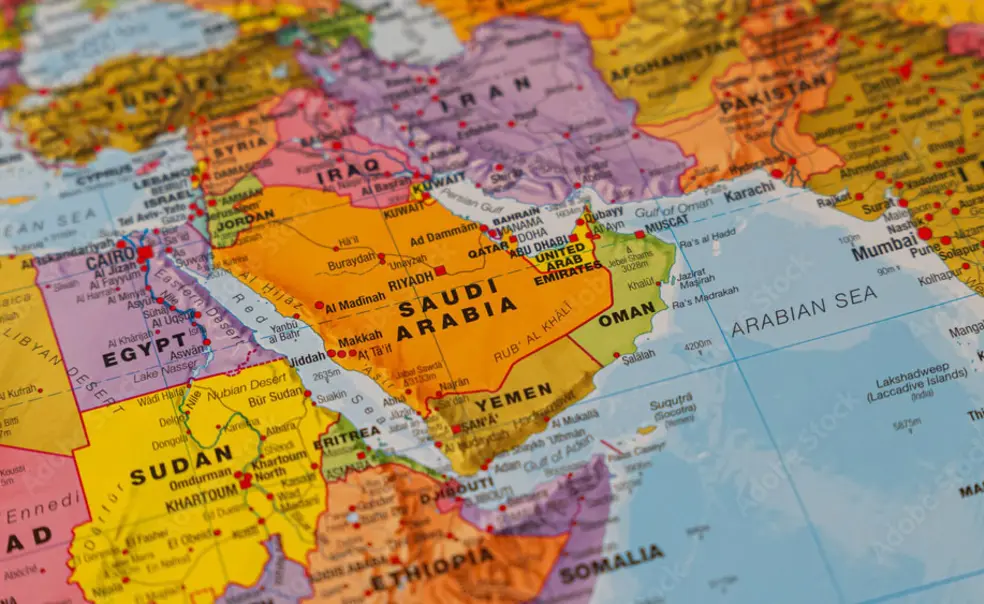
When I arrived at Princeton in September 2000, I did not intend to begin a quarter-century career that would take me to the heart of the Middle East, from working in villages in Syria to helping build a post-revolutionary Libya to growing the philanthropic sector in the Gulf. Yet each year I was at the University, I was drawn further into a region at the crossroads of American power.
The Second Intifada in the Holy Land erupted during my freshman year, the 9/11 attacks occurred in my sophomore year, and the U.S. invasion of Iraq was launched mid-way through my junior year. I finally went to the region the summer before my senior year in 2003, funded by a University grant, to work in international development in rural Syria. As I graduated in 2004, the global agenda, national conversation, and University climate were all dominated by one thing: the Middle East.
On campus, I was engaged in mobilizing debates, leading peace initiatives, and advocating against discrimination. In particular, I viewed the Iraq War as problematic and wrote extensively about it in The Daily Princetonian, Idealistic Nation, and Common Sense.
Leading the call for war on campus was then editor of The Princeton Tory, Pete Hegseth ’03. In his view, this was a matter of good versus evil. Hegseth would go on to join the military, and the rest, in many ways, is history. I eschewed a similar path and (behind-the-scenes) recruitment effort on campus that year to join the American side as a translator on the ground.
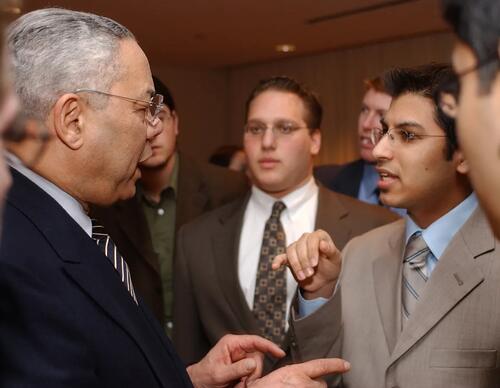
The debate on campus was no abstraction. The leading luminary of Middle East studies in the country was professor emeritus Bernard Lewis. He would host us for brown bag lunches at Jones Hall, often after returning from a trip to Washington, D.C., where he was advising Vice President Dick Cheney on the lead-up to the war. My professor on the Arab-Israeli conflict, Michael Doran *90 *97, an acolyte of Lewis, would go on to join the National Security Council shortly after the second Bush Administration took office.
The juxtaposition of imagination and imposition in the approach to the Middle East was as stark during my time there as it was throughout the intertwined history between Princeton and the region. My first professor in the Near Eastern Studies Department was Hossein Modarressi. He was an Iranian cleric who left after the Islamic Revolution. He would become a key figure in shaping the narrative of the late Princeton professor Roy Mottahedeh’s famous book on Iran, The Mantle of the Prophet.
Modarressi took a view in the tradition of Baskerville, of understanding the region from within its contours. This was echoed by Princeton’s most famous Palestinian graduate, Edward Said ’57, a critic of Lewis, whom I met when he came to campus. Within a few months of meeting Said, I had a chance to meet another Princeton alumnus, Donald Rumsfeld ’54, then secretary of defense at the Pentagon.
Rumsfeld anchored himself in the tradition of imposition, and when we had a brief discussion in the summer of 2002, he would not relent in his position that regime change was needed in Iraq. Princeton’s connection to the wider region started, in many ways, in the context of violence. James Madison, first as secretary of state and then as president, led the American side in the Barbary Wars in North Africa, America’s first conflicts outside the West.
In the remainder of the 19th century, many alumni engaged in formal government service, but most followed the missionary track. That group believed in helping shape a modern Middle East that was beginning to take form and bridging divides through education. This led to the founding of a seminal institution in the region, the American University of Beirut (AUB).
Following the Islamic Revolution in Iran in 1979 and amid broader turmoil in the region, AUB became the center of the struggle of a new Middle East and remains a place on the side of bridging divides. When I worked for several months as a researcher in Lebanon in 2007 for the United Nations office implementing the ceasefire between Hezbollah and Israel, I lived near AUB and would visit frequently. I would meet for coffee with John Waterbury ’61, who served as president for a decade, continuing the Princeton tradition.
The antecedents of the situation in Lebanon and Iran link back to the other side of Princeton intrigue in the Middle East — imposition. After World War II, the Middle East was a fulcrum for the emerging order led by America and contested by the Soviet Union. In early 1953, two Princeton graduates and brothers took on key roles: John Foster Dulles 1908 as secretary of state and Allen Dulles 1914 as director of the CIA. One of the principal operations they oversaw was the overthrow later that year of the prime minister of Iran, Mohammed Mosaddeq.
Mosaddeq sought to nationalize the oil industry and came into conflict with the American-backed Shah of Iran. While the CIA-led coup was successful, it laid the groundwork ultimately for an Islamic nationalist revolt, which would result in the Islamic Revolution 26 years later. That event would become a significant factor in Ronald Reagan’s election as president in 1980.
That 1979 revolution would mark the beginning of 47 years of an ebb-and-flow cold war between Iran and the United States, culminating in full-blown conflict on Feb. 28, 2026. Across five decades, in each successive American administration, a Princeton alumnus was at the forefront of the confrontation and engagement:
George Shultz ’42, secretary of state under President Reagan; James Baker ’52, secretary of state under President Bush (the first); Anthony Lake *69 *74, national security adviser under President Clinton; Rumsfeld, secretary of defense under President Bush (the second); and Gen. David Petraeus *85 *87, director of the CIA under President Obama.
Over the past decade, as America went through a period of retrenchment and its own political convulsions, a different face emerged. On Jan. 25, 2025, Hegseth was sworn in as secretary of defense. I would never have imagined that the bellicose advocate for war when I was a student would go on to lead the military of the world’s superpower. Hegseth, in many ways, represents the Princeton tradition of imposition in the Middle East to a radical degree.
In the Iran War in 2026, the United States may have initially deployed lofty language about regional transformation, but that soon fell by the wayside. This was not a conflict that drew upon the scholarship of either Said nor Lewis. There was no Baskerville on the ground.
In this campaign, under Hegseth’s direction, the policy toward the region has been brute force. While at Princeton, Hegseth was not in my classes debating Iran with professor Modarressi, but then, just as now, he was vocal about what a new Middle East should look like and how to get there: War.
We cannot of course fall into Pollyannish delusions of change in Iran and the Middle East. The fate of the region is due to many factors beyond the United States. The absence of war would not lead to flourishing democracy, inclusion, and peace. After all, when Baskerville himself joined the revolt to support local partisans, he was gunned down by the representatives of the Iranian authorities themselves.
Yet, since World War II, America, with too many Princetonians in its ranks, has firmly been on the side of a policy of imposition rather than imagination of the century before, when it comes to Iran and the region. Where are the dreamers who sat in Beirut in 1862 around a table, envisioning a new future emerging from within the region by building a university?
The network of Princetonians today who have ties to both the Middle East and the West are vast. And they are often at the forefront of building links in business, philanthropy, scholarship, and culture. If anything, the power of this network is understated. If mobilized effectively it would provide a stark contrast at the highest levels of a different way forward on Iran and relations between two sides of the world too often trapped in conflict.
The space for shared imagination of common futures is in the best tradition of the University and its many alumni. It’s a tradition that needs renewal now more than ever.
When defending my senior thesis at Princeton, the second reviewer questioned my second chapter that pushed back on the thesis of a clash of civilizations between the Middle East and the West. “I think you’re wrong, there is no way to bring these sides together as they are.”
That is a mindset I have never accepted.
The Latest
See all


Related News
With Prominent Journalists and Hoagies, the ‘Prince’ Celebrates 150 Years
A gala at the New York Historical raised roughly $400,000 for the independent student newspaper


No responses yet