

Kay Gayner ’86 Created an Inclusive Space for Children to Dance
Gayner co-created and co-founded the Dancers Realize Excellence through Arts and Movement (DREAM) Project

In Kay Gayner’s junior paper at Princeton, she designed a participatory arts program for children with Down syndrome who partnered with typically developing children. She had been inspired by a mother in her hometown who was an advocate for her son with Down syndrome.
“[The mother], as part of her advocacy for her son, was beginning to run arts programs and had written a book, I think, about visual arts and the way that could be used for what we would now call inclusive learning opportunities,” says Gayner. During her time at Princeton, Gayner also performed in the Triangle Club and Theatre Intime, choreographed annual dance concerts, and sang with the Katzenjammers.
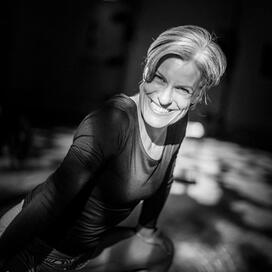
After graduation, Gayner moved to New York City with friends from college. “I was all ready to do the auditioning thing and go be a performer,” she says. “But I’m from a very small town in Georgia and realized that it was too nerve-wracking for me to rely just on auditions and that I needed some kind of steady source of income.”
She answered an ad to work at the National Dance Institute (NDI), a nonprofit arts education organization, founded by Jacques d’Amboise, that brings children together through inclusive dance and music programs.
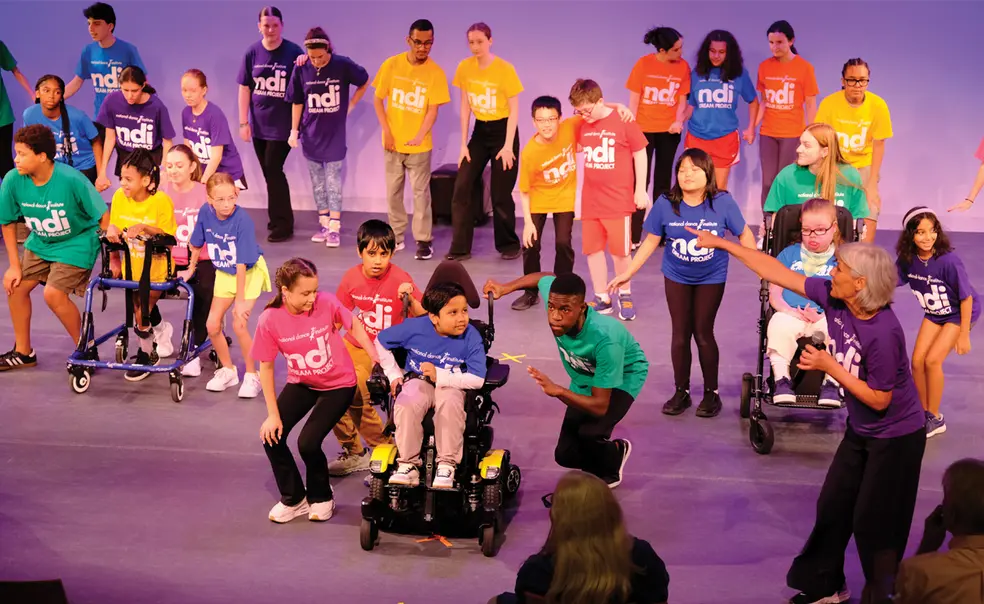
“Part of the reason the ad resonated so much with me is because I personally feel like the arts saved my life, changed me, helped me cope as a kid.” says Gayner. She worked as d’Amboise’s assistant for years, began teaching for NDI in 2000, and in 2014, served as co-creator and co-founder of the Dancers Realize Excellence through Arts and Movement (DREAM) Project, an inclusive dance program where children with a wide range of physical, intellectual, developmental, and neurodivergent disabilities dance with children without disabilities.
The focus of the DREAM Project is on partnership, and the rehearsals are conducted in a way that teaches kids how to communicate and connect. For example, they might introduce a step that starts seated and glides through space but then break it down and teach the kids how to make a version of the dance that highlights the skills of each partnership. “They start to understand how to make, partnership by partnership, their own versions of the dance,” says Gayner.
The DREAM Project performances are held in front of a public audience, and Gayner says one of the goals is to teach the children, as well as the audience, that performances can look different. Each dance “is now a piece of choreography that maybe the audience has never seen before, but that really comes out of the heart and spirit and unique abilities of every single person in the room,” Gayner says. “And the point is to celebrate that.”
“There is a high level of artistic integrity to the performances,” she adds. “But it comes out of this process of really understanding many things. One is [that] inclusion elevates everyone, not as a sentimental concept, but as a rigorous philosophical study of what it is to be human.”
Nominate Other Inspiring Alumni. This story is part of a series highlighting the stories of alumni doing inspiring work. To nominate others, please email your ideas to paw@princeton.edu.
The Latest
See all


Related News
With Prominent Journalists and Hoagies, the ‘Prince’ Celebrates 150 Years
A gala at the New York Historical raised roughly $400,000 for the independent student newspaper

No responses yet