

Blowing the Whistle on ‘Feel-Good’ Finance
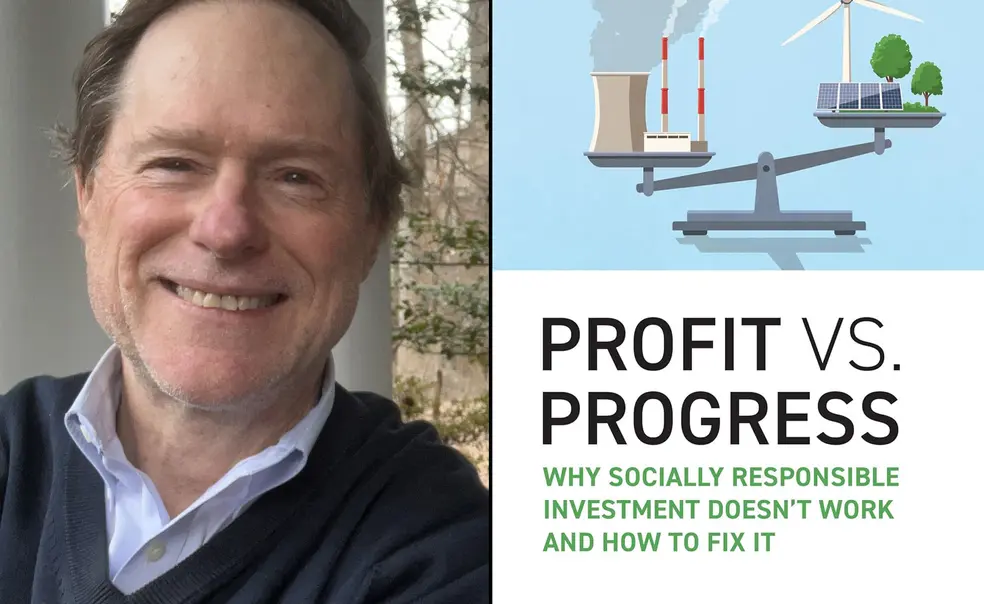

Brad Swanson ’76 is an adjunct finance professor at George Mason University, and his new book, Profit vs. Progress: Why Socially Responsible Investment Doesn’t Work and How to Fix It, will be published by MIT Press on April 7.
I am about to betray my community.
After two decades of work in socially responsible finance, I have written a book, to be published in April, that demolishes the myths underlying this huge, $30 trillion industry.
I felt it had to be done. The people who work in socially responsible investing — also called sustainable investing — are not charlatans. They are, like most finance professionals, highly skilled and have a strong commitment to ethical business.
But the vast bulk of what we do does not help solve critical social and environmental crises. In fact, it worsens them, by supporting a profits-first mentality, regardless of the consequences.
The promise of sustainable investing is to gain both superior financial returns and high-level corporate social responsibility. The mantra is “doing well by doing good.” But the promise is empty.
It took me some time to go from ardent participant to whistleblower.
For many years I made and managed investments in finance companies in developing countries who lend to small, family-run businesses that banks refuse to deal with. I went on the boards of directors of these lenders in countries such as India, Cambodia, and Bolivia, and visited often.
The practice is called “microfinance,” and fund managers have many heartwarming stories to show its success. The classic tale is of the woman — as 80% of microborrowers are women — taking out a microloan to buy a cow, then selling the milk and using the profits to buy another. She eventually becomes a successful dairy farmer, bootstrapping herself and her family out of poverty.
Inspiring, but largely an illusion. I began noticing that the clients of my portfolio companies seldom followed the storied path, and my curiosity led me to research why.
The scholarly consensus, I found, is clear: Microfinance does not cure poverty. It does help poor families cope with the burden of being poor. Access to cash when needed for things like medical emergencies or essential repairs may make the difference between a family staying afloat or sinking into helplessness. But sustained, material increases in family wealth? Nope.
My contrarian views broadened when I began teaching a course in socially responsible finance as an adjunct professor at George Mason University, in Fairfax, Virginia. As I continued to research, I learned that the entire field of so-called “impact investing” — of which microfinance is the largest single component — typically delivers below-market financial returns, debunking the illusion of “doing well by doing good.”
Impact investing is usually defined as investing in companies with explicit social missions, such as affordable housing, or solar lanterns for rural areas outside the electricity grid, or creating jobs for marginalized people. Most impact investments punch above their weight in terms of their social value. But companies, like people, can’t simultaneously maximize two things at once, and the result in the impact world is a tradeoff between financial returns and social ones, an aspect you seldom see featured in the marketing of impact funds.
As the course matured — I am teaching it now for the sixth time — other shibboleths of sustainable finance began to fall.
Green bonds, whose proceeds are used to fund environmental activity, like renewable energy? Green in name only, as they typically have the same risk profile as other bonds from the same issuer, and consequently the same interest rates. They provide no structural economic benefit for green projects.
But the biggest illusion in sustainable finance directly touches all of us, comprising about 90% of the sector. It is called ESG, for Environmental, Social, and Governance.
ESG is everywhere. Most institutional investors, like insurance companies and pension funds, own ESG assets. That means they depend, in part, on these investments to pay the claims on your insurance policies and to fund your pension.
Moreover, many individuals and families invest personal assets in ESG funds, which, like other mutual funds and exchange-traded funds, are simple to buy or sell, charge low fees, and are highly liquid.
Like traditional equity funds, ESG funds try to mirror the performance of an index of stocks. In the case of ESG funds, they track indexes of stocks with (presumably) high ESG scores. These ESG scores come from independent rating agencies that rate almost all publicly listed companies.
But here’s the trick: The ESG indexes themselves typically track other indexes that comprise the broad market, like the S&P 500. This double-tracking means that the portfolios of many ESG funds and non-ESG funds are near-duplicates. Yes, the ESG funds deliver financial returns in line with the overall market. But they also deliver overall ESG scores that are only marginally higher than non-ESG funds.
In essence, the typical ESG fund is simply a market fund with an ESG label.
There is much more that is misleading about ESG. For example, it only counts social and environmental risks that are financially material to the company. If the risk doesn’t affect the bottom line, it is ignored.
This is why fossil fuel companies, whose emissions are baking the planet, often get high ESG scores, and appear in the portfolios of about 80% of ESG funds. Big Oil is not charged for environmental damage from its products — and oil company stocks often outperform the market.
Even cigarette companies, whose products kill their customers — you can’t get more anti-social than that! — often attain good ESG scores, since smoking is legal and tobacco companies seldom face liability for cancer from tobacco use.
The answer to the conundrum of sustainable finance is not to throw the baby out with the bathwater. Yes, let’s invest in impact companies — but let’s not expect to get full market-rate returns. However, ESG, with its false promise of a free lunch — high corporate social performance together with high financial returns — needs to go into the dustbin of history.
The real solution to make companies more socially responsible is to stop being distracted by markets and to refocus our attention on politics.
We can learn from the first Gilded Age, whose obscenely high levels of income inequality and corporate concentration are now mirrored in our own era. The Progressive Era that followed saw the first large-scale reforms in business and finance, and rescued capitalism from crisis.
Today as well we need regulatory tools to bend the arc of business activity toward greater social responsibility, without blunting its competitive edge. Cap and trade is a perfect example of this, meeting a critical need of society — curbing climate-warming emissions —by harnessing free market pricing to ration a declining supply of pollution permits.
We should also take a leaf directly from the progressive playbook and break up the modern version of corporate “trusts” that are stifling innovation and stunting productivity in many industries today, including financial management.
Now, as in the first Gilded Age, it is folly to ask markets to do the job of governments. Business maximizes profits, not citizenship. That is how the game is played. If we want more social points on the scoreboard, the only alternative is to revise the rules.
Brad Swanson ’76 is an adjunct finance professor at George Mason University, and his new book, Profit vs. Progress: Why Socially Responsible Investment Doesn’t Work and How to Fix It, will be published by MIT Press on April 7.
The Latest
See all


Related News

With Prominent Journalists and Hoagies, the ‘Prince’ Celebrates 150 Years
A gala at the New York Historical raised roughly $400,000 for the independent student newspaper



6 Responses
Dennis Crean Jr. ’85
6 Months AgoAny Suggestions of Alternatives to ESG Funds?
Thanks for shedding some light on the shortcomings of ESG funds and impact investing. It’s not surprising to hear that the former does little to bring about true social responsibility in the corporate realm and that the latter is perhaps not as impactful as promised. Your piece leaves me wondering, however, whether either or both these investment options “work” to serve any lesser purpose for those who chose to invest in the market, at least until we succeed in changing the rules. For instance, how do you suggest people invest their money in hope of earning some return while also contributing positively to society?
Brad Swanson ’76
6 Months AgoWith Limited Options, Aim to Effect Change
Great question! I would recommend that people not invest in ESG funds, and pull their money out if they already have it there as it is just bolstering the status quo instead of effecting change. However, unfortunately, there are few funds in the Impact Investing sector available to retail investors, as their assets are typically small, illiquid, risky companies (they prioritize impact, after all!). You might look into making deposits with CDFIs (community development finance institutions) or an instrument like Calvert Impact’s Community Investment Notes. But fundamentally, I believe that return-positive finance is not the right tool to bring about social progress. We need to stop playing the game as it is and revise the rules.
Reed M. Benet ’84
6 Months AgoA Pitch for ‘Philanthrocapitalism’
My fellow-military-vets-empowered-and-empowering and VC-backed for-profit startup HeroHomes.com practices “philanthrocapitalism,” which we define as “Mother Theresa and Genghis Khan have a business model baby, but where the philanthropy part isn’t the weakness, rather it is its competition crushing strength.”
It leverages 100% Loan to Value (LTV) Veterans Administration Loans to “disrupt” the $300-400B a year multifamily finance market (aka capitalism) to its very core, and that today requires $90-120B of very hard, slow, and expensive to get investor equity to get to standard 70% commercial LTVs to build housing.
And we’ve got a “By/for/with locals first to VETrify versus GENTrify the Great American Renewal” mission statement.
So no, Brad, the solution isn’t to accept lower returns for ESG investments; it is to find, promote, and fund better investments.
As I’ve long said, if you like nonprofits, invest in high-risk-for-high-reward startups, since all but a very few of them crash and burn, but the few that succeed do so very, very well.
As for microfinance, for which Mohammed Yunus won a Nobel Peace Prize, and for which Brad practiced and after a long while became unenamored with because (no duh?) it doesn’t materially and scalably work, I long watched with frustration when today’s forms of ESG finance crowd out all other efforts because of the fashionable and politically correct factors.
I suggest three solutions:
First, all socially responsible investments by foundations, governments, and nonprofits should be apples-to-apples compared using the MR SUCCESSS acronym, i.e. is the investment Material, Repeatable, Scalable, Unbeatably politically correct, Capital efficient, Cheap, Expeditiously accomplished, Self-sustainable, Self-financing, and Simultaneously accomplishable in as many of these attributes as possible?
This, I think, will eliminate the so many fashionable and politically correct things like microfinance.
Second, not just allow but require foundations, for 25% of their required minimum 5% of assets yearly distributions, to make Program Related Investments (PRIs) in for-profit startups, and then via independent evaluation apples-to-apples compare the outcomes between the foundations’ for- and nonprofit efforts.
This I think will eliminate and rationalize much of the circular logic, self-validating, insular against “true” innovation, risk avoiding, and “yes, the outcome wasn’t what we wanted, but we learned something” touting “foundation, government, and nonprofit industrial complex” efforts aimed at ESG.
Third, not only should PRIs in foundation identified nonprofits be tax exempt, but the same should be true of first in lead and sole investments by for-profit investors (such that there is neither risk sharing nor the hassle of finding co-investors) in the foundations identified for-profit PRIs, plus any returns of profit from them to these for-profit investors should be tax free also.
This will give incentives to many more shots on goal being taken at solving ESG challenges, plus keep the nonprofit PRIs and all the other foundations and nonprofits’ efforts honest and rationalized also.
I welcome all critiques or discussion via reed@herohomes.com.
Beth Brockman Miller ’89
6 Months AgoDifficulty of Investing for a Positive Impact
Thank you, Brad, for this article which so clearly lays out the false promise of socially responsible investing. This is exactly what I’ve found in attempting to invest in a way which would have a positive impact on our earth and society. All the ESG funds are supporting the same major corporate players as other funds. I was trying to find a way to invest in small businesses owned by people who have typically been marginalized by our culture. I agree that “we need regulatory tools to bend the arc of business activity toward greater social responsibility.” Thank you.
Brad Swanson
6 Months AgoA New Progressive Era
Beth, I am so pleased the article resonated with you. My hope is that we are on the cusp of a 21st century version of the Progressive Era, when we again revise the rules to make capitalism work better for all. First we have to recognize the futility of finance as a tool for corporate social responsibility, and focus on what works. Thank you for reading and commenting.
Reed M. Benet ’84
6 Months AgoIdea for Investing in Housing
Hey Beth. Regarding your LinkedIn, which relayed “As Co-Registrar for the Ecumenical Community of Chautauqua, I help hundreds of people to access affordable housing at Chautauqua Institution during its 9-week season,” I've got an idea on how to use what I’ve relayed above to create more permanent housing for the area that is also useable during for your season. Pair your efforts with very nice workforce housing for teachers who spend the summer elsewhere? This could not only solve your challenge but also provide a profit center for you. I welcome a chance to connect. reed@herohomes.com