

Lin King ’16’s Translation of a Taiwanese Novel Is Up For the Booker Prize
Taiwan Travelogue by Yáng Shuang-Zi explores the island’s colonial era and food culture under Japanese rule
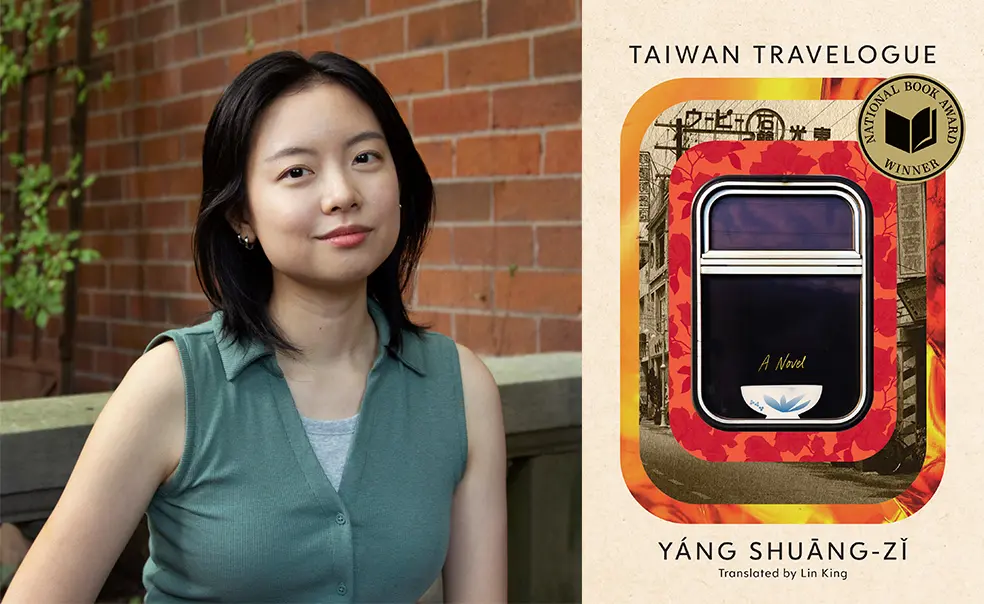

Editor’s note: After this story was published, judges announced that Taiwan Travelogue won the International Booker Prize, becoming the first book translated from Mandarin Chinese to do so.
Lin King ’16 remembers feeling “initially tricked” in 2020, the first time she encountered the book Taiwan Travelogue at a Taipei bookstore. The dust jacket made it seem like the book was a memoir written by a Japanese author visiting Taiwan in the 1930s and later translated into Mandarin by the 21st-century Taiwanese writer Yáng Shuang-Zi. King figured she didn’t need the translation because she reads Japanese.
Only after corresponding with Yáng did King realize that the book was actually a work of fiction; in fact, the author was only purporting to be the book’s translator to lend verisimilitude to the novel’s narrative. King, who studied literary translation as a Princeton undergraduate and through her Master of Fine Arts in fiction at Columbia University, was intrigued by the premise and the literary potential of “another” translation — this time for an English-speaking audience. “This is such a rare opportunity for an actual translator,” King says, characterizing the book’s scholarly artifice of footnotes, forewords, and afterwords as “perfectly crafted to talk about translation on a meta level, while also following this story about the colonialism of language and culture.”
King’s translation of Taiwan Travelogue was published by Graywolf Press in 2024 and won the National Book Award for translation. This year, it was shortlisted for the International Booker Prize, to be announced May 19. King attributes part of the book’s resonance to its themes, centering on Japanese-Taiwanese relations during the Empire of Japan’s 50-year rule of Taiwan, as seen through the evolving relationship and romantic yearning between two women: a Japanese journalist and her Taiwanese interpreter.
“It is really a non-Western take on how to view colonialism,” King says, arguing that the typical liberal Western reaction to colonialism considers the process uniformly negative, but the reality in Taiwan was far more nuanced. Just as the two principal characters of the novel form a relationship alternating between affection and conflict, the uneven relationship between Taiwan and its imperial overlords in Japan formed a strong bond between the two countries that endures to the present. “In Taiwan, we’re known for being weirdly affectionate toward the Japanese,” King says. “They’re our closest ally.”
King’s Taiwanese background and fluency in Mandarin, English, and Japanese proved key to translating this particular novel, which contains words from not only Mandarin and Japanese, but other Taiwanese dialects like Hokkien, especially in descriptions of Taiwan’s diverse culinary offerings, as much of the novel’s pages are devoted to the Japanese protagonist’s explorations of various Taiwanese dishes.
“I’m not like a super foodie at all,” King says, noting she won’t blink at frozen meals from Trader Joe’s. But conveying Taiwanese food cultures proved to be a challenge in English, a language in which most culinary verbs (such as sauté andjulienne) are borrowed from French, which in a Taiwanese context could be confusing. As a result, translating “the food was tough, and the classical Chinese poetry was tough,” King concludes. “Everything else was OK.”
Literary translation can have huge geopolitical implications, King says: After Russia’s 2022 invasion of Ukraine, for example, many Ukrainian writers struggled with the realization that their past work in the Russian language may have helped support Russian culture at the expense of Ukraine’s singular identity. If China someday invades Taiwan, King worries she could face the same dilemma. “I made a very conscious decision that I would only translate stories by Taiwanese writers,” she says. “If and when Taiwan is ever in that sort of trouble,” she wants to know that “I have done everything that I can to understand and promote [Taiwan] in the international imagination.”
The Latest
See all


Related News

With Prominent Journalists and Hoagies, the ‘Prince’ Celebrates 150 Years
A gala at the New York Historical raised roughly $400,000 for the independent student newspaper



No responses yet