

Meeting My 19-Year-Old Dad, Eight Years After His Death
Chuck Dressel ’71’s daughter remembers her dad, an All-Ivy heavyweight wrestler who taught her ‘that hard work mattered’

Emily Dressel Hampson, proud daughter of the late Charles “Chuck” Dressel ’71, resides in the Chicago area with her husband, two daughters, and a gregarious Bernedoodle. Although she earned a BA from Stanford University — a decision that gutted her dad at the time, but at least it wasn’t Yale — she cherishes multiple childhood memories of attending Princeton Reunions, adorned in Tigers apparel. A part-time writer, Emily’s short fiction has appeared in Fractured Lit, Writer’s Digest, The Sunlight Press, and WOW! Women On Writing.
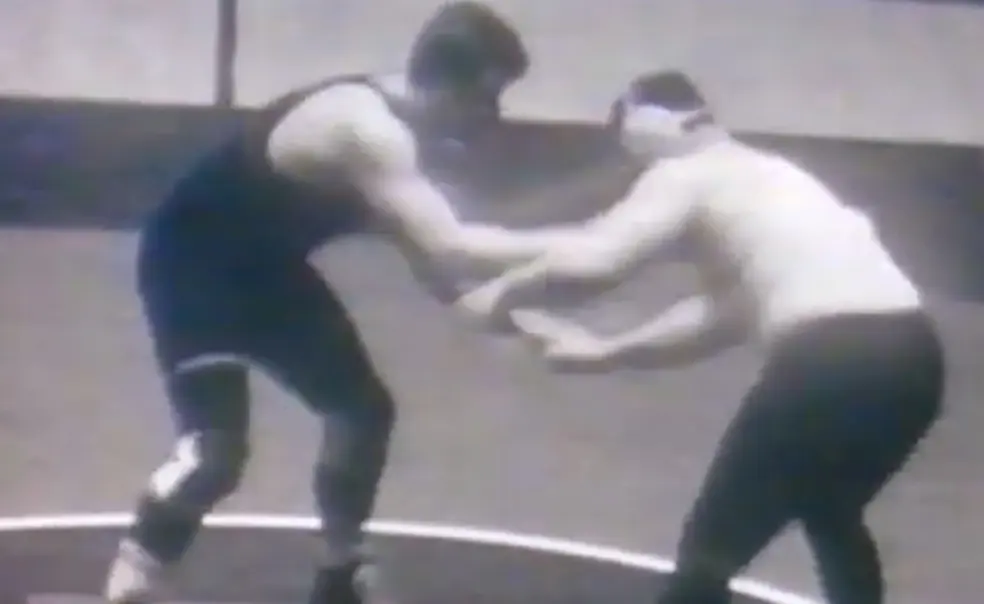
My 45-year-old eyes beheld my 19-year-old dad — a young man in motion, panting and focused mid-wrestling match, at the pinnacle of his athletic career.
Dad’s been dead for eight years, and yet there he was on my iPhone, bobbing and flexing, thick brown hair and brawny shoulders, familiar angles and mannerisms.
The video was black and white, grainy, and without sound. A one-hour-and fifteen-minute recording of the January 1969 Penn vs. Princeton wrestling meet had arrived in my inbox as a YouTube link. Dad, then a sophomore heavyweight, doesn’t materialize until the final 10 minutes.
Over the years, I’d glimpsed photos of my dad from his youth, but never video footage. Even the sporadic home movies my parents captured of my siblings and me in the ’80s on gigantic, cumbersome, shoulder-resting camcorders have mostly vanished. VHS tapes that have been lost, damaged, or recorded over by previous primetime showings of The Boy Who Could Fly or The Princess Bride.
Photographs are nostalgic and charming, but seeing a person who is gone from this world, alive and existing — stretching muscles and extending limbs — robs you of breath. His knees and elbows work in concert as he falls, scrambles, and then rises again. His expression tightens as he stalks his opponent, unaware of all that will come at him in the years ahead. Jagged forks in the road and strangers morphing into friends. A wedding ceremony on a particularly frigid January night and his mother sucking ice chips in her hospice bed. Weekly fertilizer hauls to hardware store basements and sofa naps with a 10-pound infant aboard his chest. Swims to Floridian sandbars with a trio of shark-phobic kids clinging to his neck and dusty afternoons on the softball diamond — oblivious to any of it ending, because none of it has happened yet.
On the video, a bald referee jostles around the wrestlers, navigating the perimeter with a whistle between his lips, occasionally holding up fingers to signal points. Admittedly, I never mastered the scoring. Even after several years of attending my brother’s high school matches, the sum of my wrestling knowledge can be boiled down to the notorious half nelson, ring worm, and cauliflower ear — one of which involves contagious fungus and another, an auricular hematoma. Objectively, I understand that victory isn’t always the product of pinning an opponent supine to the mat like some taxidermied beetle, and that reversals, takedowns and escapes earn points, but the details are murky.
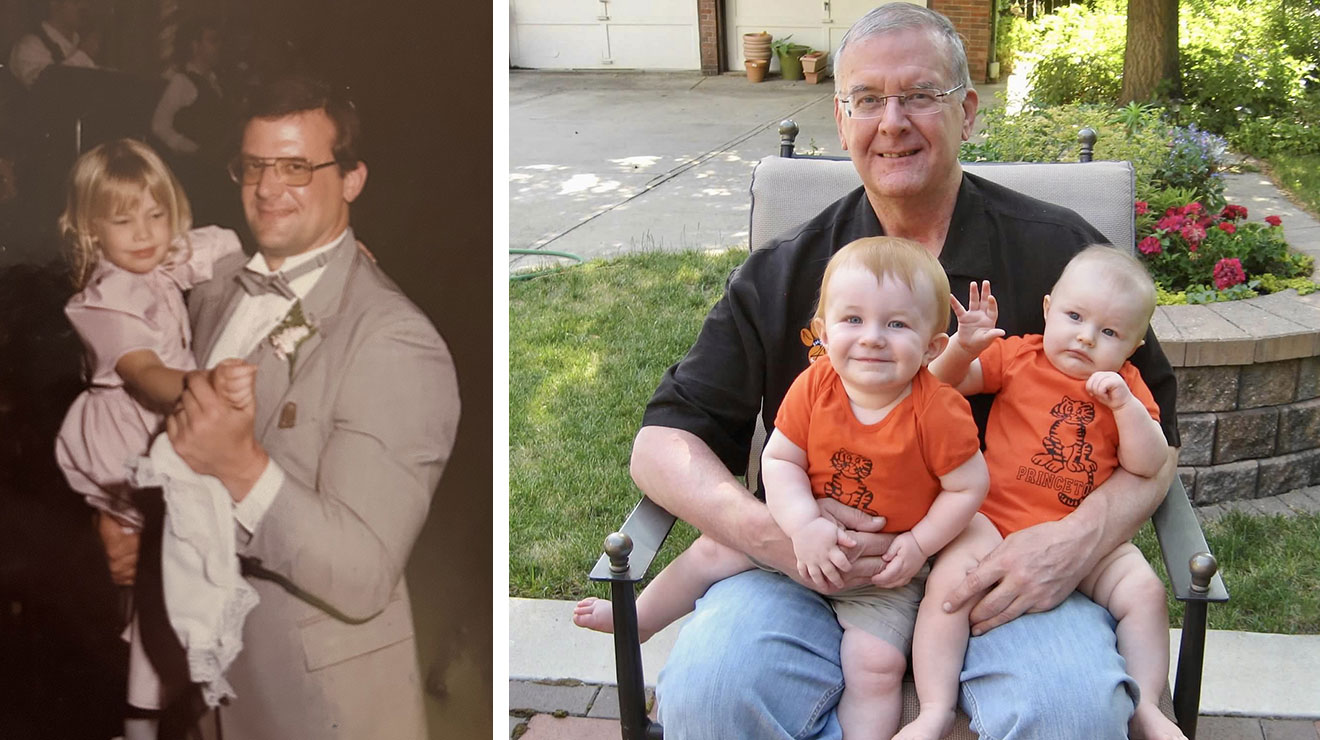
In the end, the technicalities cease to matter, as do the stats. During his time at Princeton, Dad was All-Ivy, a top-four Eastern heavyweight, and the team’s high-scorer for two years. He was pretty darn accomplished. But what Dad ingrained in me throughout my childhood was not how to wriggle out of headlock, but that hard work mattered. Practice mattered, especially when you least felt like committing. When others forewent trudging through snowbanks in sub-zero temperatures to windmill 100 pitches in a makeshift softball attic, you doubled down and threw 200. Persistence was sacred. Quitting was sacrilege. In competition, yes, but even more so in life.
This vehement level of commitment tracked because as the firstborn son of an alcoholic and abusive father, Dad insulated himself in sport. The football field was his church. The wrestling mat his therapy. Athletics were a harbor where Dad could be physical — where he could tackle his demons and pin his ghosts.
When I was growing up, Dad was the strongest man I knew — the epitome of toughness. He tallied chin-ups on the bar by our garage while we kids dangled off his legs. In the summer, he’d scale the 30-foot climbing pole in our backyard with the ease of a raccoon, and until I was a teenager, he could lift me one-handed in the swimming pool. The tragedy of my father dying at 68 was that his demise was both drawn out and drastic — a finale incongruent to how he lived. By the end, he was diminished, a giant so leveled by depression and heart failure that he couldn’t even hobble to the toilet.
The second time I watched the video footage while listening to his favorite sport’s movie anthem, “Chariots of Fire.” The instrumental track never ceases to rouse my nerve-endings. The soaring composition and crescendo of synthesized sound always seem to trigger some primal itch to run for the sake of muscle movement. For the sake of expelling air from lungs — to suffer the glory of a cold, respiratory burn. At least until I remember that I actually hate running.
By minute seven in the clip, the exhaustion of both wrestlers is evident, but as Dad’s opponent fades, Dad clicks into another gear, subsisting on grit, digging into his energy stores. I sense the phantom roar of the crowd in the bleachers, detect the vibration of stomping feet, and smell the sheen of ripe sweat. I hold my breath until the very end as though I don’t already know that he’ll win the match. As though he might glance up at any moment, in the direction of the camera, and nod. I am still more than decade away from being born.
The video that landed in my inbox was a profound gift — 10 minutes of Dad’s bonus track. Given the choice, I probably wouldn’t have opted for footage that involved him sporting a skintight black singlet — which, for the unacquainted, resembles something of an oversized toddler swimsuit or sleeveless wetsuit. On dry land. But the probability of this buried recording ever reaching me was so pitifully low, it might as well have materialized out of some Marty McFly-worthy time warp.
First, a Penn supporter in 1969 had to haul out a video camera on location and film it, then post it to the internet five decades later for someone on the opposing team, one of Dad’s old Princeton wrestling buddies, to stumble across it. This alum then had to arbitrarily recognize my mom’s email address in the reunion directory and devote precious time to send it.
I like to think Dad had a hand in its delivery. This year has been a tough one for me. And while I’m struggling on several fronts, I’m choosing to believe he orchestrated this correspondence to convey an old-fashioned, paternal pep talk. A fatherly reminder that life is not a 10-minute match — that one must hang in there and play the long game.
Remember, Emmy, when the going gets tough, the tough get going.
It’s true what they say about continuing a relationship with a loved one, even after their death. And as improbable and mystifying as it sounds, it never feels one-sided. For me at least, there’s always two people on the mat.
A final note from the author: I would like to extend my gratitude to Randall “Randy” Meadows ’71, who took the time to send the linked video to my mother, as well as all of my father’s wrestling teammates who continue to honor his memory and legacy. If Dad abides in his Elysian Fields, he is most certainly sporting orange and black.
The Latest
See all


Related News
With Prominent Journalists and Hoagies, the ‘Prince’ Celebrates 150 Years
A gala at the New York Historical raised roughly $400,000 for the independent student newspaper


No responses yet